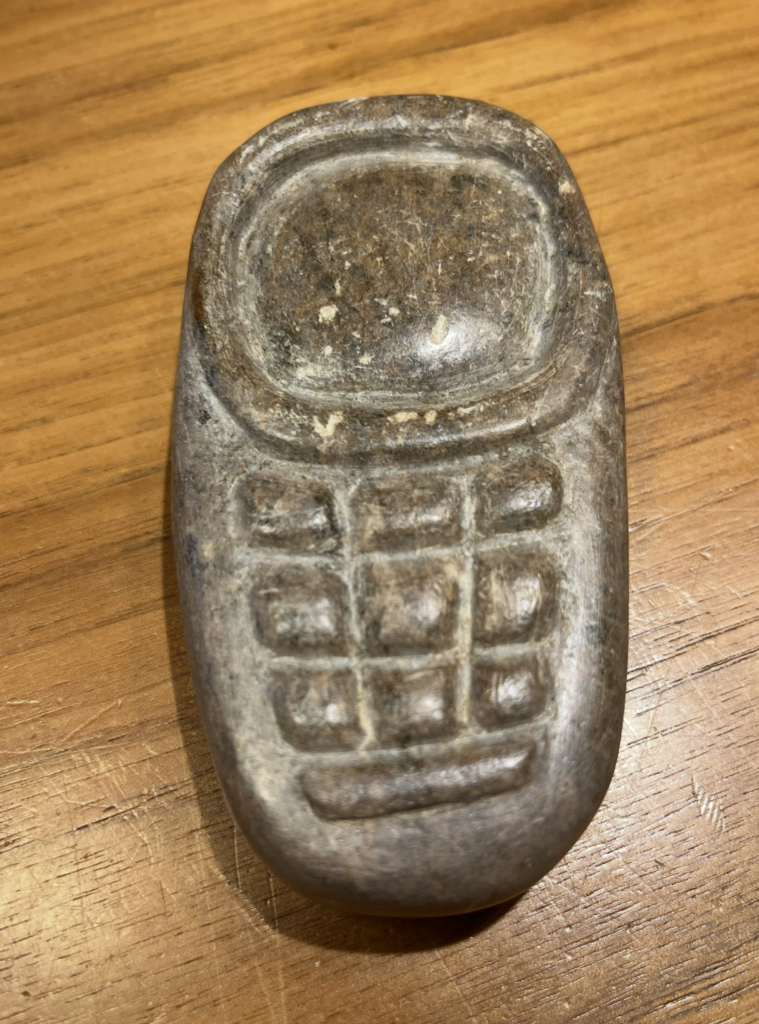
// Artwork: MobilePhone. Artist as yet unknown. ~2000.
It is one of my favourite artworks from the digital age because it skilfully translates the present into the past and makes it accessible once again in the present. At a time when this type of mobile phone is already a thing of the past, history. It also touches on the idea of the ‘global village’ (McLuhan), which found its way into everyone’s hands via the mobile phone. Just like the stone knife or the hand axe – only now in the realm of communication. It marks the beginning of total accessibility and also an era in which this device made everyone reachable and controllable.
When you hold it in your hand, it feels cold. It is stone, and yet not stone – but a mobile phone, or ‘Handy’, as it was called in Switzerland. The way it is crafted and presented transforms the industrial object that is the mobile phone into a unique piece of soapstone. It is, in fact, not an industrial product – or rather, an industrial product of the second order. The screen is, in a sense, dead and yet alive, because it gleams (soapstone) and appears polished.
On another level, the curves are reminiscent of humanity’s earliest works of art, with their depictions of women. Here, however, it seems more like a child. A child of its time – and we, as users, are also the children of this era, right up to the present day. This becomes even clearer when you slip the protective case over it.
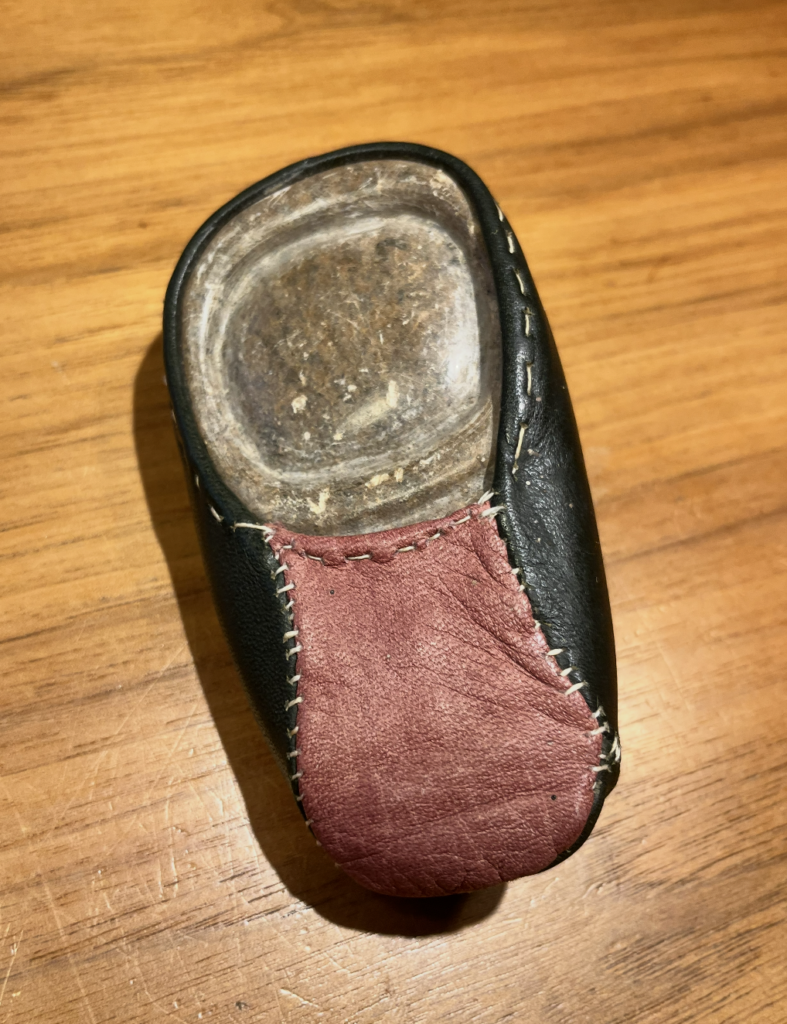
Here it is protected inside a leather ‘case’. The screen appears as a sort of child’s head inside a little child’s bag. The screen becomes the counterpart – at that time still without an image – with sound alone. But it must be protected. The leather and its stitching also hark back to a time when everything still had to be made from materials found in the immediate surroundings. Such as dead animals. On this level, this soapstone mobile phone is, of course, the opposite of the ‘real’ object. For the mobile phone is, in fact, entirely synthetic. Here only the form is.
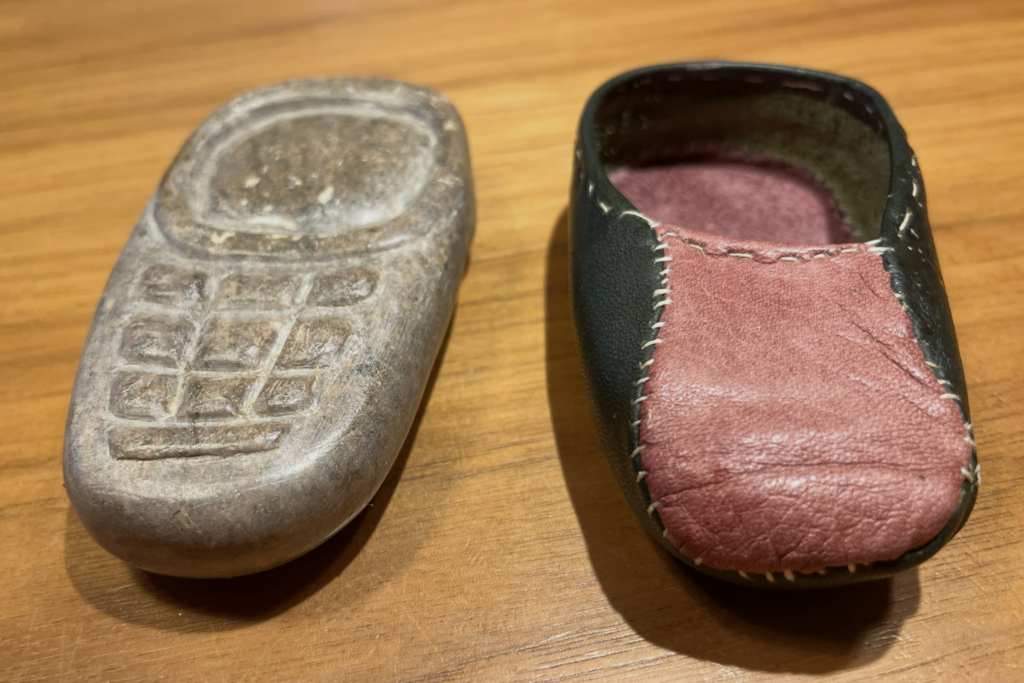
To conclude, here are both objects laid out side by side. What is also interesting about this artwork is that the longer it goes on, the more critical, interesting and thought-provoking it becomes, as even this analogue mobile phone – devoid of any function – prompts discussion. This is only possible because it is no longer a mobile phone from that era.
It must continue to be contextualised and recontextualised. It moves, so to speak, constantly onto and within different planes, and this even depends on the viewer.