
The innovations in monetization, packaging, gameplay, game mechanics, styles, graphics, sound, game design, tools and hardware
by René Bauer & Beat Suter, Stefan Schmidlin
This text will be published as book chapter in a revised and different version.
I started to create computer games in 1983 on the Oric 1, an 8bit computer with 48k of RAM. I had been fascinated by arcade games for a long time. I was fifteen. The discovery of personal computers was a revelation – that it was possible to create game at home, and also the discovery that there were many other kinds of games than pure arcade.
E. Chahi (Another World), https://cheesetalks.net/ericchahi.php
Key Question: What made home computer games special?
The central question of this article is to determine what defines home computer games from 1981 to 1994. The question is not so simple, because also the office computers Apple II or PET or IBM PC 1 were used at home or for gaming. To do so, we must ask: From what traditions do these home computers and personal computer games stem?
E. Chahi already identifies two traditions: video games and computer games. These two strands of gaming history must be explored in depth, because they converged in home computer games. In German, home computers were also called „Spielecomputer“ (game computers) and, in part because of this, were not taken seriously as a platform..
Two gaming cultures “come” together
As E. Chahi writes these lines, he finds himself in the midst of a cultural clash: on one side, the well-known video game industry with its arcades, arcade games, and video game consoles; on the other, personal computers like the Apple II and home computers, which were increasingly capable of running arcade games. In doing so, he notes that computer games had their own tradition, their own games, their own gameplay mechanics, possibility to create games and their own culture. And these two cultures were merging, particularly in home computers, which were becoming increasingly cheaper, more colorful, and faster.
If you boil it down to a purchasing decision, it comes down to the question people used to ask back then: Do I buy a console just to play games, or do I buy a computer to play arcade games and other games, copy games, or do something else entirely? Most people who have opted for a console have not even explored the full range of possibilities offered by computer games.
Digital Games (or electronical games)
Electronic or digital games almost always have an interface, mechanics, and displays (for audio and/or visuals).
We propose the term “digital games” here because the term “video game” is derived from the displays of what were presumably the first commercially available arcade machines from the 1970s onward. (A discussion regarding “Tennis4Two” from 1958 would still need to be had here. But it was also an analog-electromechnical circuit). This is no longer tenable today, given that the majority of early games were never actually run on a video display, but rather on typewriters connected to mainframes—latest, with BASIC starting in 1964+. There were early games that also ran on plotters (Potshot 1965), and only later did the expensive displays come along. Spacewar! from 1961 is a computer game that ran on a “video display,” but it was extremely expensive and didn’t have much in common with the “video playback device” known as a television. The arcade counterpart didn’t come out until 1971 with Space Wars. And it wasn’t until 1975, with Gun War, that the arcade industry followed suit and began incorporating CPUs instead of their own electronic circuits.
The term “video game” therefore distorts the discussion and also adds to the tension. This is particularly important in this article, as it also points out that computer games have a much longer tradition in the realm of digital gaming than video arcades, which are based on electromechanical technology (electro mechanical arcades: http://www.pinrepair.com/arcade/index.htm#arcade and https://www.gamelab.ch/?p=448). In this sense, the term “digital games” is more accurate from a scientific perspective; it highlights what the concept is ultimately about—namely, that the core of a game is something electronic or digital, while the displays can vary. The term is also future-proof because many games today are increasingly moving away from traditional video displays.
Video- & Computer Games
Computer games, as a category of digital games, include home computer games, mainframe games, minicomputer, workstation games and personal computer games as subcategories, is an umbrella term bringing together various trends in gaming culture. The same applies to video games, which brings together arcade games, handhelds, and consoles.
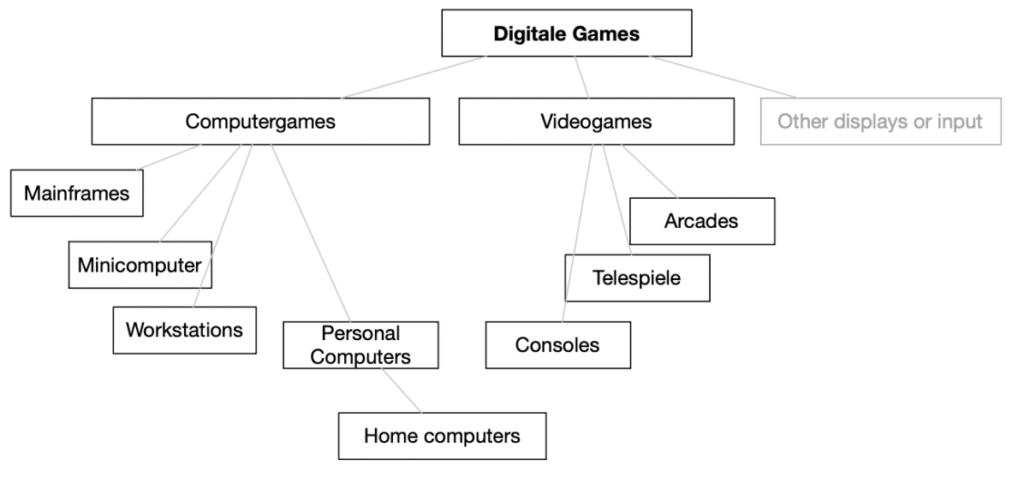
Games from these different cultures are often ported, further developed, adapted, and tailored to new hardware. However, “new” graphics, sound, and game mechanics are also invented in the process. The way games are programmed also changes over time. An important aspect of this is that, with computers—and especially home computers—users can also develop their own games in every respect using BASIC, Pascal, C, or assembly language, ranging from block graphics to pixel graphics or 3D graphics. All of this is what defines the (home) computer game, its evolution, and its spirit of experimentation. This also brings with it elements such as self-expression, the local, and the personal—beyond the realm of mass markets.
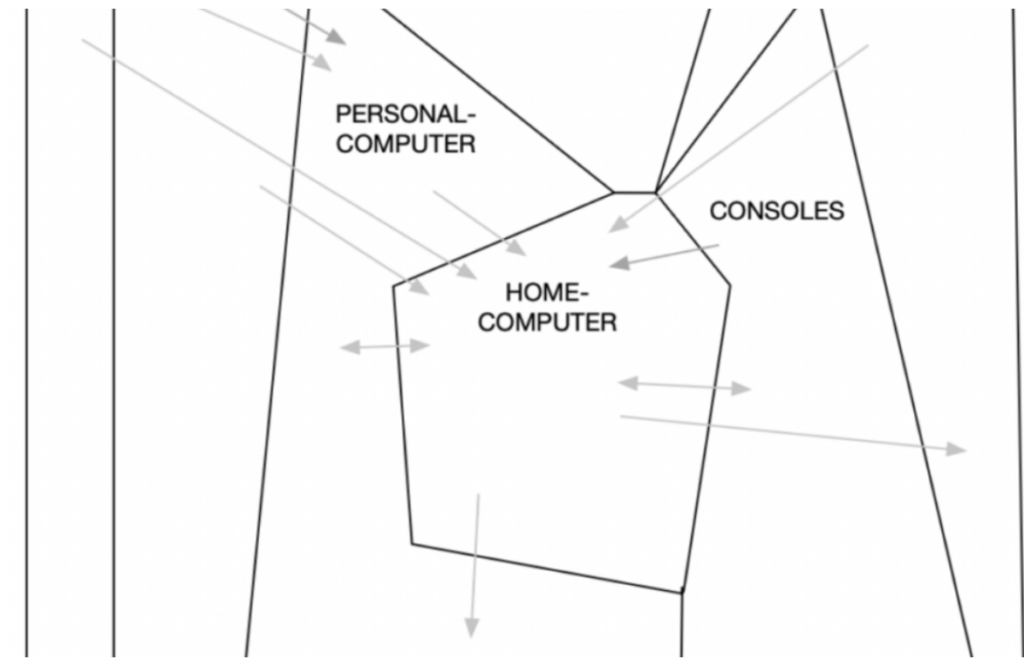
The development of the computer games can be simple structured and visualized somehow like this:
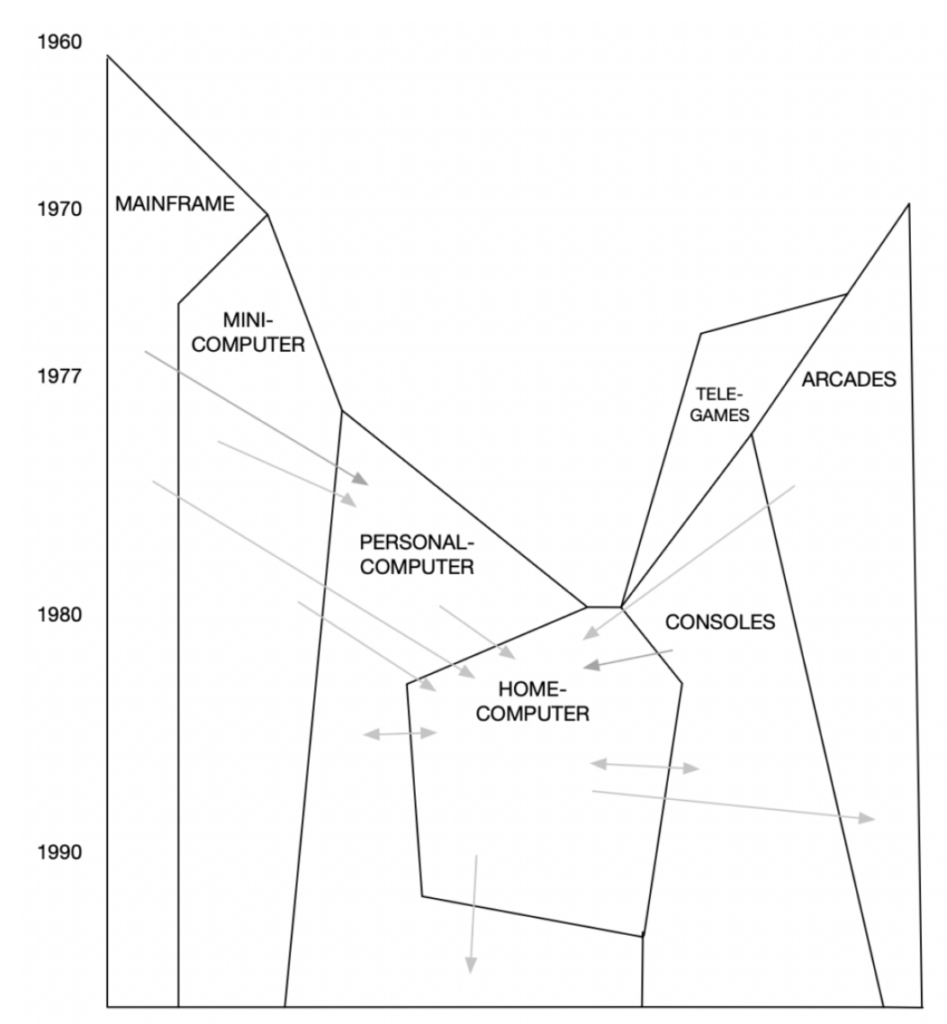
// The computer game and its internal and external influences. In the middle the new computer category Home computers. The production stopped, the reproduction of its gameculture and games often too. Picture: R. Bauer
Ignorance or and Social Resistance
D. Darling (Codemasters): “Maybe they were into Isac Asimov and science fiction, and they just loved the idea of robots and artificial intelligence and all of the kind of stuff, so they were able to use these homecomputers to kind of live their fantasies. Their parents and grandparents, nobody really understood what they were doing, so it was like a real adventure.” (Britsoft – An oral history. Wiltshire, Alex. 2022. Page 40 )
Society in Europe was hostile toward computer technology; on the one hand, there was a fear of government surveillance—which manifested itself, for example, in a protest against the census in 1983 (https://de.wikipedia.org/wiki/Volksz%C3%A4hlungsurteil) —and, on the other hand, there was also a fear of job losses due to computerization. And, of course, computer technology posed a threat to the society built on the Gutenberg Galaxy.
This trend is even more pronounced in video games: These are games and a gaming culture often engaged in by teenagers and young adults; they are almost hermetically sealed off from the outside world; the themes they explore are often simple narrative tropes such as sci-fi, fantasy (DundgeonAndDragons 1974 – controversies: https://en.wikipedia.org/wiki/Dungeons_%26_Dragons_controversies), sports, or military settings; and the graphics have a culture of their own. Games have nothing to do with the analog world; therefore, they cannot be used for political or social purposes. There are almost no connections to existing culture, and there is no social group that distinguishes itself as a political group through them. And the most compelling argument: It is technology—dicspecifically, applied cybernetics. In other words, it is completely useless in the eyes of many—or, rather, it points toward change.
Arcade Culture
A. Maclean (Dropzone): “The first time would be Pong on a school trip in the early ’70s …. I went through an arcade to get to an ice cream … and instead of all the mechanical machines there was the yellow thing with a dot bouncing around.” (Britsoft – An oral history. Wiltshire, Alex. 2022. Page 33)
On the other hand, in arcades, there were games designed for action that replaced the action-packed electromechanical arcade machines dating back to the 1950s. For more information look at: https://www.gamelab.ch/?p=448. Starting with Pong (1972, US), Space Invaders (1978, JP), Pac-Man (1981, JP), Paper Boy (1985), Out Run (1986, JP), R-Type (1987, Japan), Arkanoid (1987), and Klax (1989, US). The Japanese design technique “Mukokuseki” (de-nationalization, the creation of something new from existing elements) plays a decisive role here (https://uplopen.com/chapters/e/10.1515/9783839453452-006 )
This is something that Western designers tend not to pursue as actively. Nevertheless, their influence is also evident in the design aspects of PC and home computer gaming culture.
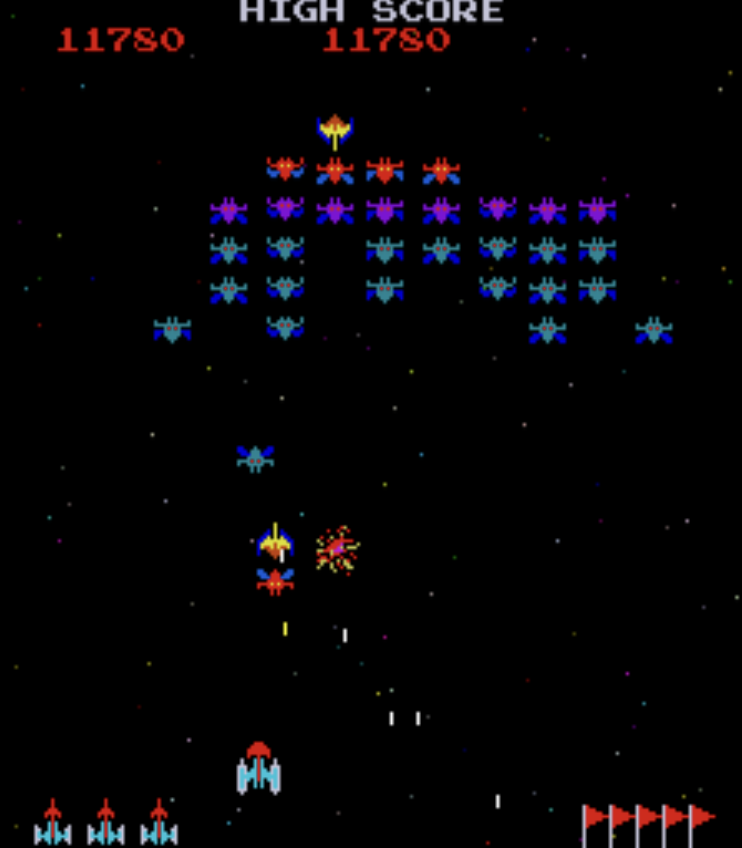
// Galaxian 1979 JP: It doesn’t get any more Japanese „mukokuseki“ than this: Battling insects from outer space—The life of the „ALIEN“s
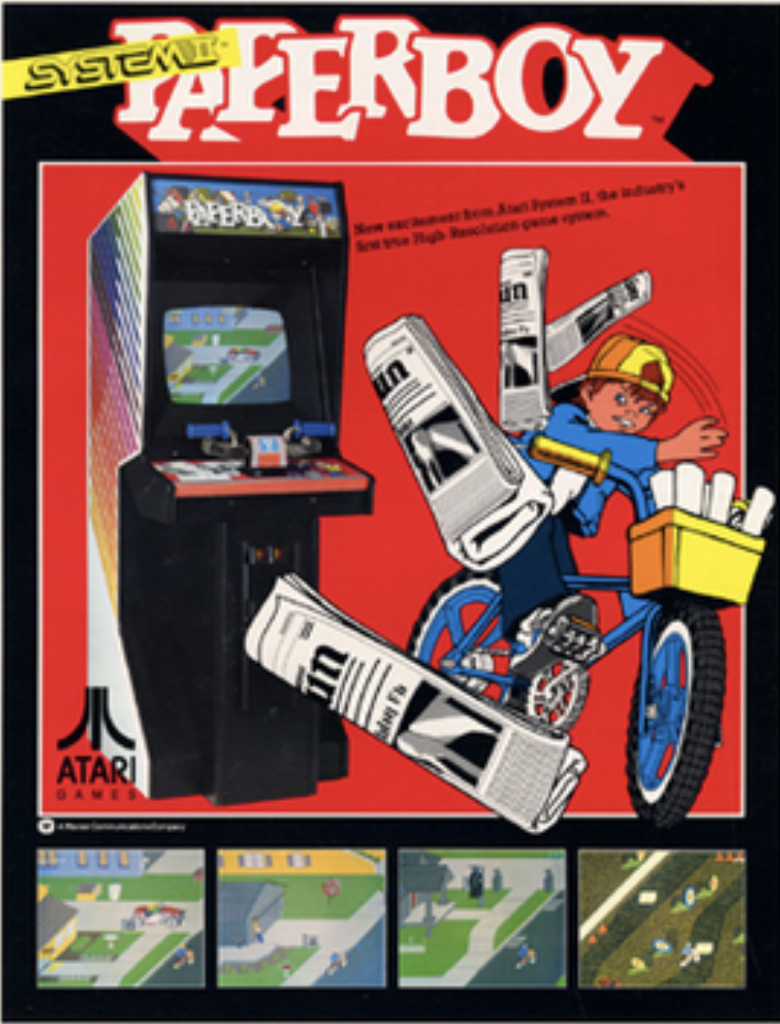
// Paperboy 1985 Arcade US. The setting is like – US pinball machines – more realistic setting than the Japanes Games. Picture: https://en.wikipedia.org/wiki/Paperboy_(video_game)
These were mostly expensive, customized gaming systems costing anywhere from several thousand to 10,000 Swiss francs, featuring colors, sprites, sprite collision, hardware scrolling, and a sound system. The single, interchangeable (Jamma – Japan Amusement Machine and Marketing Association) board was the game itself; the cabinet was, in effect, the interface casing. Yamma is the interface normed by the Japan Amusement Machine and Marketing Association. (https://en.wikipedia.org/wiki/Japan_Amusement_Machine_and_Marketing_Association). The monetization of these games was a game mechanic in and of itself: You paid once and played as long as you stayed in the game. As monetization took hold, games became exponentially more difficult. One meta-mechanic was high scores, some of which—such as in KLAX (1989)—could be saved.
Many games were single-player games pitting the player against the “machine/computer.” These complemented many of the often-analog multiplayer games, such as table soccer or air hockey. Game parlors—social entertainment venues called ‘Spielsalon’ (usually for ages 18 and up in German-speaking Switzerland)—became more widely accessible and served as an alternative to slot machines, which were typically played in the same room.
Console Culture
Console culture also emerged in the wake of Pong Atari 1972, with Pong variants and hardwired video games (mostly sports games) for home televisions.
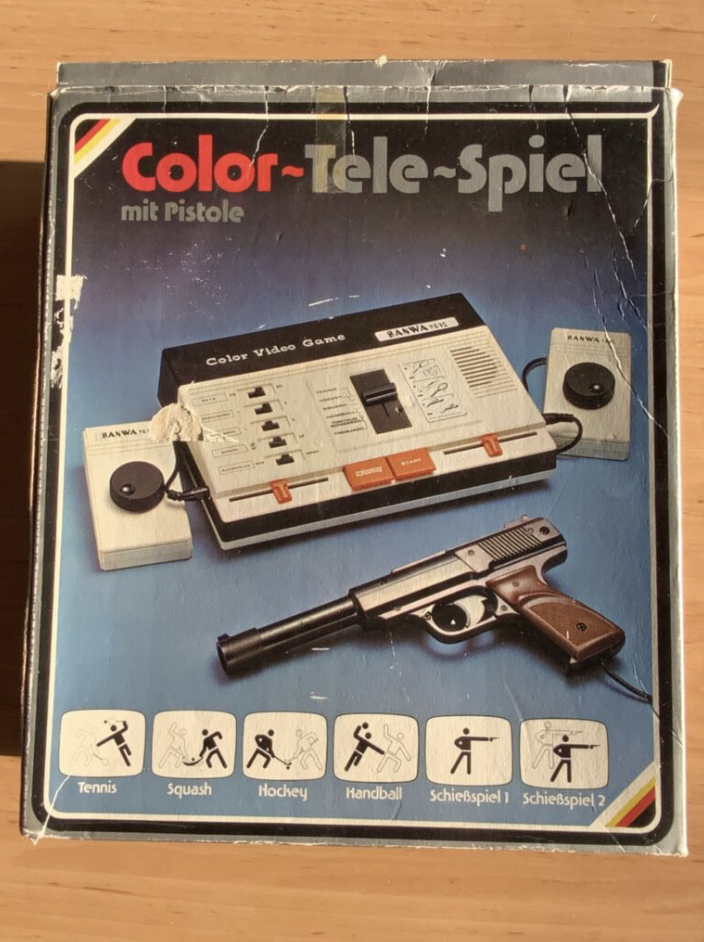
// Telespiel https://www.jungsi.de/sanwa-9012-pong-konsolen/ had 6 different Games and even a lightgun for shooting games. But it was clear all are sport games and often looked like a pong variant.
The scene really took off with new ideas like cartridge-based consoles—such as the Fairchild in 1976—and then, above all, with the Atari VCS 2600 starting in 1977.
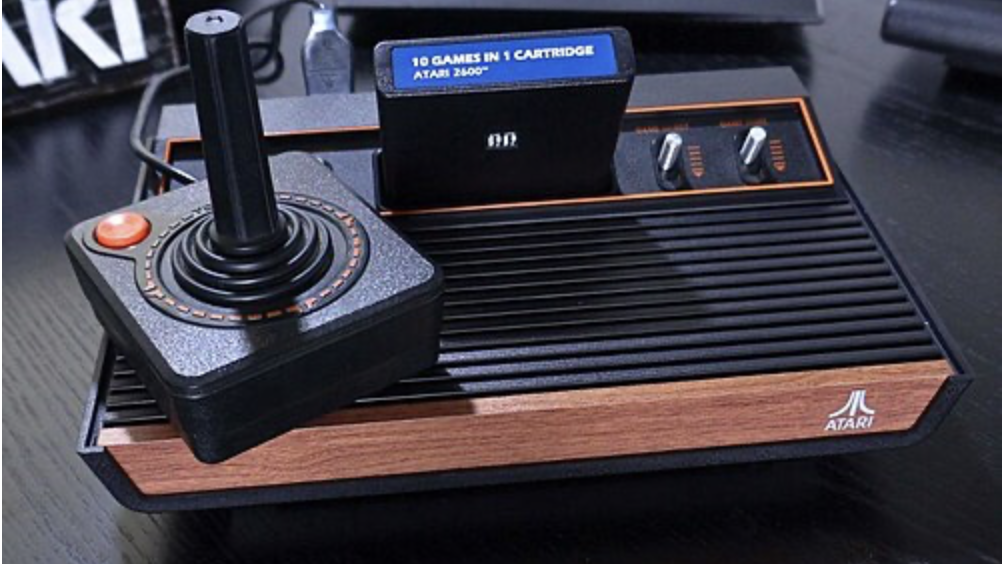
// The atari 2600 with a joystick. Most of the later consoles will have control pads. Picture: https://en.wikipedia.org/wiki/Atari_2600%2B
Here, you bought the hardware once and then paid a one-time fee for the electronic cartridges. You just inserted the cartridge and started playing. After that, you could play as much as you wanted, whenever you wanted. This changed not only the arcade ports but also the games themselves. For example, games like Zelda wouldn’t necessarily have been conceivable in an arcade. One problem here was certainly that most consoles actually had only one graphics mode, and it wasn’t particularly high-resolution (Intellivision in 1981: 160×200; the NES in Europe in 1986: 256×240); the input options were control pads. This was also an adaptation to how consoles were initially used—namely, playing on the TV while sitting on the floor or on the sofa.
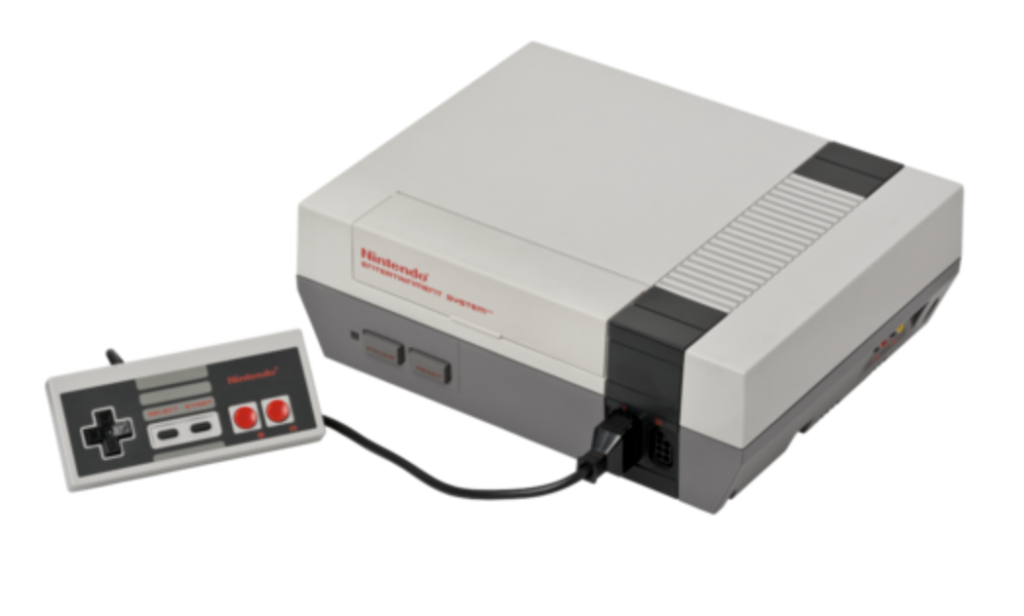
// NES 1982 Europe with spongy buttons. Picture: https://en.wikipedia.org/wiki/Nintendo_Entertainment_System
Mainframe and “Minicomputer” Games
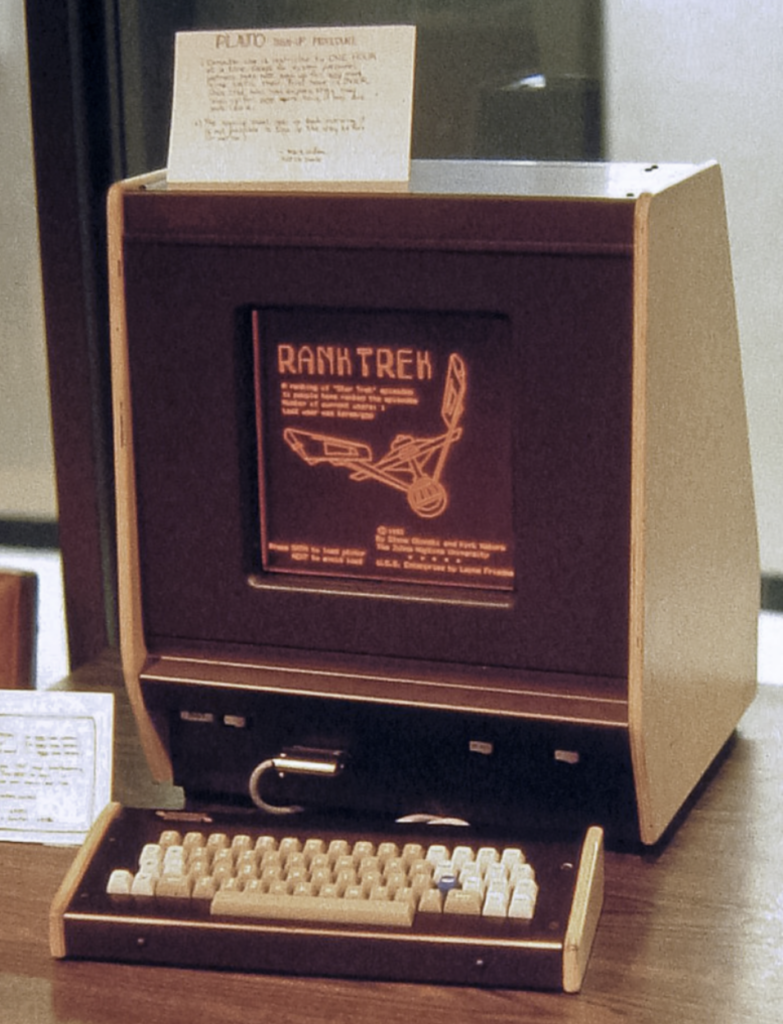
// A terminal for the PLATO systems 1964+ with 512×512 monochrome pixels, showing a game – inspired by Star Trek obviously.
Computer games were invented long before personal or even home computers existed on Mainframes and ‘Minicomputers’. The difference between mainframes and minicomputers is that mainframes are simply larger than minicomputers, and minicomputers are usually just scaled-down versions of mainframes—they aren’t multi-user, for example. And it was not so clear for what you could use mainframes, minicomputers or computers at all at home in the beginning (https://www.chronos-verlag.ch/node/28378). But computer games are an undemanding medium; all you need is a computer with keyboard and some kind of display.
More specifically, computer games were developed first on mainframes and minicomputers such as PDP-1 with Spacewar! 1962. This was a complex space fighting simulation with a sun and their gravitation.
An entire ecosystem of games emerged on the Mainframe PLATO System, which was in use starting in 1964. The PLATO System will serve as an example here. It was a very expensive mainframe system at the University of Illinois, consisting of a server and many graphical terminals/clients with a resolution of 512×512 pixels. “The friendly orange glow : the untold story of the PLATO system and the dawn of cyberculture” (2017 Brian Dear)tells the story of this early system in detail. https://archive.org/details/friendlyorangegl0000dear/page/n653/mode/2up. The whole thing was actually a digital learning system (now known as e-learning) and therefore came with a simple programming language called Tutor (language-based, tab-driven). Many practice programs—some of them game-like—were developed for lectures and exercises, and—since it was accessible to anyone who could get their hands on some memory—there were also many very early computer games. The range of game topics was enormous, even including a game set in a contaminated hospital or an advertising game or a game about getting the pilot license or a course for pregnancy. Almost everyone could write a game-like.
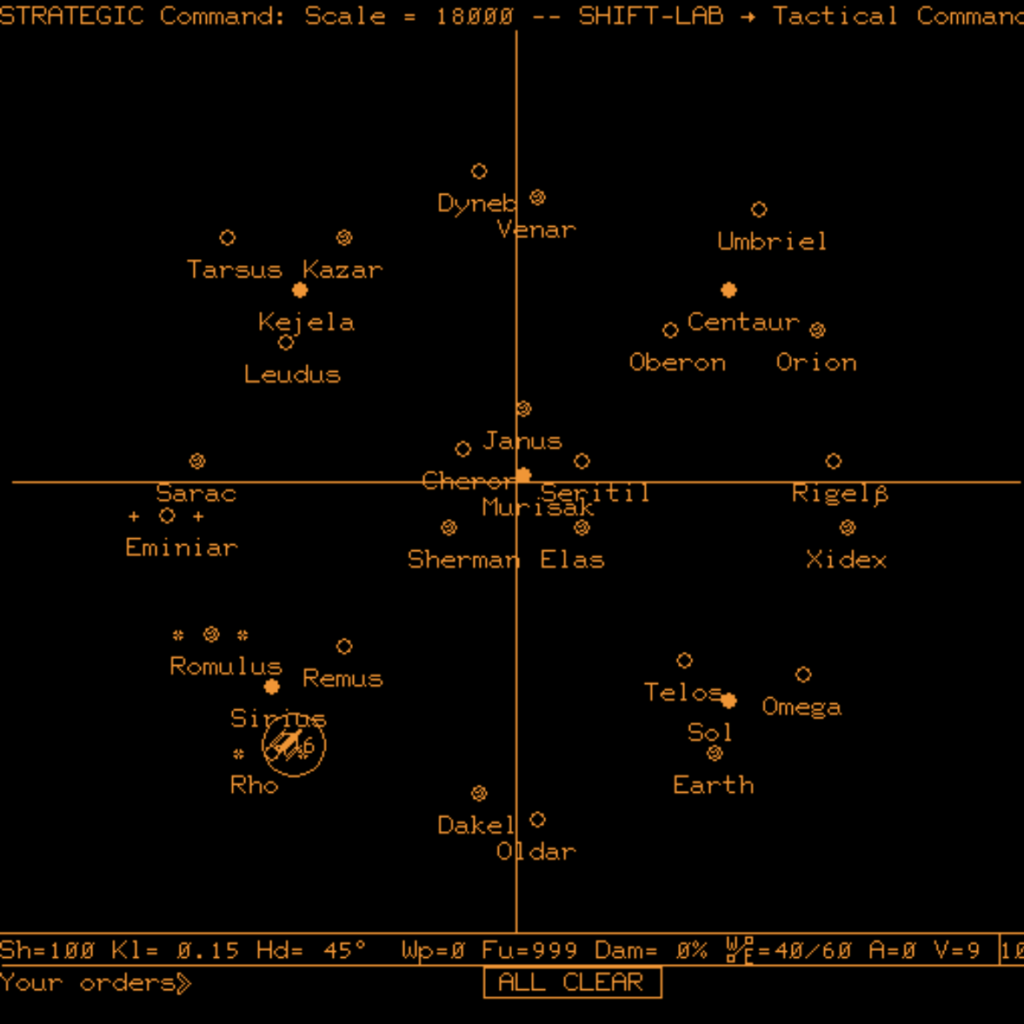
// Empire PLATOSYSTEMS 1977 Multiplayer Strategy
Thanks to the „free“ storage and processing power, a wide variety of games emerged, ranging from complex D&D-inspired 2D role-playing games (pedit 1975, dnd 1975, moria 1975, sorcery 1980), complex 3D dungeon crawlers (BugsNDrugs 1977, moria 1978, oubliette 1978, camelot 1979), action games such as aerial combat (Dogfight 1976), first-person shooters (Futurewar 1975), strategy games (Empire 1977), or Free3D (SPASIM 1976).
There were many single-player games, but also many multiplayer games. People also adapted later arcade games like Asteroids etc. It was an early public digital space where people could meet in games and play together (made possible by system-wide variables). However, the games also varied depending on the system. Read more here >
The Reach of Ideas
Unfortunately, it remains unclear to this day exactly how much of the game design from this pioneering era of PLATO and other mainframe computers influenced the game design of personal and home computers. One argument against a significant influence is that the developers of most later games were often younger and likely rediscovered these concepts on their own, meaning they were unable to recognize the connection or were not influenced by it. One strong argument in favor of this, however, is that these systems were accessible to the university community and partially open to the public, giving them a wide reach. So Lotus Notes was made after the idea of PLATO and and and. Another point in its favor is that some people went on to work at game companies, and that the connection is clearly evident in other areas of application, such as Lotus Notes, etc. Here, as at Xerox PARC, many ideas were carried forward or copied also from PLATO to Xerox and back.
But the situation was even more complex, this shows also in the following quote from UK from A. Maclean (Dropzone):
“I joined a computer club called the ACC, the Amateur Computer club and I was like member 200 or something. It was full of middle-aged weirdy-beardy types. One was Hugh Malander, who had worked on mainframes and was a research scientist […] writing simple games on this TI-99, which had colour graphics!” (Britsoft – An oral history. Wiltshire, Alex. 2022. Page 37 )
So the world in those days were more a complex habitat of different cultures, here even in one room – a mille plateaux.
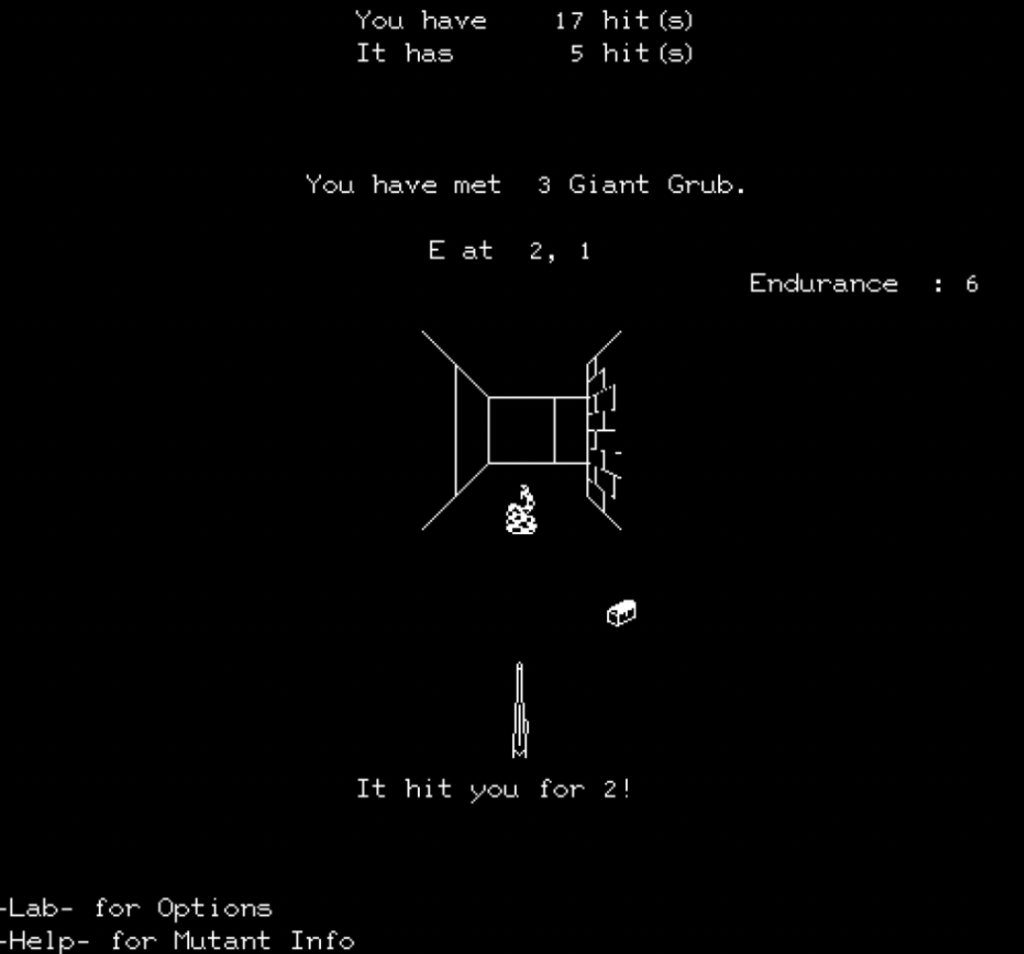
// Futureware PLATO systems 1977. The first ego shooter? Or just a dungeon crawler? At least there are a lot of parallels to the later Doom 3D like the EXIT-Sign over the exit.
At the same time, however, its university-based nature made monetization impossible. For this reason, traditional histories of video games often begin later, with the commercialized games found in arcades, on consoles, PCs, etc.—that is, games sold on the market that had a broad impact. Nevertheless, discussions about the early scenes—such as those surrounding the first-person shooter FutureWars (1976) on Plato Systems—are, of course, important. So who really came first? Even among roguelikes, there are debates surrounding Plato games—wasn’t one of them ever generated? In that regard, it must be said that many histories of gaming focus solely on commercialized games and overlook the mainframe era. This also has to do with what happened to mainframes afterward or or technically beforehand. Many mainframes were not as interactive or visual as the Plato system.
Return-based and therefore Turn-based Gaming
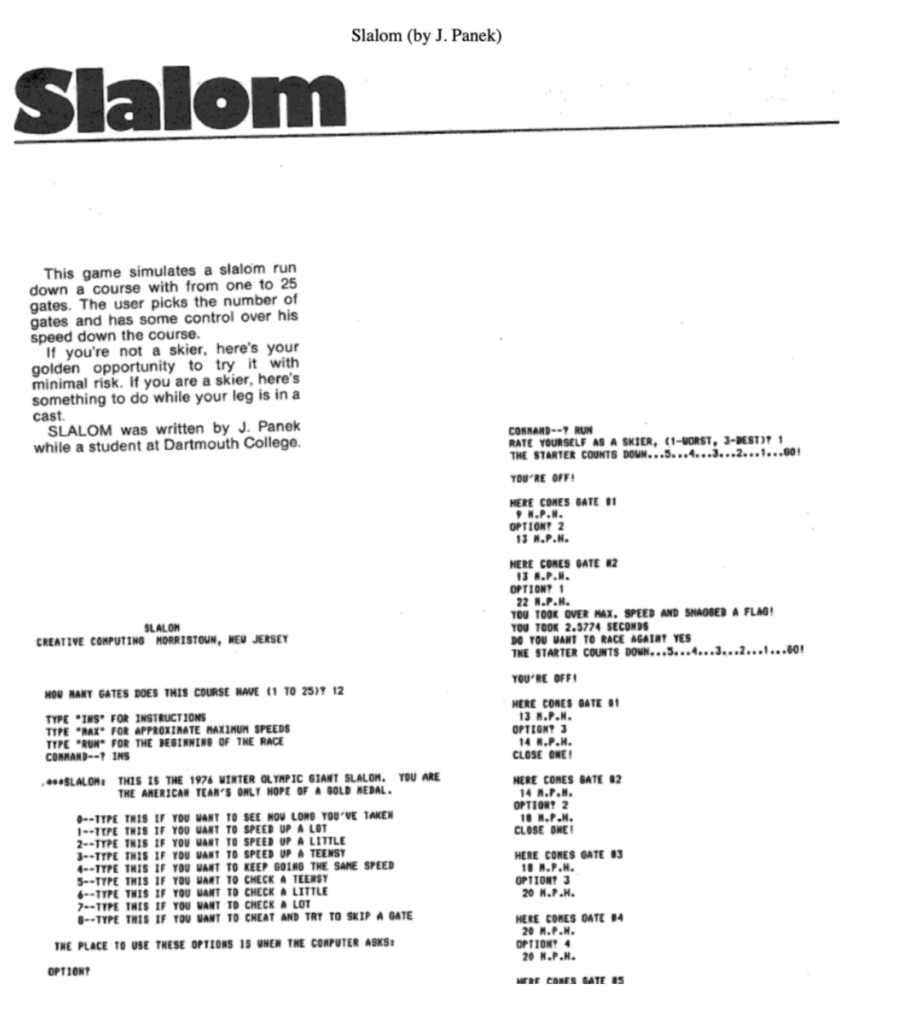
Mainframes later made their mark with their text terminals and, consequently, text adventures (Wander 1973, by the future CEO of Lucas Games), multi-user dungeons (MUD, 1978), and roguelikes (Rogue, 1980)—even though graphical displays eventually became possible in this area as well (Tektronik, 1972+), as did Xterm (1984+). Mainframes were primarily used in universities and large corporations. People simply played other games on mainframes as well. This is illustrated by the book published in 1973: 101 BASIC. This is illustrated in the book 101 BASIC Computer Games*, published in 1973.
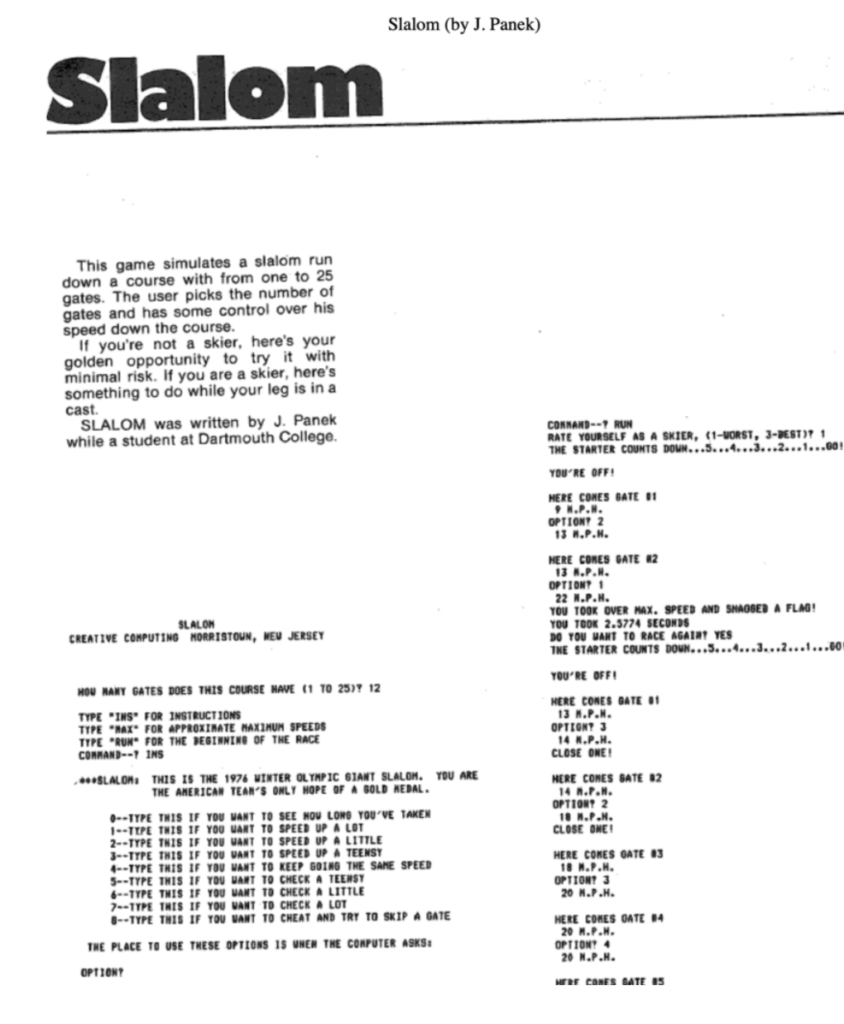
// Play Slalom – a usally very interactive game: https://www.atariarchives.org/basicgames/#google_vignette
These games ran on BASIC 1964+ and were intended to be typed out by hand. They used standard BASIC without graphics capabilities or direct keyboard input. However, they were available on almost every system, from mainframes to DIY computers. They used standard BASIC without graphics capabilities or direct keyboard input. Most were played using the “Return” command, meaning they were turn-based. But most of them were also customizable—you could name the players. The advantages of the keyboard.
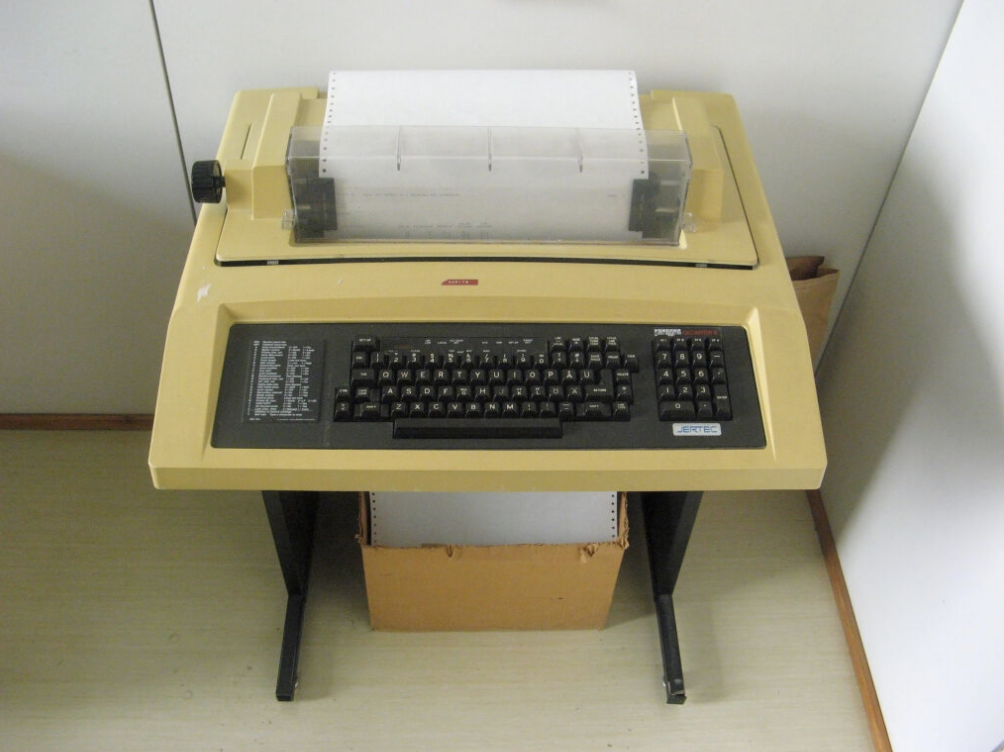
// The input and output-device on many mainframes: Teletyper Picture: https://en.wikipedia.org/wiki/The_Oregon_Trail_(1971_video_game)
Little remains from those days. They seem more like digitized games than computer games, but they are, of course, computer games as well. According to A. Hahn, while he was a high school student in Uster in 1972, he developed a simple Snakes and Ladders game remotely on a computer at ETH during class, he told in a unpublished interview (Bauer 2025). The terminal was a teletypewriter—in other words, essentially a typewriter that could be used both locally and remotely.
The situation is similar with the strategy game Oregon Trail*, which was developed in 1971 and released in 1975 as a game (BASIC). In this game, you can only decide at the very beginning what to take with you on the journey; the rest is then calculated. This concept was later expanded upon.

// Return-based Gaming Oregontrail Picture: https://en.wikipedia.org/wiki/The_Oregon_Trail_(1971_video_game)
At the same time, monitor terminals were increasingly used. These could replace teleprinter terminals on a one-to-one basis and, of course, offered even more features, such as clearing the screen or printing at specific positions.
Not only high-end mainframes played a role here, but also the category of “minicomputers.”
Rogue (https://en.wikipedia.org/wiki/Rogue_(video_game) was also developed in 1980 on a Unix-based minicomputer. It was one of the first games to feature procedurally generated levels and monsters.
Tetris (https://tetris.wiki/Tetris_(Electronika_60)), for example, was created in 1984 on a PDP-11 clone in the USSR. Tetris was then ported to all kinds of platforms, eventually making its way to arcades in the U.S. in 1988. Originally the game had no levels it was endless, the arcade of course had levels. From time to time, the player has to be able to take a break.
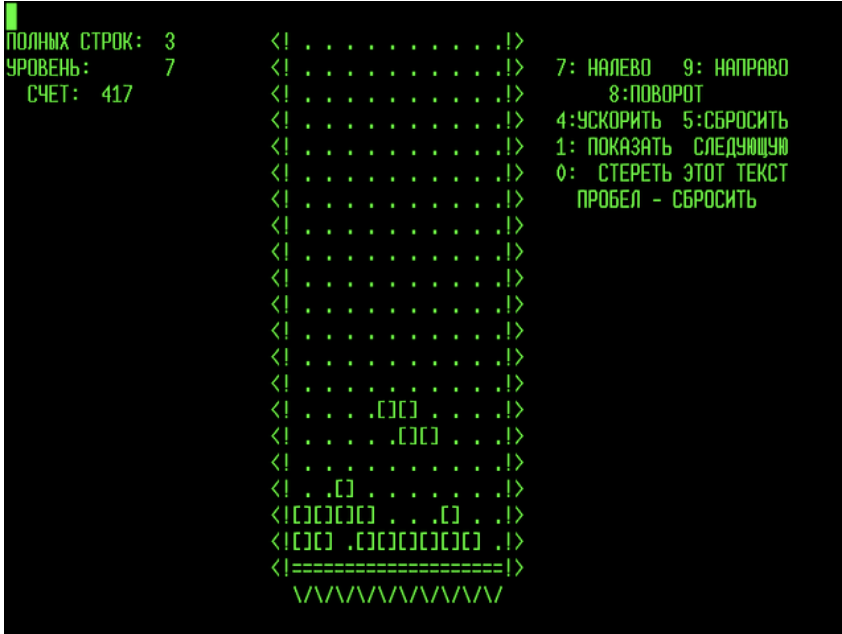
// Original Tetris 1985 on PDP-11 Clone in the USSR Picture: https://tetris.wiki/Tetris_%28Electronika_60%29
In the Swiss context, Roger Sieber certainly deserves a mention here; he purchased a “minicomputer” (it was actually quite large) and used it to run a game commercially—specifically, the game Galactic Empire*. He redeveloped it as a port specifically for a VAX and took advantage of the multi-user capabilities of the mainframe architecture. It was accessible via Telnet or directly as a BBS. Later, a web front end was added that allowed users to play the game directly there. More on this in “Genre: Gateway to the World / Web Games.”
It’s important not to overlook the ‘final step’ in this line of mainframe development: it also gave rise to a series of workstations such as as the PDP-8, Xerox Star, HP 9000, or, more specifically the Lilith ETH in 1980 (https://en.wikipedia.org/wiki/Lilith_(computer)) and NExT Cube in 1989. These computers were mostly designed specifically for computing power or/and 3D graphics and were expensive; more information can be found here: https://en.wikipedia.org/wiki/Workstation.
It is the top down approach, that will be at the end the winner over all the upcoming Personal Computers and Homecomputers, because they have multi-user, multithreading, ethernet, object orientation programming, virtual machines – all a computer will need around 2000 and they have it from end 60ies.
Office computers / personal computers and also used as Home computers 1977+
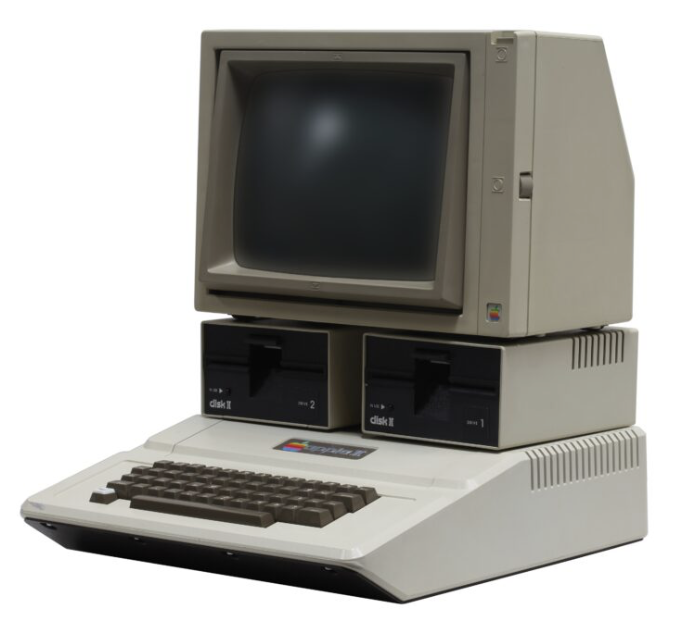
// The first ‘personal computer’ 1977. Keyboard and Computer were not seperated. Picture: https://en.wikipedia.org/wiki/Apple_II
The first office computers hit the market at almost the same time as video game consoles, replacing do-it-yourself computer kits; they were essentially (expensive) office machines, starting with the Apple II in 1977 (3,500 DM – https://8bit-museum.de/sonstiges/preisliste/ ), the Commodore PET in 1977, and the TRS-80 in 1977. In terms of price, they were at a completely different end of the spectrum than, for example, game consoles or, later, home computers. IBM was very late to the game with the IBM Personal Computer 1 in 1982 (7,000 DM – https://8bit-museum.de/sonstiges/preisliste/), which later gave rise to the inexpensive “IBM-compatible” MS-DOS computers that were considered “pirated copies.”
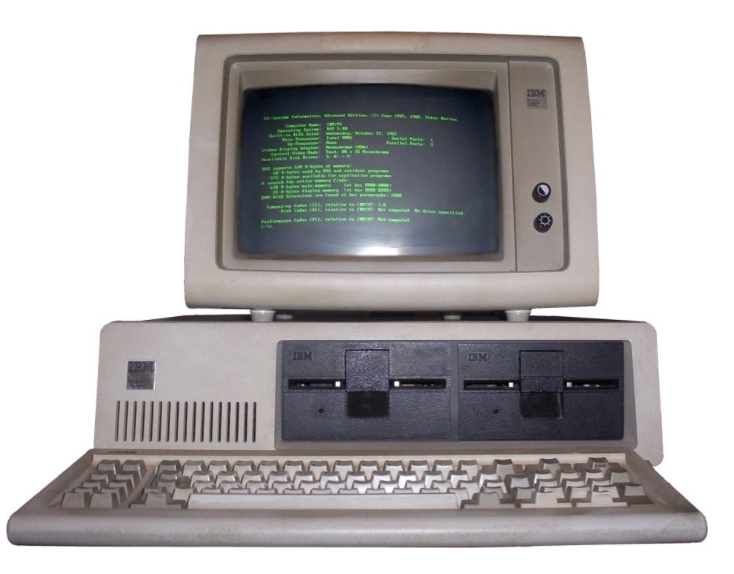
// Late: IBM PC 1 1981 looked more like a workstation with its separated keyboard and two (!) 5 ¼ Floppy disks. Picture: https://de.wikipedia.org/wiki/IBM_Personal_Computer
These office personal computers all had monitors. Many of these systems were consistently monochrome right up until the later Macintosh in 1985. Color was available, but monochrome was preferred, as it made working with text and numbers on less-flickering screens less eye-straining. Games were also purchased once, and you could play them as much as possible. People played at (office) desks, and sound wasn’t important.
Game development also took off very quickly on these early personal computers, especially on the Apple II. Naturally, these games also found their way into the world of home computer gaming and served as models for it. After all, many Apple IIs, PETs, and other computers were also found in home offices. People often recognized and used the software from the office at home and therefore purchased the same computer system for their homes; IBM-compatible systems benefited from this the most.
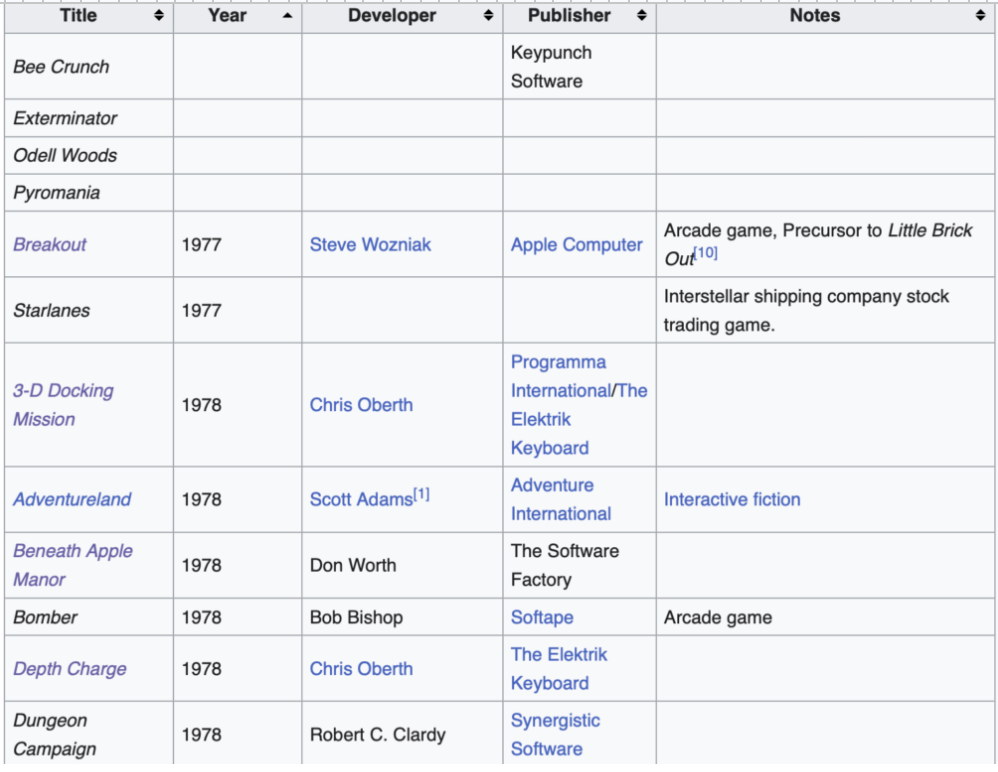
// The production of published games started with the release of the Apple II. Picture: https://en.wikipedia.org/wiki/List_of_Apple_II_games
One of the later games for the Apple II—Oregon Trail:
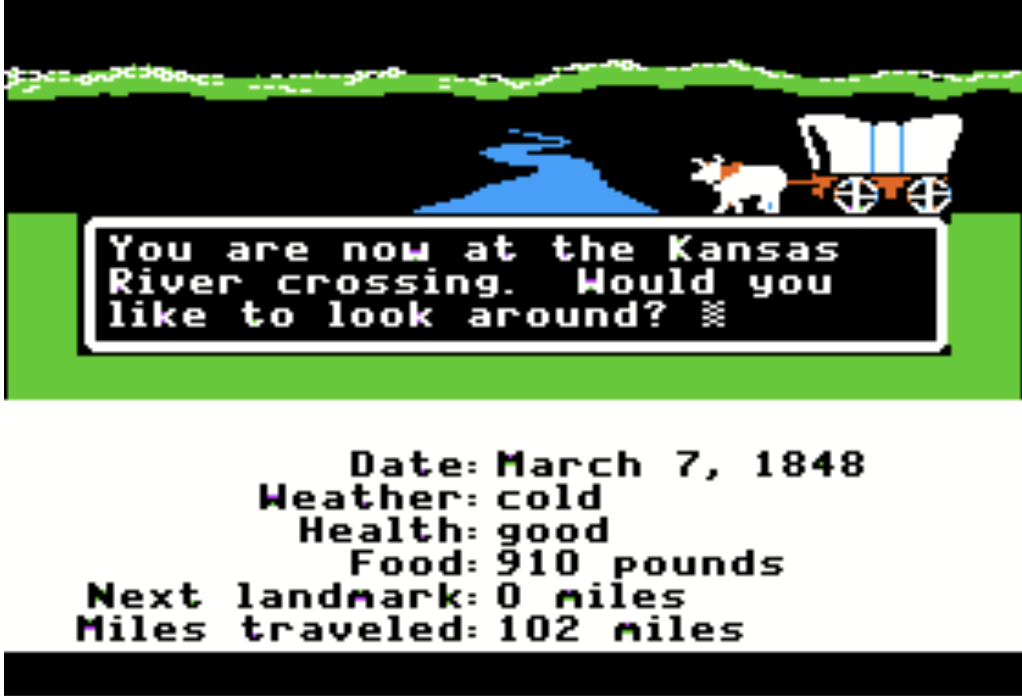
// Oregon Trail Apple II 1985. The game about the colonialisation of the east of us. Picture: https://en.wikipedia.org/wiki/The_Oregon_Trail_(1985_video_game)
Due to its design, the MS-DOS platform was initially difficult to use, especially for scrolling, until ID Software (later known for Doom*) released Commander Keen in 1990 and demonstrated that it was indeed possible to create scrolling games on MS-DOS without any stuttering (https://en.wikipedia.org/wiki/Adaptive_tile_refresh).
One example from Switzerland in a private setting was Galactic Empires*, developed starting in 1984. It was a turn-based strategy game. At first, it was played primarily in the ETH computer labs. Galactic Empires for Networks (GEn) – a Swiss multiplayer game (1984–2000)
Starting in 1987, Apple also offered its own hypertext system called “HyperCard, which was based on cards and stacks (https://apple.fandom.com/wiki/HyperCard). Many in-house projects were developed for this platform as well, though little is known about them. The only one still available today is a learning “Battleship” game. Schiffli versenken (1991) by Markus Koller.
The Boss Key or „Work key“
Games were also adapted to the gameplay situation, for example with boss keys or panic keys. Pressing the Esc or Space key would bring up an image of a shell or a spreadsheet. This feature was first introduced in 1981 by the game BEZARE on the Apple II. It was subsequently used frequently in games such as Rogue (1980), Tetris (1987), Star Wars (1989), Leisure Suit Larry, and Wolfenstein 3D (1992). More here: https://en.wikipedia.org/wiki/Boss_key
Of course, personal computers were, in a certain sense, also home computers, because people with an affinity for technology could simply have them at home. And because they were also becoming increasingly affordable—see, for example, the IBM clones. Conversely, home computers were also used in the office. The distinction is therefore a fluid one. And yet it’s also a clear-cut one, because in the end, only two systems—or three, with the introduction of Linux (though, like macOS X, it’s ultimately just a variant of UNIX)—will remain.
Homecomputer 1981+
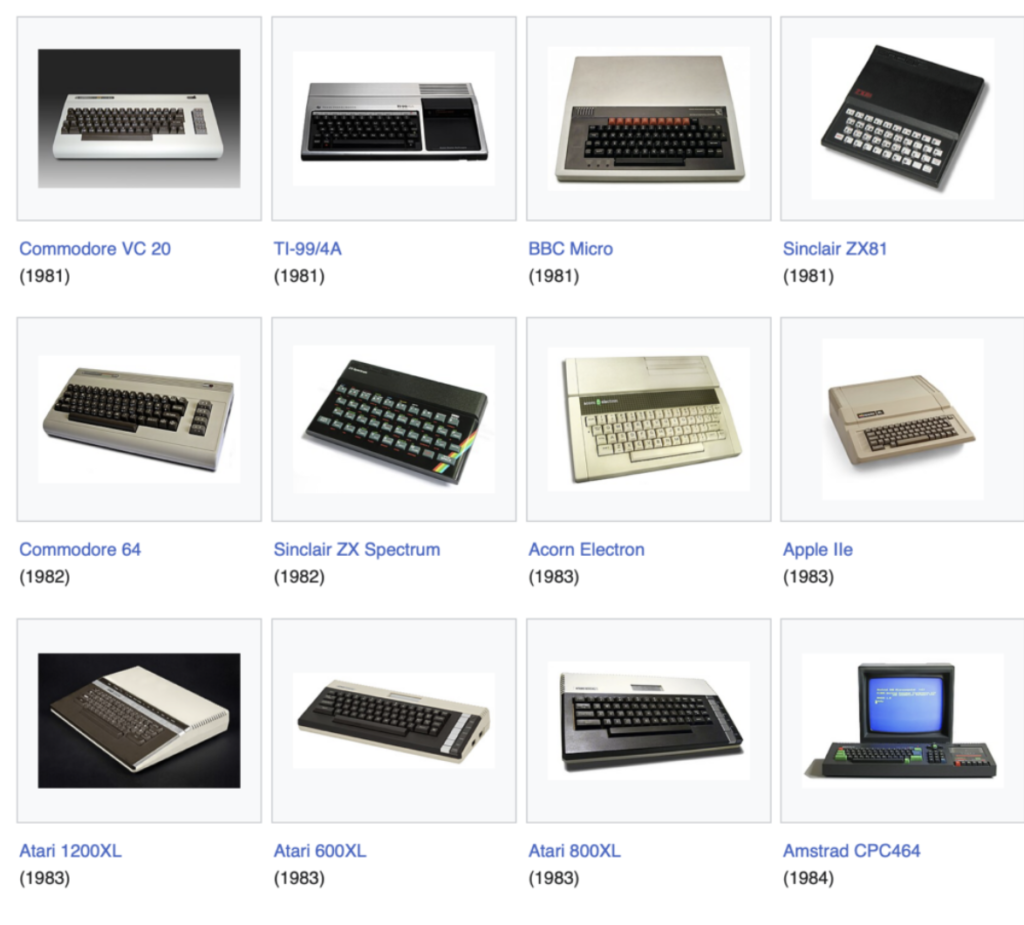
// A small selection from the world of home computers. In addition, there are many more home computers, some of which are only available regionally, such as the Smaky (CH). However, it is not entirely clear why the Smaky (https://en.wikipedia.org/wiki/Smaky ) is classified as a learning computer. Picture: https://de.wikipedia.org/wiki/Heimcomputer
Home computers such as the ZX81 (1981), TI99 (1981), and C64 (1982) made computers affordable for home users and were initially used with televisions.
Compare here: https://8bit-museum.de/sonstiges/preisliste/
Later, 16/32-bit home computers were introduced, such as the Atari ST in 1985 and its counterpart, the Amiga 500, in 1987 (following the very expensive Amiga 1000, released in 1985, which was marketed more as a workstation).
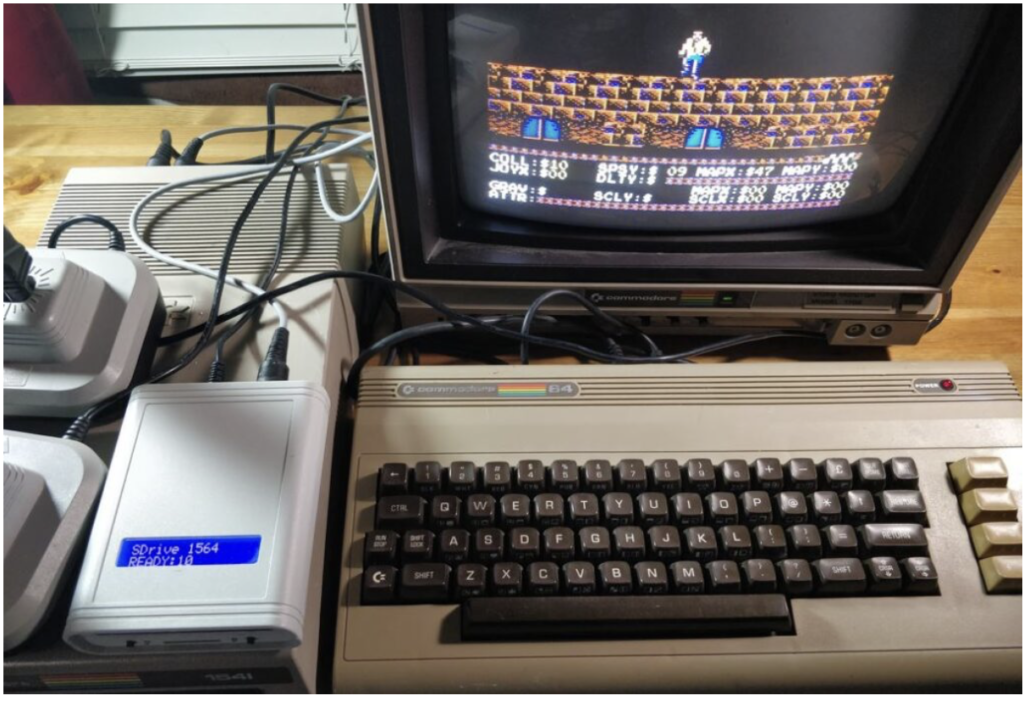
// The C64 connected to a Commodore Monitor. Picture: https://www.c64brain.com
Households. And they supported both mainframe and personal computer games, as well as arcade and console games. So they stood somewhere in the middle of these two cultures. Many units were sold (3 to 12+ million (C64)), and they were open to their users. (https://www.guinnessworldrecords.com/world-records/72695-most-computer-sales)
You could do office work, play games, program, and even create and distribute your own games. They often also included console hardware chips from consoles (TI99, C64, Amiga). Both arcade machines and consoles (following the Atari 2600 with its many porn games—warning: some of these games are beyond the bounds of decency. Porno Hustlers Of The Atari Age https://kotaku.com/porno-hustlers-of-the-atari-age-1847622176) were closed systems. This was also true for handhelds, from the Game & Watch in 1980 to the Game Boy in 1989. So the only option left for independent development was the personal computer or home. So the only option left for in-house development was the personal computer or home computer.
Especially when learning programming languages like BASIC, many games—such as Hangman and quiz games—were created; today, these would be referred to as digital games, and they are also featured in the 1973 book 101 BASIC*. But in those days this were games of course.
Ahi writes about the book:
“Everybody likes games. Children like tic tac toe. Gamblers like black jack. Trekkies like Star Trek. […] I got 21 version of blackjack, 15 of nim and 12 of battleship. […] I selected the 90 best games and added 11 that i had written myself for a total of 101.”
(Computer Games, D. Ahi, Infoworld, 11. May 1981, https://books.google.ch/books?id=Cz4EAAAAMBAJ&pg=PA44&redir_esc=y#v=onepage&q&f=false)
Unfortunately, not much of customized or other personal coded games has survived or been documented to this day. Nevertheless, these are probably the most widely programmed games of all time. Often a coding course ended with the most powerful, interactive and funny thing: a game or like the named it then: „a computerized game“.
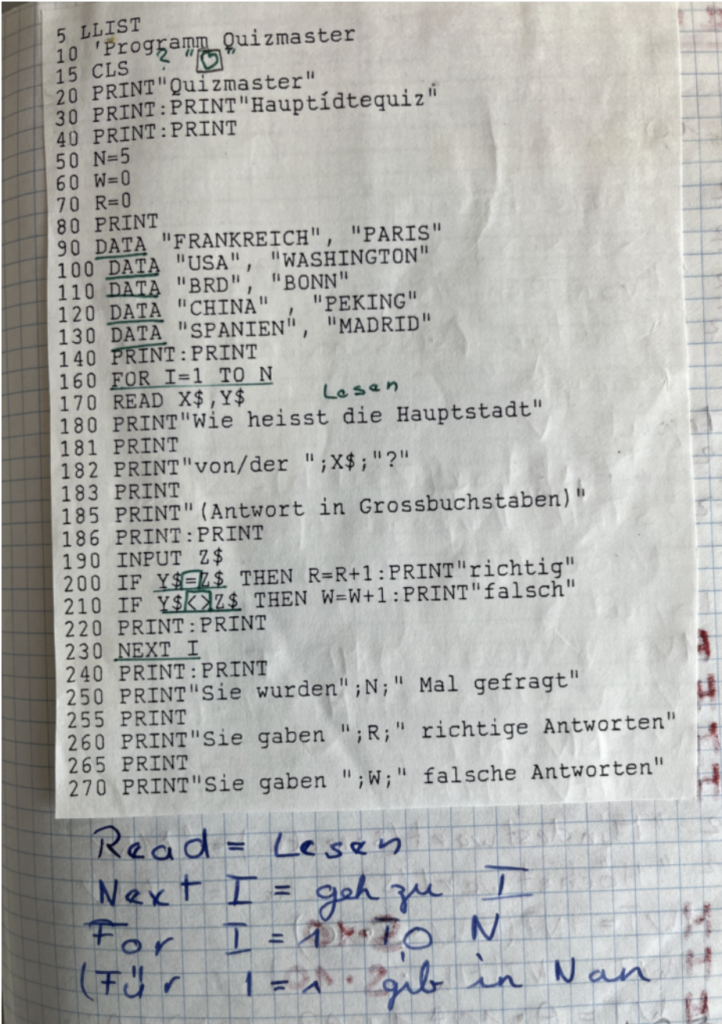
// Quizmaster—a quiz-like game digitized in BASIC in 1985 at a computer camp by one of the authors in Romanshorn CH. Picture: R. Bauer.
Later, 16/32-bit home computers were introduced, such as the Atari ST in 1985 and its counterpart, the Amiga 500, in 1987 (following the very expensive Amiga 1000, released in 1985, which was marketed more as a workstation).
J. Minter (llamasoft) about this:
“I heard of the Amiga and it sounded fantastic, but Commodore had this weird attitude at the time that it was very definitely not a games machine.[…] People were buying the STand playing games with it, even though the Amiga was a better machine. Then they real-ised and came out with the Amiga 500, which was much more of a games-oriented version of the Amiga, and then finally they started to catch up.” (Britsoft – An oral history. Wiltshire, Alex. 2022. Page 266).
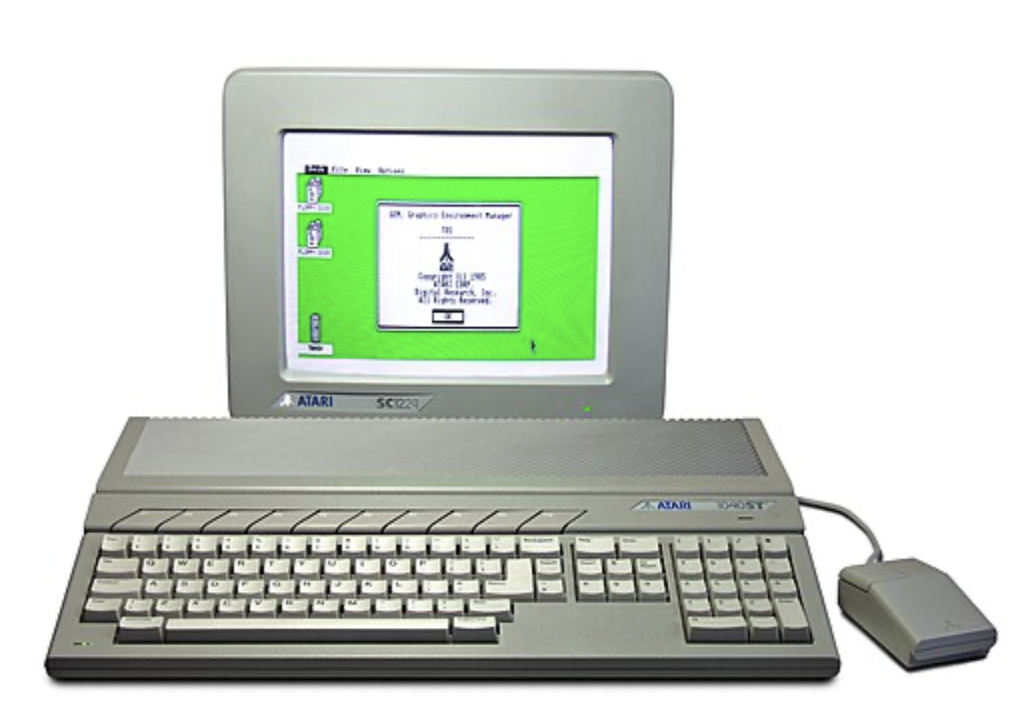
// The Atari ST – A keyboard computer Motorola 68000, a lot of Memory (512kb) with a two button mouse and modern GUI inspired by LISA and Macintosh 1984. Picture: https://en.wikipedia.org/wiki/Atari_ST
These were released with a resolution of 320×200 and 16 colors, but could also be run on a TV if necessary. Both came with a mouse and a GUI. The Amiga also featured better graphics (16, 32, or even flickering 4,096 colors), better graphics chips, and fully digital sound. Like computer games in general, home computer games could potentially be copied, which also contributed to the appeal of home computers. There were no more classic game cartridge interfaces like in a lot of 8bit computers.
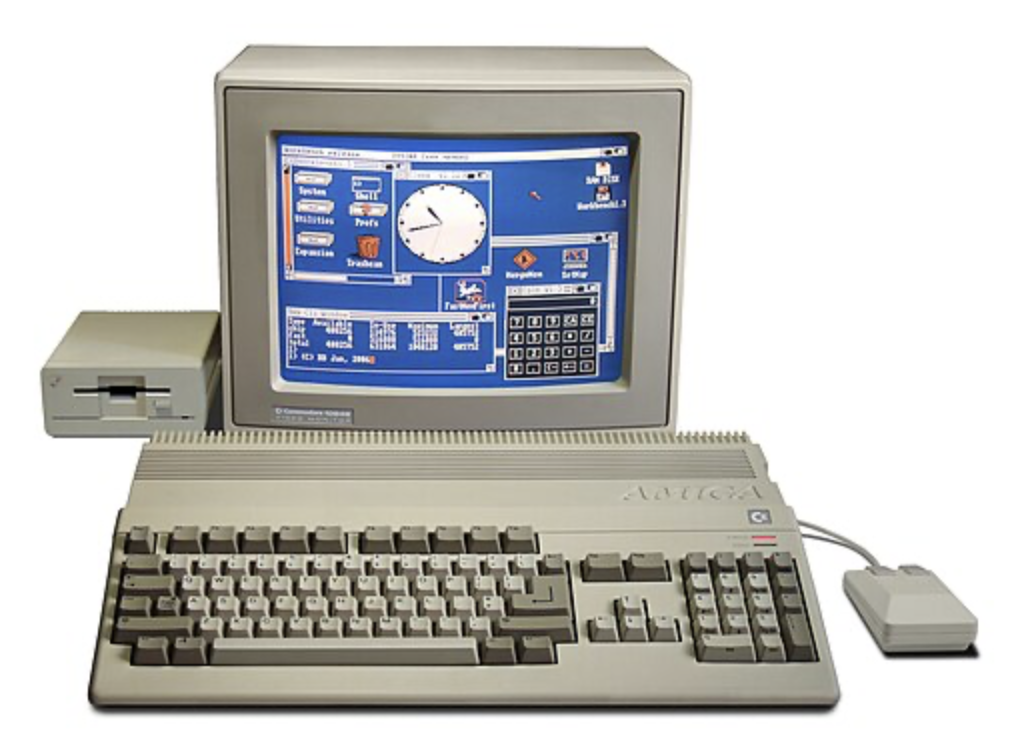
// Amiga 500 1987 – Keyboard Computer based on 68000, 512 kb RAM and a mouse with two buttons and a lot of dedicated chips for graphics and sound, GUI-OS with multitasking features. Picture: https://en.wikipedia.org/wiki/Amiga_500
Homecomputer games
Most computer games were never ported to platforms other than computers. Many games were developed exclusively for 8-bit systems, and—especially in the case of 16-bit games with their many innovations—there were few ports, either outside their own community or to platforms such as MS-DOS, Windows, or Mac. These games and their tradition essentially died out with the end of the home computer scene around 1993 and beyond. Their settings, game mechanics, ideas, and information about development teams and developers were not reproduced—unlike console games (Nintendo etc) and PC games (Windows) later.
Home computer games, along with their boxes, were entirely digital—unlike consoles with their ROMs. As a result, they had no analog copy protection. Instead, they were equipped with digital copy protection (exceptions, such as holes in the packaging and on the disk, served as a bridge to the analog (retail) world). Some insights into C64 protections: Copy protection (https://www.commodoregames.net/copyprotection/)
Gameculture and Game Situation of Home computers
How should we think about the “appropriation”/privatization of games? How were they played?
Semiosis Cascade (booklet, advertisement, packaging, the game)
“We had Elite agreed as finished by Acorn probably in June 1983 […] Also, they wanted it to have a lot of testing, and in the box a big manual, a story, a poster, and all those sorts of things, and they were all being made and approved. Acorn wanted a lot of stuff in the box to show the game was different to what had come before. They also charged a much higher price for it.” D. Braben UK. Britsoft – An oral history. Wiltshire, Alex. 2022. Page 102.
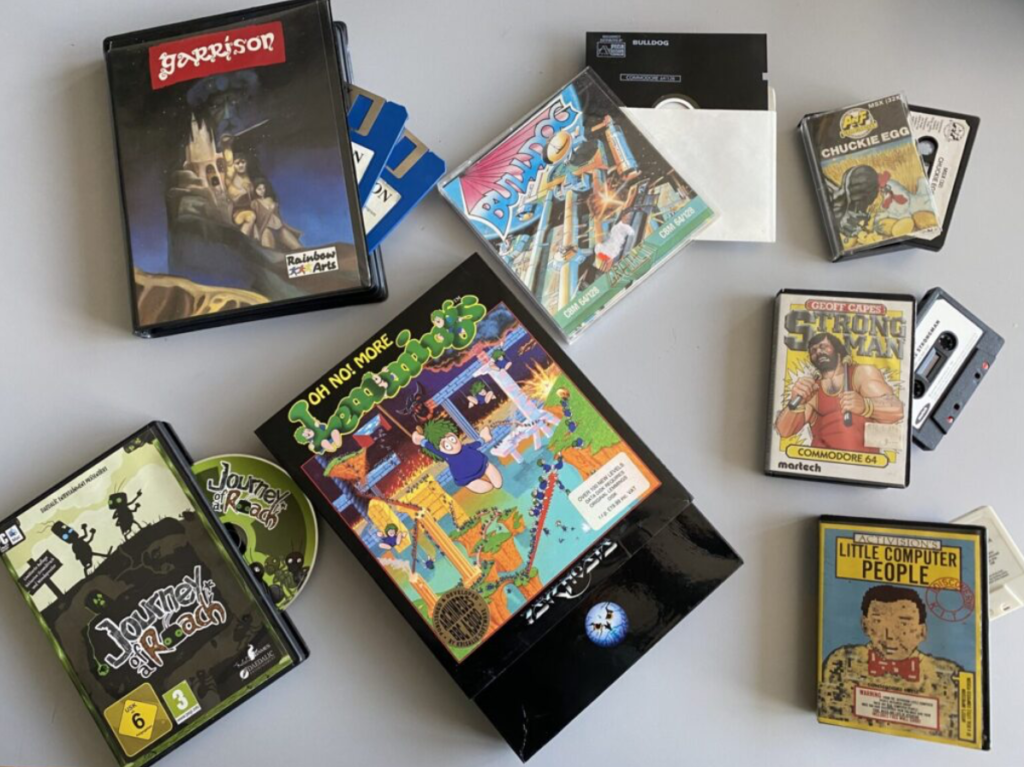
// Boxes: The first fully digital data storage medium: cassettes. Often used for 8Bit homecomputers. Than 5 ¼ -inch disks. Than 3 ½-inch Disks and later CDs. Not on the picture: computer cartridges. Picture: Beat Suter
The semiotic cascade surrounding home computer games could be very long in extreme cases. Here’s an extreme example: A player played a game on an arcade machine at an arcade, talked about it with colleagues, saw the ported game advertised in a computer or gaming magazine, read a review, saw it at a computer store, played it there, talked about it with colleagues, saw it at a friend’s house, bought it, looked at the box cover, opened it, read the booklet that came with it, maybe hung up the poster inside in their room—thus bringing gaming culture into their room—inserted the game into their home computer, typed in a cryptic “Load Basic” line (or, in rare cases, used a cartridge), saw the title screen in full color with a 3D perspective and music, and then played a 2D game with 4 colors at a resolution of 160×200 pixels—for example, on a C64—using the joystick. Also failing was much easier than in the arcade (or at a friends console): Loose less money and the player could be alone. Nobody knew how often players tried! So even failing was much better. More about the failing in games in the book “The Art of Failure” by https://jesperjuul.net/artoffailure/
That was a different kind of cascade than what you’d find with an arcade cabinet and its designed environment or a console with its cartridges. Waiting was part of the process too. The player could look into the booklets, read there.
| Game magazine like “HappyComputer” | Advertising, test report |
| Schoolyard/Colleagues | Discussion |
| Computer Store | Discussion, Gaming, Buying |
| At home | Unpackaging with a high-resolution print imageUnpackingRead the bookletHang up the poster |
| On the home computer (connected to the family TV or, later, to a monitor) | Load diskLong loading time. Cover art with music. Menu screen with music. Interactive in-game graphics. Play with a joystick or mouse. |
More detailed
The magazines were a window and connection to the digital community around the world. It was an analog and virtual community and it is till today. This community is called in the following article: “digital game internationale”, because the virtual community is often more connected than the analog one. The following blog post highlights the importance of computer magazines in the context of computer communities (in german): Die eigene Game-&Computersozialisierung und das „Spieleheftli“(Spielmagazin) in der Ordnung der persönlichen Dinge und die Gameinternationale [wird überarbeitet und ergänzt] (translated: My Own Gaming and Computer Socialization, the “Spieleheftli” (gaming magazine) in the Order of My Personal Belongings, and the “Gameinternationale” [to be revised and expanded])

// 3 Teenies sitting on a bank, reading the game magazine “Power Play” after buying it at the kiosk around 1989. The advertising on the left seems for the game KULT. Picture: S Bauer
S. Turner (Avalon) talks about the function of magazines in Britsoft P. 239. “Suddendly we had Crash and Zzap!64, and they seemed to be written by young people for young people. They were full of lovely artwork and lots of opinions, which could be really devastating. They set about reviewing virtually every game that came out, even the unpublished before the magazines started. You thought that they were the voice of game players […] They alos almost treated games like the pop industry. […] If you had a bad review your game was probably not going to do well.”
What did a magazine like that look like? For example the Happy Computer Magazin from 1983 (https://de.wikipedia.org/wiki/Happy_Computer)? Here with a special issue for gaming.
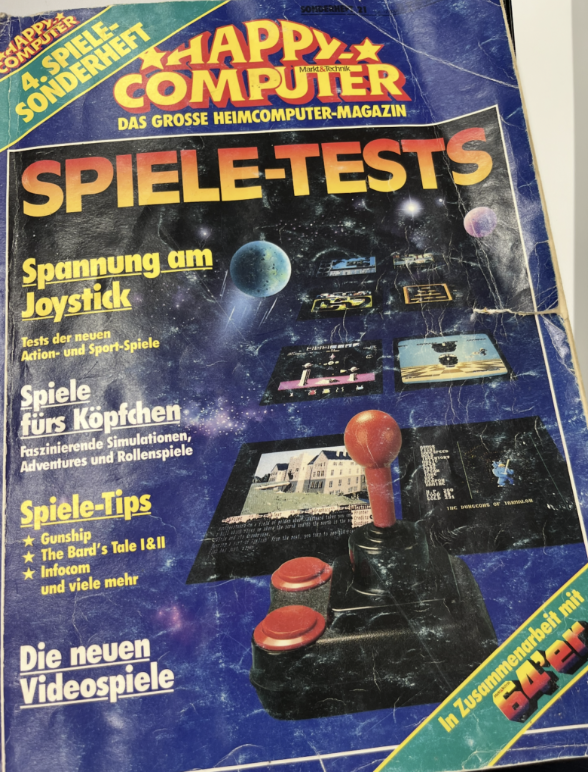
// Happy Computer. The Big Home Computer Magazine. Special Issue No. 4: Game Reviews. https://de.wikipedia.org/wiki/Happy_Computer. Picture: R. Bauer
Later its gaming part became an own magazine, the Power Play 1987. https://de.wikipedia.org/wiki/Power_Play_(Zeitschrift)
These specific features did such the Power play magazine offers: highlighting trends in gaming culture, news from all platforms (such as arcades), reports on trade shows, other platforms, new platforms, game reviews, game development, in-depth reviews (game mechanics, graphics, sound), tipps, walk throughs, entertainment comics (Star Killer in PowerPlay), advertising, recruitment of game designers, classified ads, and regional ads.
Readers became part of a larger whole, as in everyday life – the ‘digital game internationale”.
The following blog post details the box’s evolution over time, its uses, and its contents: Eine Box ist nicht nur eine Box. Game Verpackung im Wandel der Zeit
The box in the usage in swiss digital games:
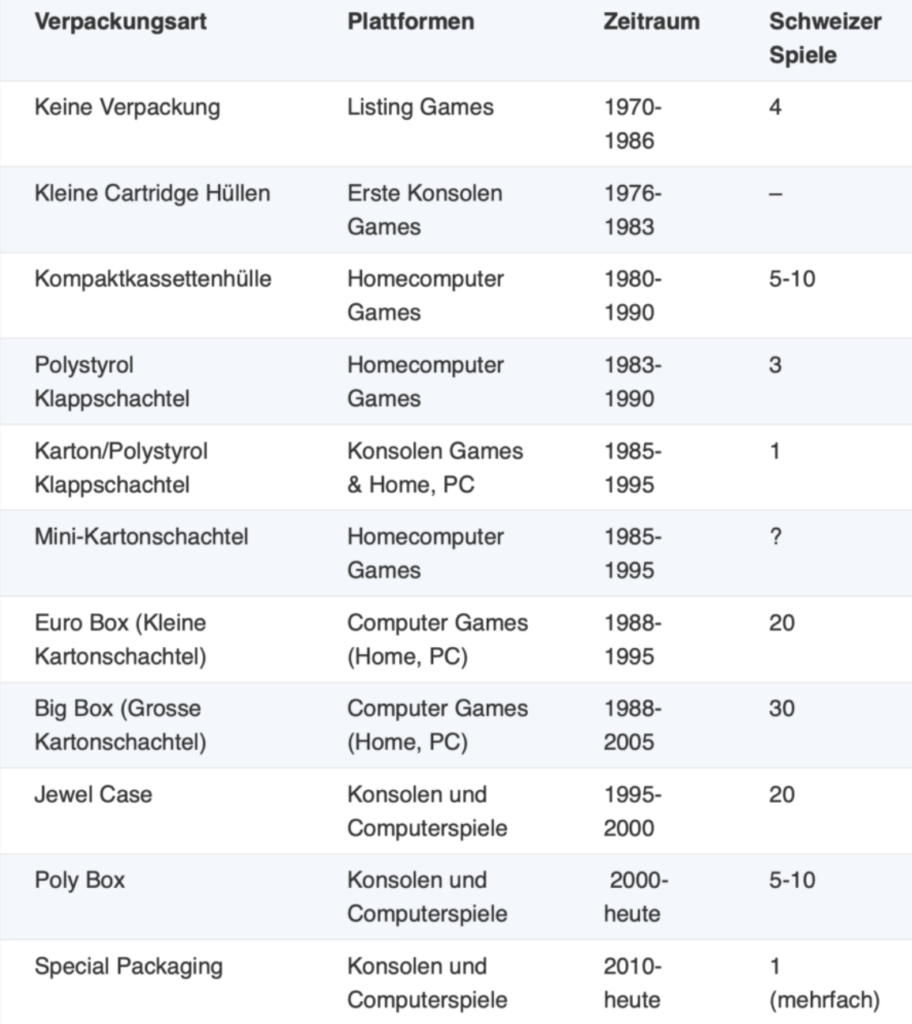
Starting a game on the C64.
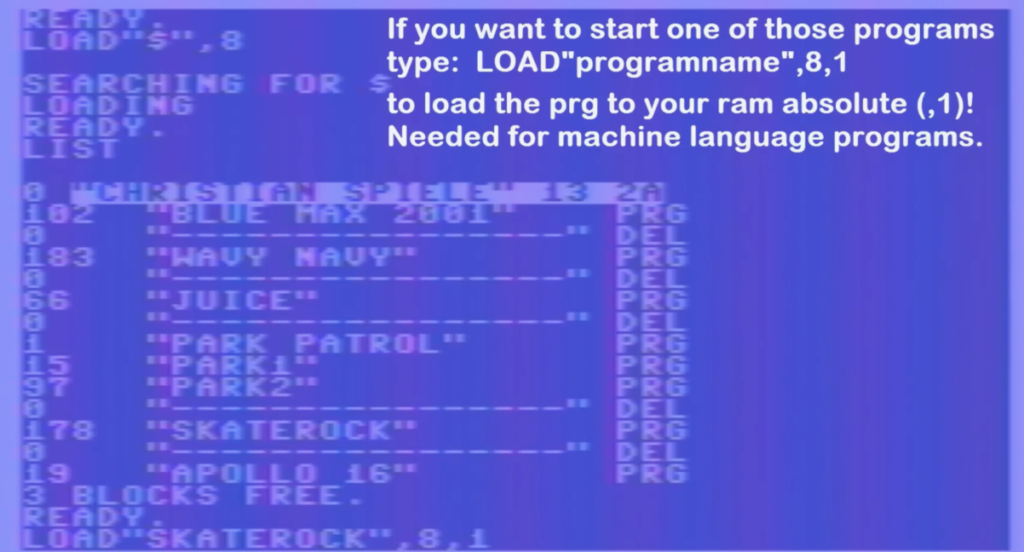
// Load the director with the BASIC command LOAD”$”,8 (DISKS) and than list the directory and than load the program and run it. Picture: https://www.youtube.com/watch?v=DVEQua5bADs&t=19s
With 16/32-bit computers like the Atari ST and Amiga, things got easier because 3 ½ floppy disks made it possible to create boot disks. But that also brought with it the problem of boot sector viruses.
Gaming Environment
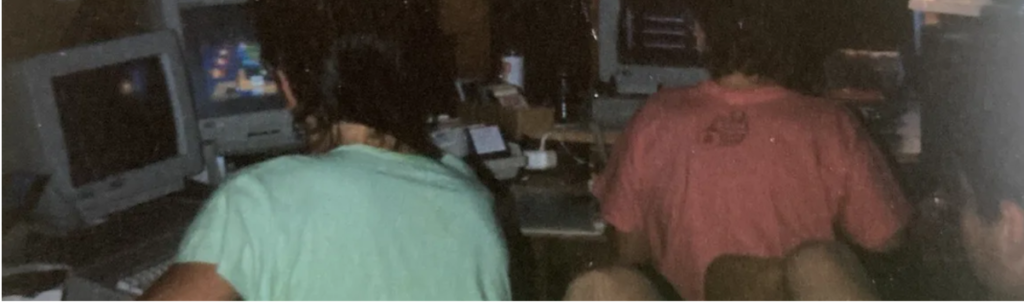
// A typical home computer gaming scenario around 1990. A lot of home computers in a dark corner and 3 players. Playing Klax and an unknown game. Picture: S. Bauer
Once the TV was left behind (i.e., the console era), the typical gaming environment usually involved playing at a table with a joystick, a keyboard, and later, a mouse as well. This made computer gaming fundamentally different from console gaming, with its often imprecise controllers, such as those found on the Intellisivion or NES. The joystick was either held in the hand (which was possible with the Competition Pro) or often placed on the table—some even had suction cups. As a result, from the outside, the gaming setup on home computers resembled arcade games more than console games, where you play on the sofa or on the floor.
All home computers used the same standard for joysticks. Here are a few examples online: Joystick (https://www.c64-wiki.com/wiki/Joystick)
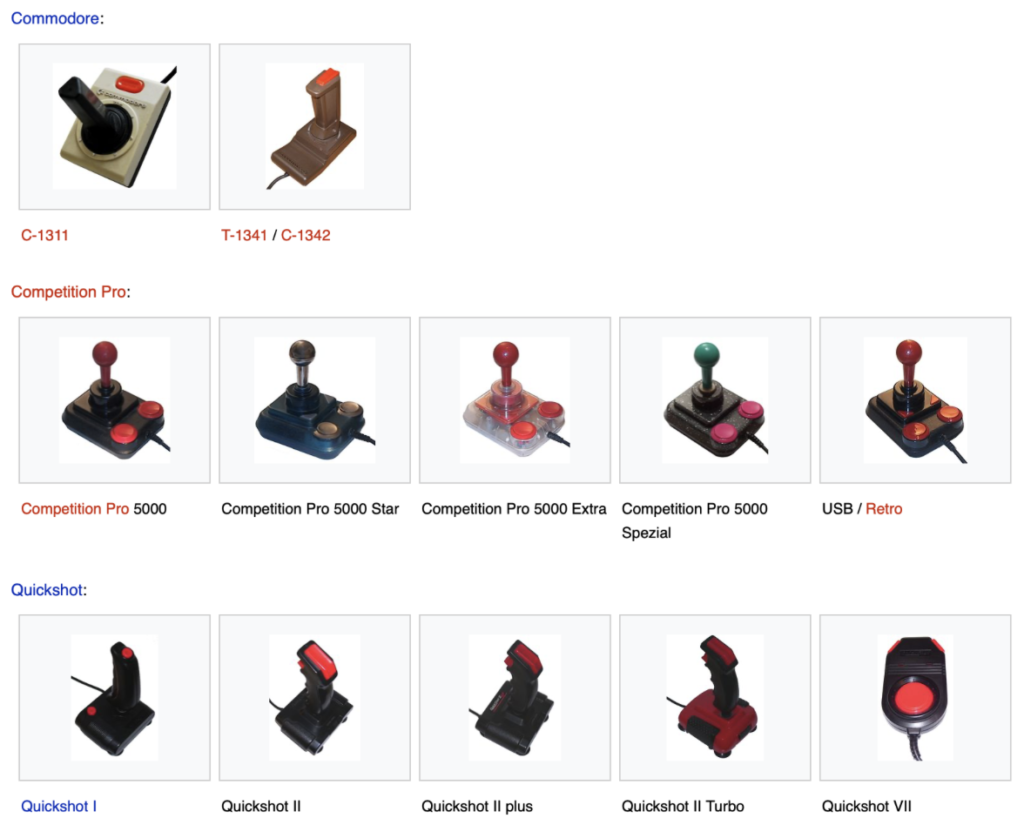
// C64 Joysticks. Picture: https://www.c64-wiki.com/wiki/Joystick
The joystick is even featured in the game magazine shown above. Even though the game on the left, „Guild of the Thieves,“ is played with a keyboard rather than a joystick. The joystick, even more so than the mouse, was an essential part of this home computer culture.
Genres or categories
“If you look at what was happening in the early ’80s, when the game scene in the UK really caught fire, you need to look at the background before that, that late ’70s to early 80s massively creative, vibrant, international music scene. We had all sorts of different types of music coming out:ska, punk, early electronic music and various fashions, New Romantic … We had the creative mentality that we could go out and make anything happen. We had the home computers, some of which were being made and created here. ” J. Hare [Wizball] (Britsoft – An oral history. Wiltshire, Alex. 2022. Page 38)
The following section profiles various genres that are specific to computers, but especially to home computers. Some games may appear more than once, as they have had a formative influence on different areas or subgenres of gaming culture. Here, too, emphasis is placed on highlighting these aspects in the context of Swiss games. Computer gaming cultures have always been very local in nature too, because ‘everybody’ could participate.
Arcade Adaptations
Arcade Computer Games (Ports)
O. Twins (Dizzy): “Pac Man in Arcades (if we had a bit of money), but on a friend’s Apple II there was a good version.”
Britsoft – An oral history. Wiltshire, Alex. 2022. Page 35
Arcades, with their specialized hardware, were considered the primary platform for action games (or, more simply, arcade games). As a result, many games were professionally “ported” from the arcades by game publishers; in most cases, this required rebuilding the games from scratch—essentially reconstructing them for the new systems—often, of course, in a scaled-down form. This is called demake.
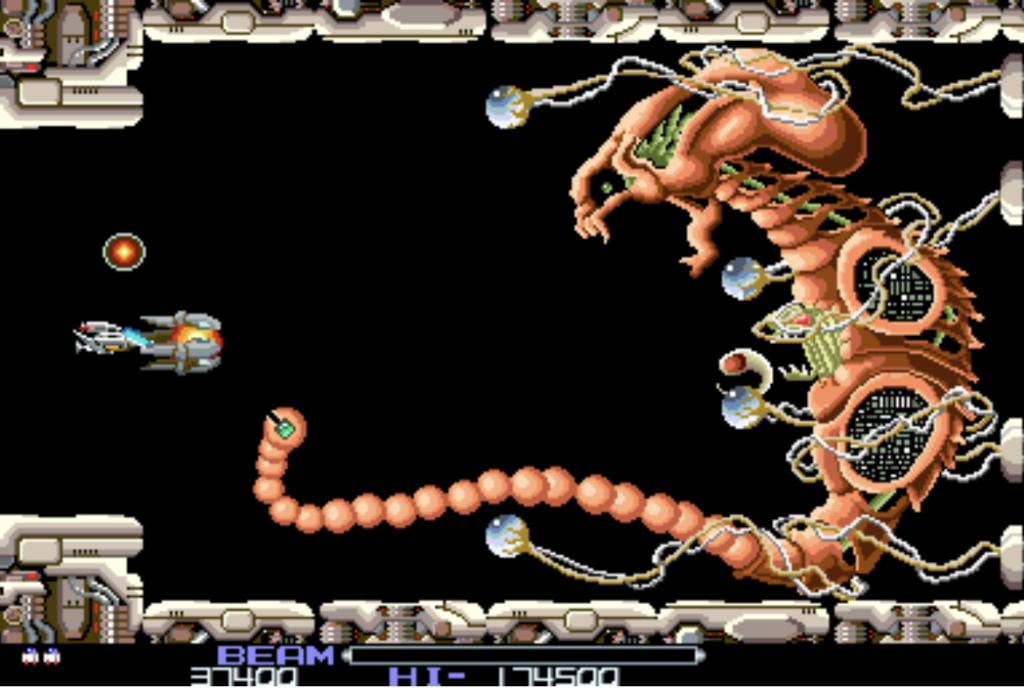
// Original: R-Type 1987 Arcade
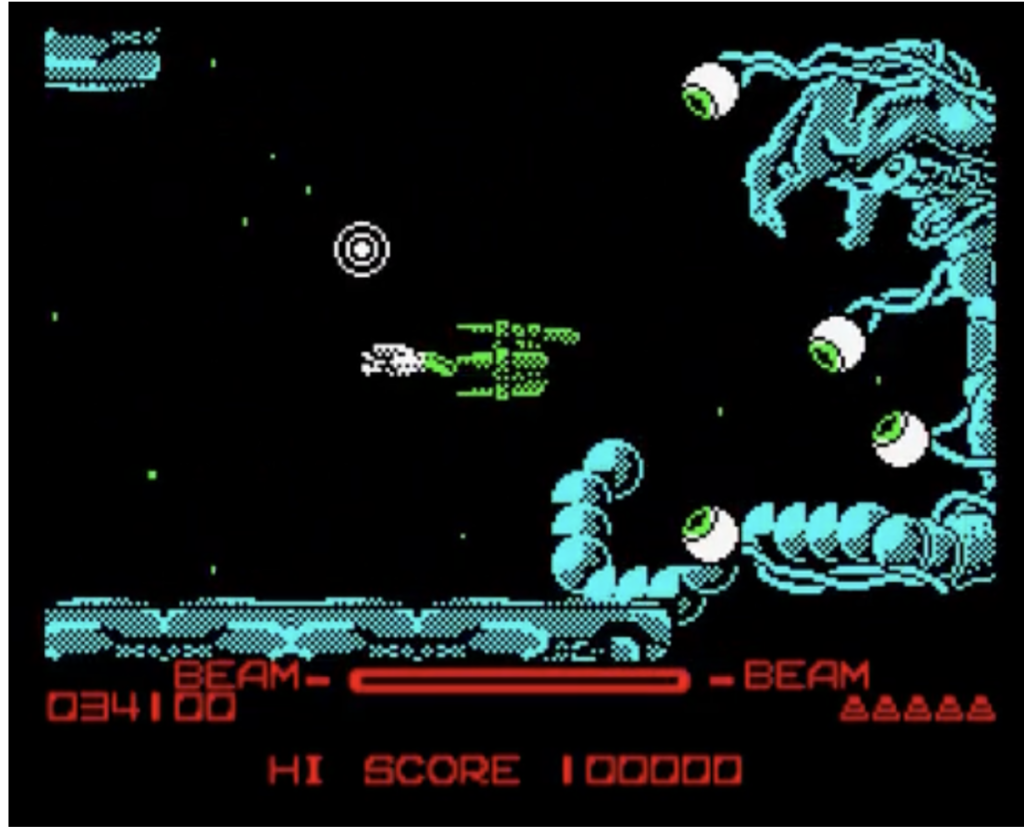
// 8Bit-CPC Version: Much less colors and the opposite of a smooth scrolling. Picture from https://www.youtube.com/watch?v=KpppLAPwMHc
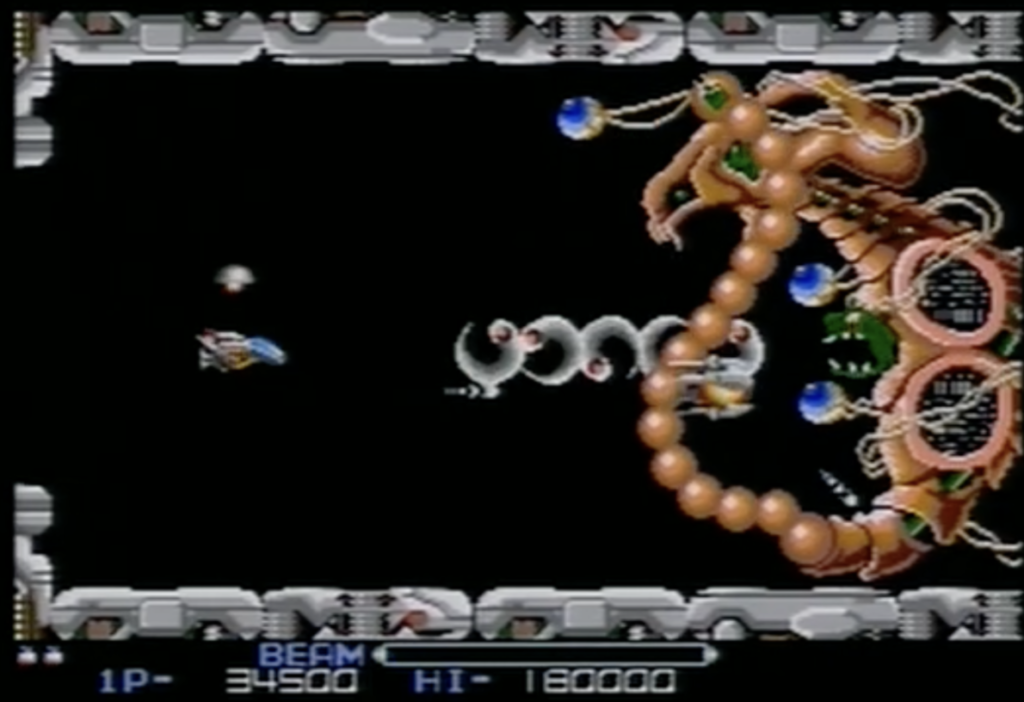
// 16Bit-Amiga-Version: Near to the arcade version. The sound is total digital even better than the original arcade version. Picture: https://www.youtube.com/watch?v=GNA97XnWya4
The main goal seems usually to preserve the game mechanics and capture the visual style as well as possible. And if the platform is better, then more of that platform’s features need to be included, such as digital music on the Amiga.
Linel ported Eliminator 1988 from Atari ST to Amiga. C. Haller tells about this port:
“But they [Hewson] were very unhappy with it, since it was a direct port, which wasn’t what they wanted. They wanted an Amiga version, but that’s how it ended up. We then spiced it up a bit with an Amiga intro—we just added an intro at the beginning, in the Amiga style, with sound effects, music, and so on. […] Well, that was one of the Amiga’s biggest strengths—it could produce much more amazing sounds.” Original German (Interview: L. Wild & D. Krummenacher with Christian Haller. 02:19:13 XYZ)
Nevertheless, there are many games that became even more popular and “cult classics” thanks to their adaptations, such as Bubble Bobble (1986) or Gauntlet II (1986). With “endless coins,” these games were even more fun to play at home with friends and their nearly 100 levels, and they could be enjoyed anywhere. It’s also no surprise that a „copy“ of the game gauntlet comes from Switzerland as well: Garrison Amiga 1988 CH.
In this regard, the game adaptations were closer in feel to arcade games than to console games, because they could be played on a table using a real joystick like the Competition Pro. Or they had found a worthy substitute for the rotary controls and trackballs found in arcades, such as the mouse controls in Marble Madness (1984) and the Breakout and Arkanoid ports.
If you wanna look more into this: Clusteranalyse:
Breakout/Arkanoid-likes im CHLudens-Korpus und seine gesellschaftspolitische Bedeutung (Translation: Breakout/Arkanoid-style games in the CHLudens corpus and their sociopolitical significance – https://research.swissdigitization.ch/?p=4431 )
Home Computers specific genres
D. Dini (Kick Off): “There was a motivation to make technology work, and then there was also this idea of creating something special that people hadn’t seen before. […] you could take control of something that your parents didn’t have any clue about. […] superhero on a certain level,[…] we were using the most cutting-edge technology that had ever existed on the planet and making stuff work with it. it turns out that making games is actually very cutting-edge, and it has pushed forward the boundaries of computing.”
Britsoft – An oral history. Wiltshire, Alex. 2022. Page 36
However, many games went far beyond minor adaptations and brought about lasting changes to the arcade classics. Many of them can be considered standalone games, as they no longer seem easily conceivable in an arcade setting—whether in terms of graphics (visual expectations), setting (global use), or gameplay mechanics (such as game length).
Genre: Arcade/Console “Inspirations”
The adaptation of game mechanics into home computer games was widespread. Some Swiss key figures, such as Roman Werner(TrapsNTreasures in Switzerland, even went to arcades and filmed games with video cameras so they could analyze them later and use that knowledge in their game design. This he told in one of our first meetings.
Anyone who wanted to make more than just a copy of an arcade game (which was prohibited by copyright law) was essentially forced to make other changes as well—or the developers simply wanted to create something of their own or something new.
Some games remained close to their originals, such as Insanity Fight (Amiga, 1987, CH) (based on Space*) or War Heli (Atari ST, 1987, CH) (based on Tiger Heli*, 1985, JP). That said, War Heli also had a specific adaptation: it could be controlled with the mouse!
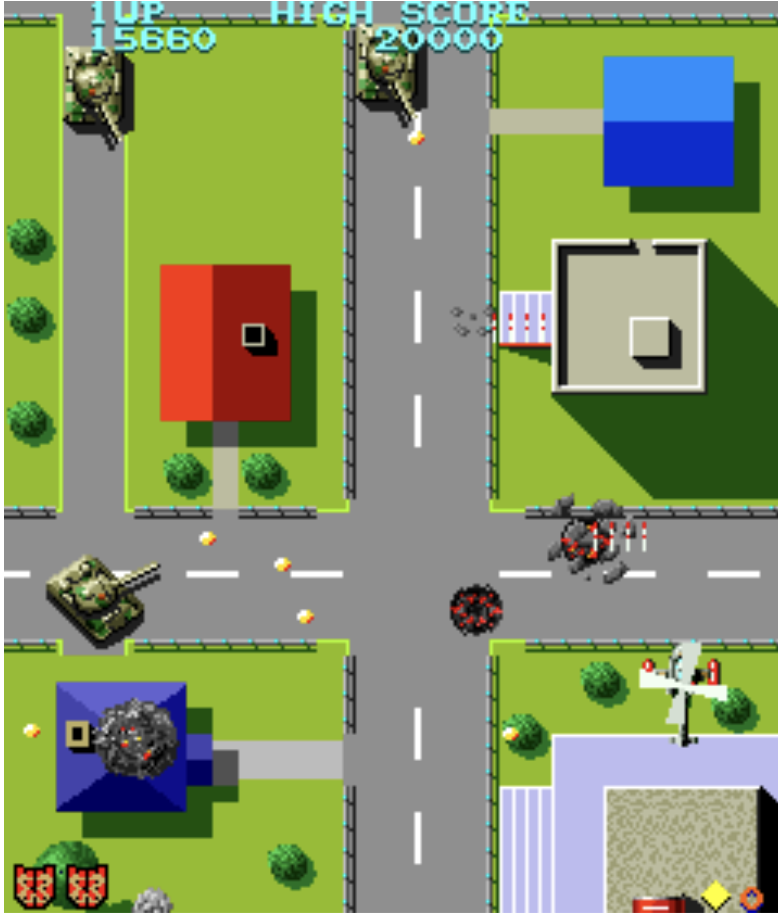
// Tiger-Heli 1985 Arcade. Classic shoot em up. Fullscreen 2:3 Shooter.
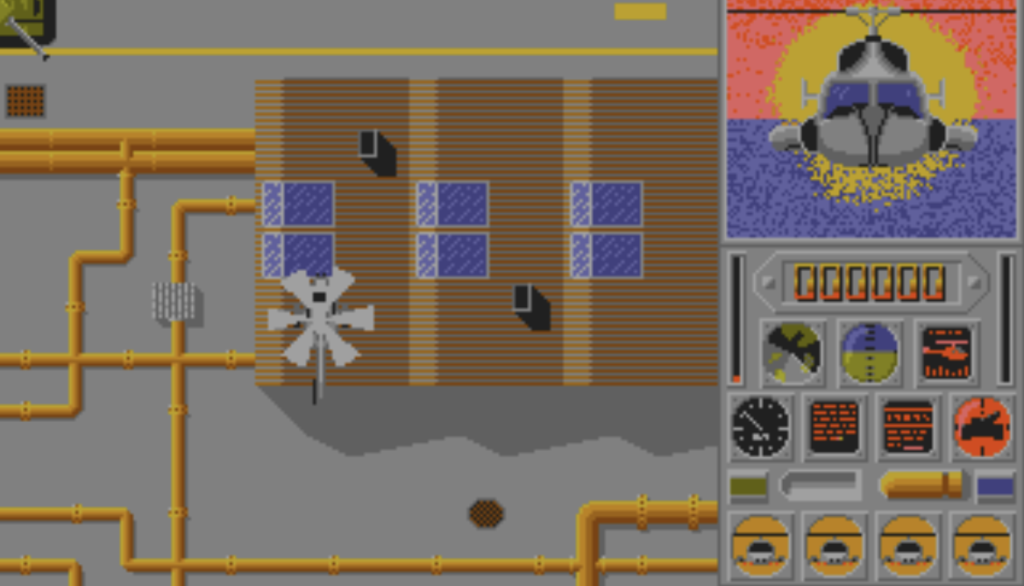
// War Heli: Not fullscreen but horizontal (3:2) – much bigger Sprites Picture: https://www.atarilegend.com/games/war-heli
Very often, the setting was simply changed. But even this contributed significantly to the game design scene. A particularly successful example is Great Giana Sisters (1987) – you could call it also satire. It was somehow a gamemechanic clone of Super Mario but something total different. The claim on the box: “THE BROTHERS ARE HISTORY”. For the first time, the main character isn’t a male Super Mario-style avatar, but a teenage girl who transforms into a punk rocker rather than simply growing taller. Even on the box is And this came just one year after Metroid was released—a game considered to feature the “first” (not recognizable till the end scene) female heroine, though her attire varies depending on how the game progresses.
Nintendo put pressure on them and—as far as I know—threatened the distributors that they would no longer receive any games if they distributed Giana Sisters*.
Thomas Hertzler (Rainbow Arts later CoFounder Blue Byte Softfounder): “I don’t think anybody expected Nintendo’s response. From top to bottom, we were pretty naive about copyrights and intellectual property. All the wanted to do was make games. It was a blow to the company, but the team recovered pretty quickly. […] I believe that Nintendo filed something equivalent to a cease and desist order, but I don’t think the case ever went to court.”
https://www.arcadeattack.co.uk/thomas-hertzler/
This illustrates both the precarious nature of „copies“ and the fact that the legal situation was uncertain; the case likely never went to court.
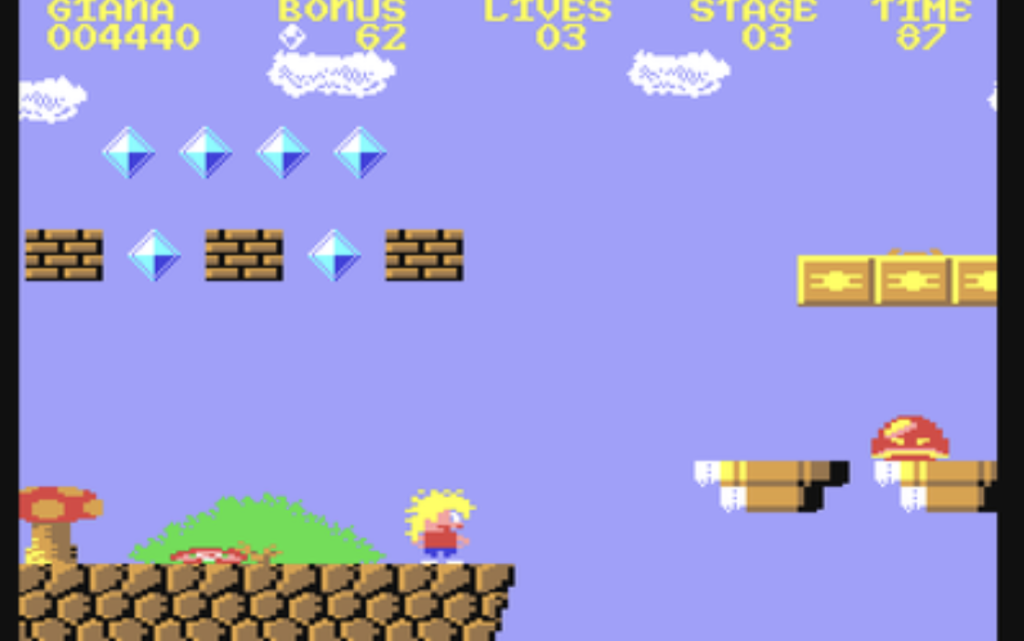
// Great Giana Sisters 1987 D – A gamemechanic clone of Super Mario at first sight but the setting changed everything. The heroine can change from girl to punk by eating fire wheel!
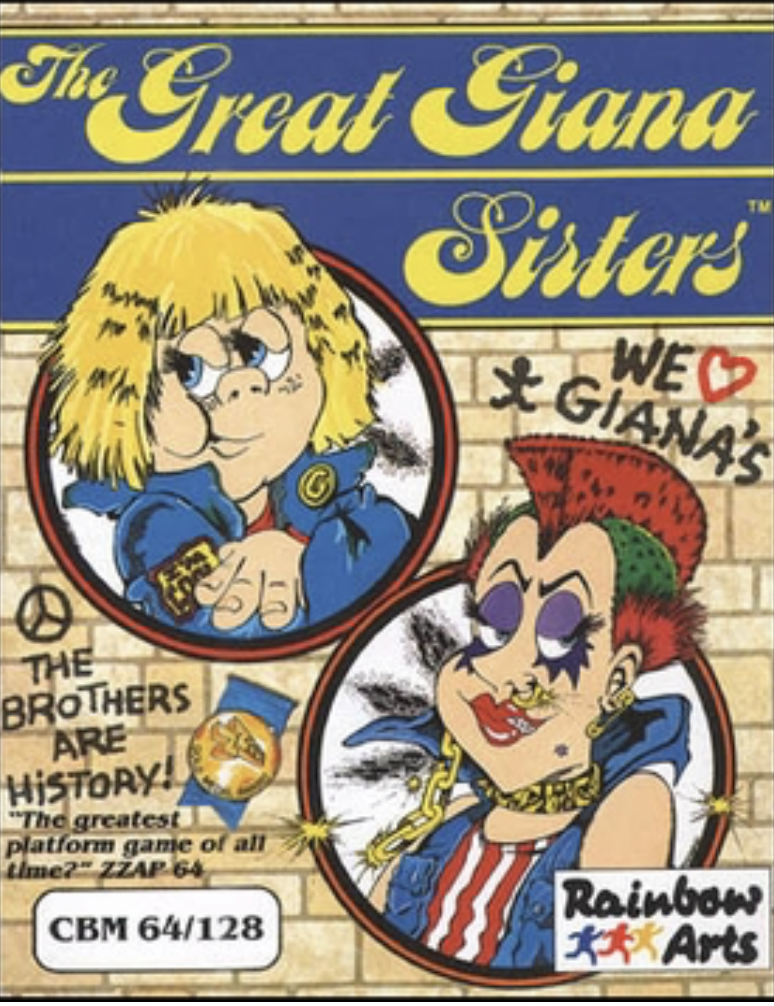
// The Great giana Sisters and its claim against the Mario Brothers: “THE BROTHERS ARE HISTORY”. Nintendo threatened to stop distributing any games to anyone, who sold this game. As a result, the game was pulled from stores. Picture: https://en.wikipedia.org/wiki/The_Great_Giana_Sisters
However, many elements were also modified and adapted in the process. For example, in their Arkanoid variants BallRaider 1987 CH and Crack 1988 CH*, Swiss game designers replaced the tile-based background with their own graphics that players had to uncover. This created a small additional game mechanic.
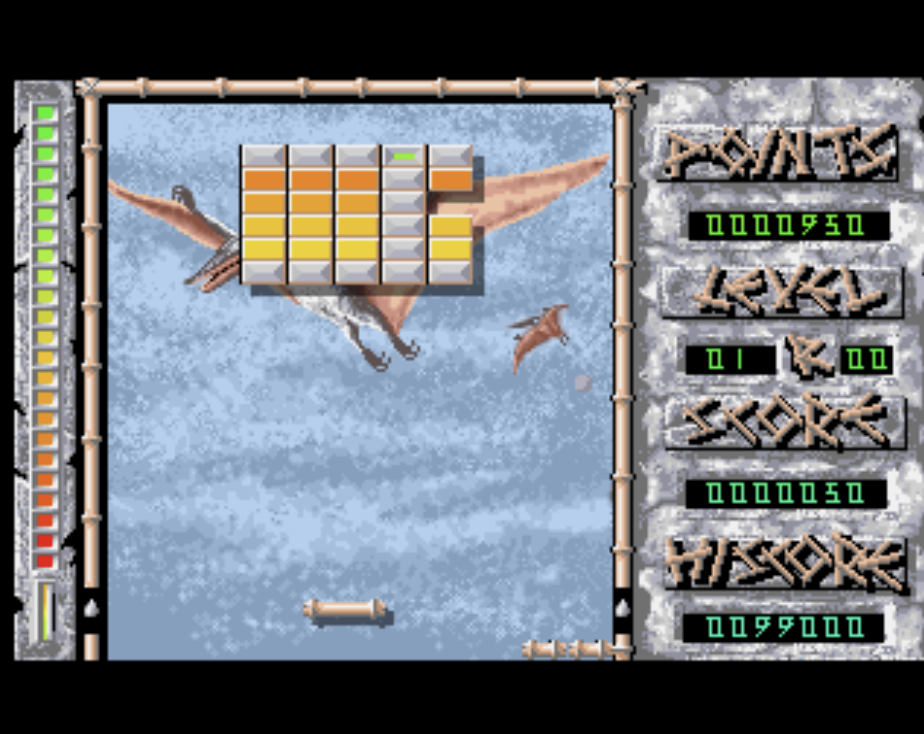
// Crack 1988 with a new addon mechanic. Destroy the stones to see the whole image. Quite similar to later ‘erotic’ arcades. [Chapter4] Picture: https://www.lemonamiga.com/game/crack
Genre: Shoot ‚em ups
“It felt weird to be famous, actually, but it was nice that people liked the games enough to want to come up and shake your hand for having made them. I think making a game back then, especially for me, was a very personal thing. When people liked it, it was almost like they probably had the same sense of humour. People who like the same kind of music often like the same kind of bands, so I think it’s the same kind of thing. Somebody likes a Llamasoft game, they’ll probably like Red Dwarf and Monty Python, Pink Floyd, the same kind of stuff that I like.”
J. Minter UK (LLamatron) in Britsoft – An oral history. Wiltshire, Alex. 2022. Page 183
Modern shoot-‚em-ups underwent a truly rapid evolution when they were adapted for home computers. On the one hand, new settings became possible—as seen, for example, in games like Goldrunner (1988), Return to Genesis (1988), and Xenon 2 (1989), with their journeys through modern history—and on the other hand, the genre is, of course, open to any style, any setting, and any combination thereof.
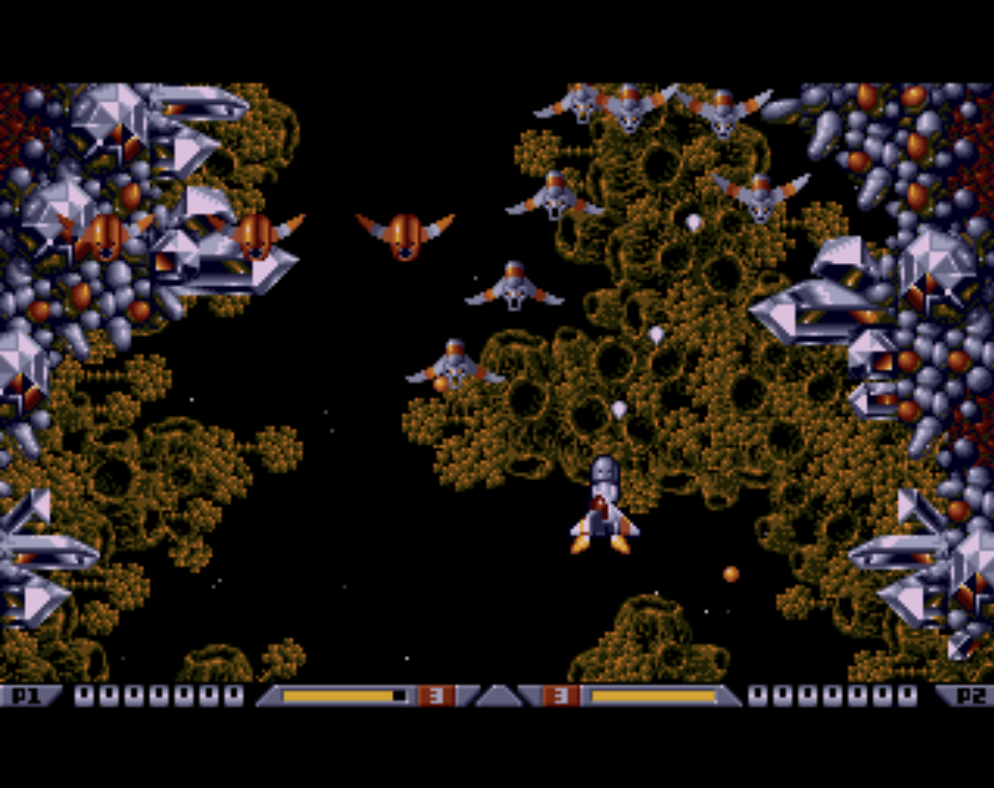
// Xenon 2 1989 Amiga. An own art style all in tilebased graphics. Picture: https://www.lemonamiga.com/game/xenon-2-megablast
A kind of postmodern genre. It’s also good for developers because it’s relatively detached from story, can be streamlined or expanded in equal measure, and features familiar game mechanics. A radical example of this is certainly Jeff Minter’s Llamatron (Atari ST, 1991, UK). It mixes everything from Coke bottles to junk food, crossing one or two of today’s cultural red lines in the process.
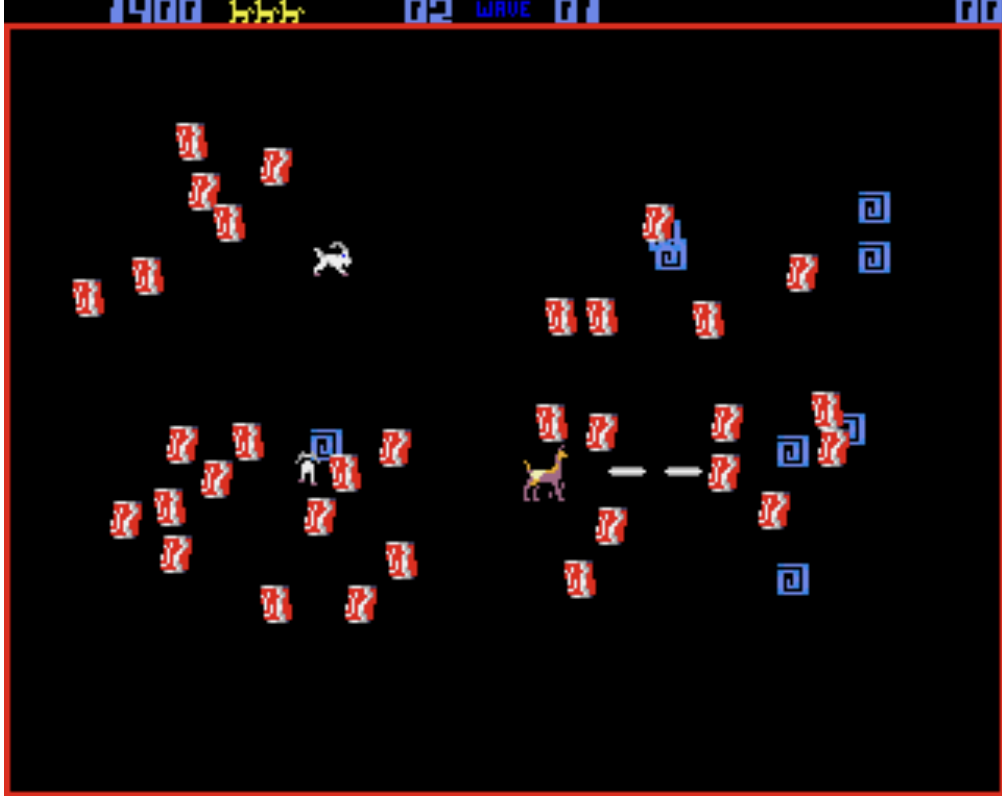
// LLamatron the pure mix of all different influences from camels, labyrinths, billy goats to cola. Postmoderne pure. Picture: https://en.wikipedia.org/wiki/Llamatron
Time Bandit (TRS-80, 1983), on the other hand, takes a less dramatic journey through time and the world of computer games.
Another feature of Xenon 2 was that the game had a shop. Players collected transparent bubbles—which acted as a kind of currency—and could then spend them in the shop. This made the game much more strategic than very linear games like R-Type. Necronom CH for Amiga (1991) introduced the ability—much like in a role-playing game—to upgrade your spaceship using action points, allowing you to choose your own path through the levels. So it was multilinear! And it featured graphics inspired by Giger’s design methods, reminiscent of Mukokuseki.
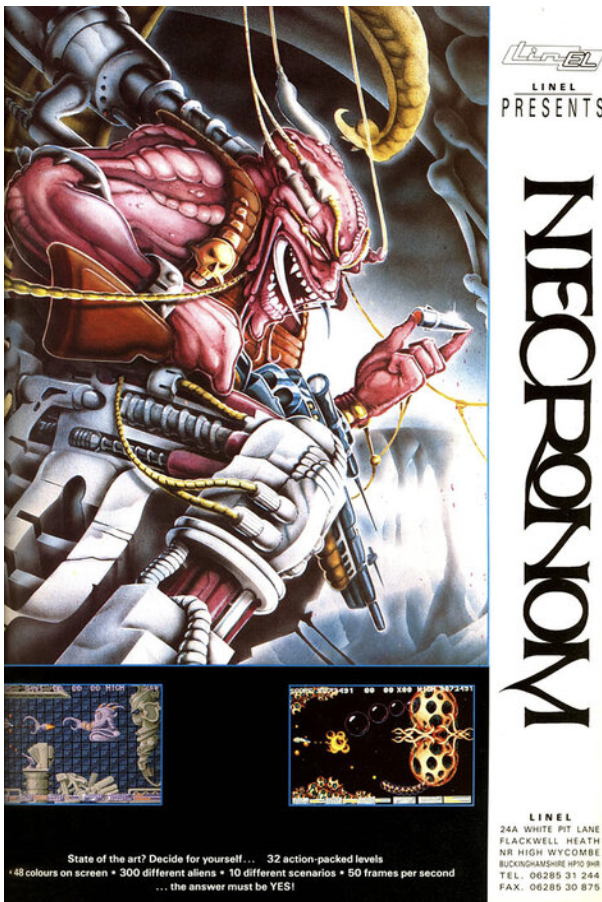
// Necronom 1991 Box . The influence of the swiss industrial designer and artist can be seen from eggs (ingame screen) to the machine-biotech cyberborg . Picture: https://en.wikipedia.org/wiki/Necronom#/media/File:Necronom_game_cover.png

More about this you will find here: Necronom (CH), Linel, Amiga, 1991. Ein multilineares ShootEmUp-Rollenspiel mit HRGiger’s Designmethode
Many home computer games also drew on a variety of influences and refined them into a genre all their own. Games like Turrican 1990 D are worth mentioning here. This game was inspired by the arcade game OSCAR (according to Hülsbeck in a personal conversation at PopCorn in Zurich). M. Trenz one of the creator said about Turrican
I wanted to do a new game, but it should not be a shooter again. And an arcade game gave me the inspiration. This arcade called „Oscar“ had a heavily armoured hero jumping around, transforming himself into a spikey wheel and throwing lots of weapons. At this time, nothing with this style was available for C64 and so Turrican was born!
Again, the name was taken from the telephone book (Italian, Turricano). Everything in this game I did by myself. (https://www.atlantis-prophecy.org/recollection/?load=interviews&id_interview=105)
The final product, however, is something entirely its own, something new. This applies even to the music by Hülsbeck D and Co. The music didn’t come from the arcade scene either, but from the home computer music scene.
Some of these games were actually ported to consoles like Nintendo, such as Super Turrican for the SNES in 1993, toward the end of the home computer era.
It was the 16-bit computers and their 3 1/2-inch floppy disks that made it possible to save and reload games. This made it possible to create longer and more challenging games, especially in the shoot-’em-up genre. Examples from Switzerland include War Heli (1987), Illyad (1989, Amiga) , and Necronom (1991). It was likely the boot-sector viruses on home computers that put a stop to this trend. It was simply too dangerous if the virus overwrote the boot sector.
Genre: Platformers
There aren’t actually that many pure platformers among arcade games. Even the earliest ones, like Donkey Kong from 1981, were combined with a second action, such as hitting enemies. Later games were no different. Nevertheless, this genre continued to evolve on handhelds, consoles (*Super Mario*), and home computers. Games such as Miner 2049er (Atari 400, 1982), Montezuma’s Revenge (Atari 400, US, 1984), Bruce Lee (Atari 400, 1984), Monty on the Run (UK, C64, 1985), and Nebulus (Amiga, 1987) were released.
Most of them were more than just simple platformers. Bruce Lee 1984 C64 even had an asymmetrical game mode.
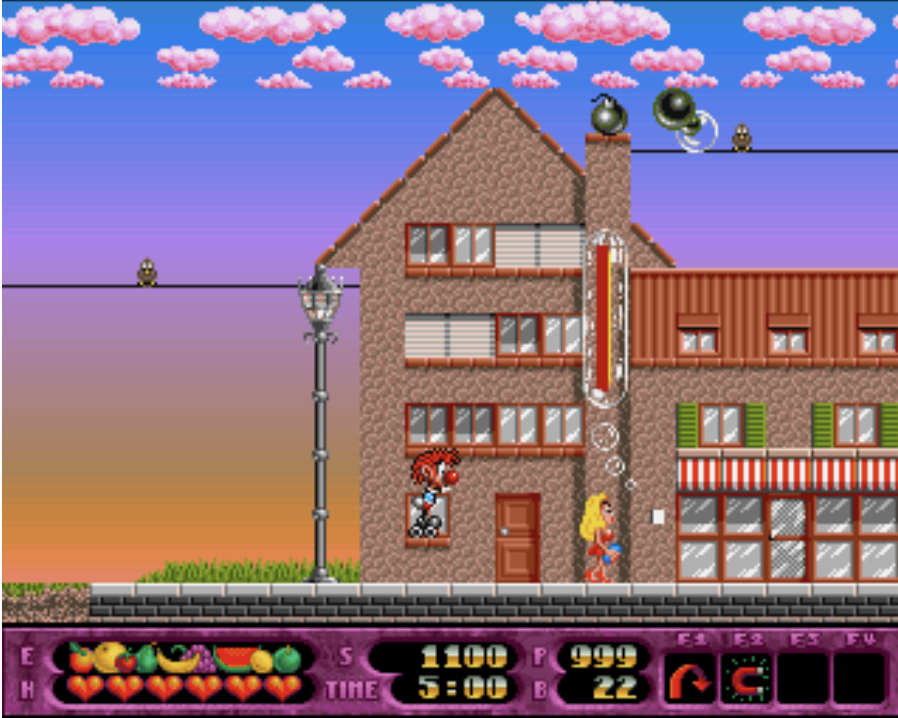
// Rolling Ronnie Amiga 1991 CH. JumpAndRun constructed with tiles and some color radiant as background. Picture: https://www.lemonamiga.com/game/rolling-ronny
Among the Swiss titles featured here are Rolling Ronnie Amiga 1991 CH and Clown-o-mania 1990 CH . The best known of these is undoubtedly TrapsNTreasures 1993 CH . Like many home computer games, this one also expands the genre. It involves jumping, fighting, finding keys to unlock doors, rescuing fellow pirates, visiting shops, and exploring vast, interconnected worlds—and thus leans toward the adventure genre. It, too, follows the trend toward more complex game mechanics.
Genre: Sports Games
Sports games have been around since the very beginning of video game console development, whether it was Tennis for Two (1957), Pong (1972), or the Telegames with their various “sports.” This is where mainstream television transitions into gaming. The home computer scene also drives innovation and creates new concepts. That’s how BallBlazer*, a futuristic ball game, came into being in 1984.
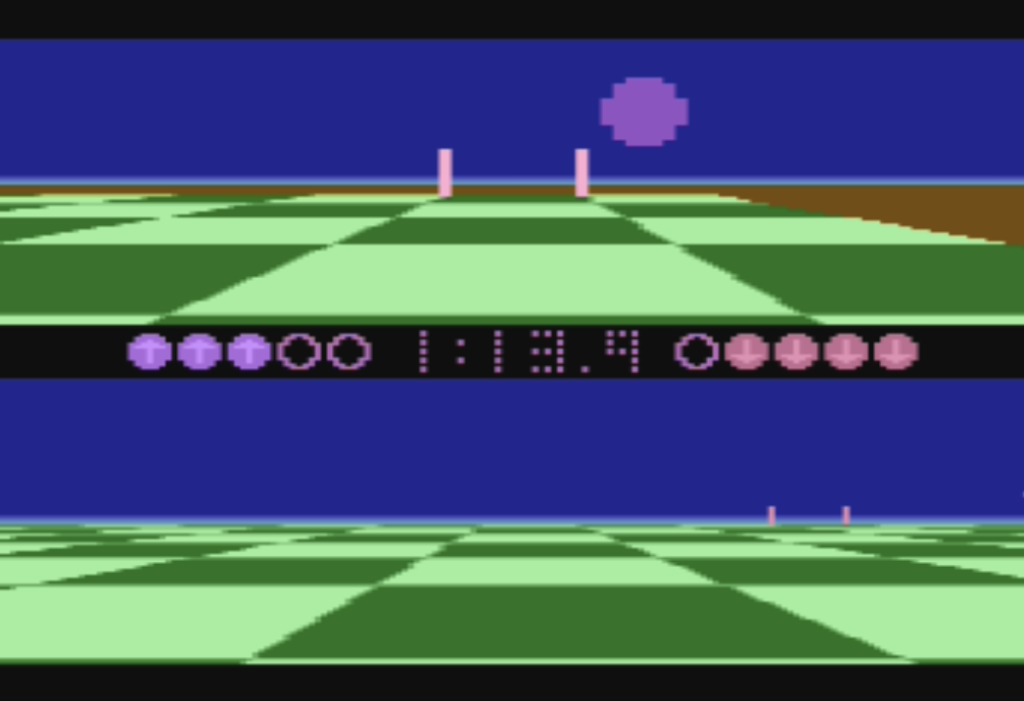
// BallBlazer (LucasFilm) – futuristic Football. Atari XL Version. Picture: https://en.wikipedia.org/wiki/Ballblazer
Digital versions of sports games began to appear, such as Summer Games 1984 for the C64, Winter Games 1985 for the C64, and then California Games for the Apple II and C64 in 1987. Through these games, the trends of the time in California were spread to the rest of the world.
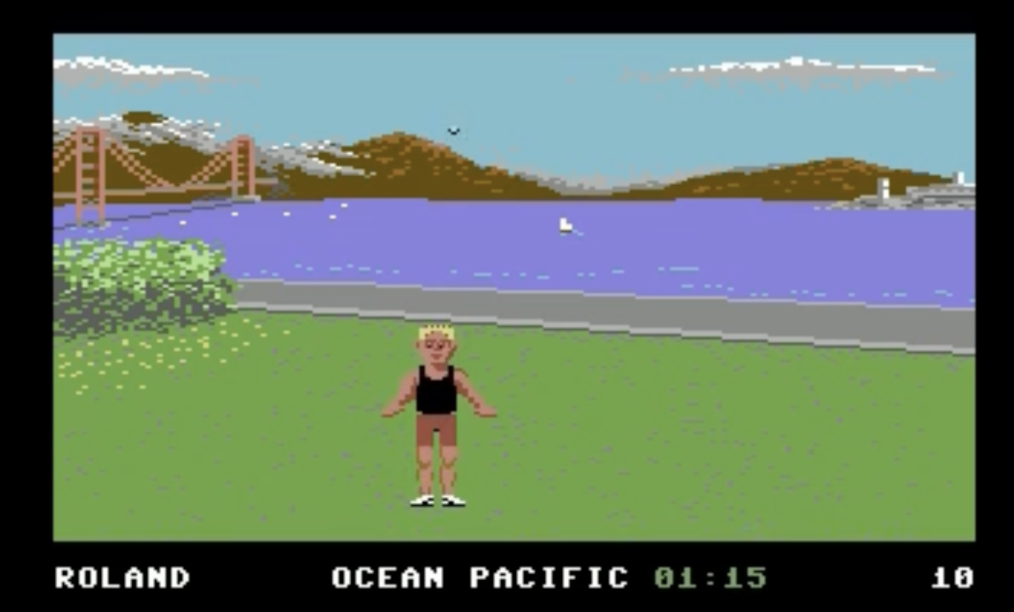
// California Games: Hack Sacky. C64 1987. Picture: https://www.youtube.com/watch?v=KxIbP__QXeg
This made the game more popular than, say, “Hacky Sack” (Footbag). That trend didn’t reach Europe until years later. Morally and ethically, many barriers were also broken down, for example with Speedball in 1988. Fouls and bribery were allowed here.
The Swiss scene produced games such as The Champ (Amiga, 1989 CH) , Over the Net (Amiga, 1990), Top Wrestling (Amiga, 1992 CH), Skate of the Art (Amiga, 1989 CH), and Sport & Worldwide Hunting (Amiga, 1991 CH).
Genre: Puzzle and Action-Puzzle Games
Games that required players to think on their own weren’t exactly ideal for arcades (where revenue is generated by having many players), so there are no pure puzzle games for arcades (as far as we know). These can, of course, be found in the BASIC 101 book. On home computers, on the other hand, there are pure puzzle games—that is, games without time pressure, such as Archon (1983), Battle Chess for Amiga (1988), Minesweeper (1989), or Solitaire for Windows (1990).
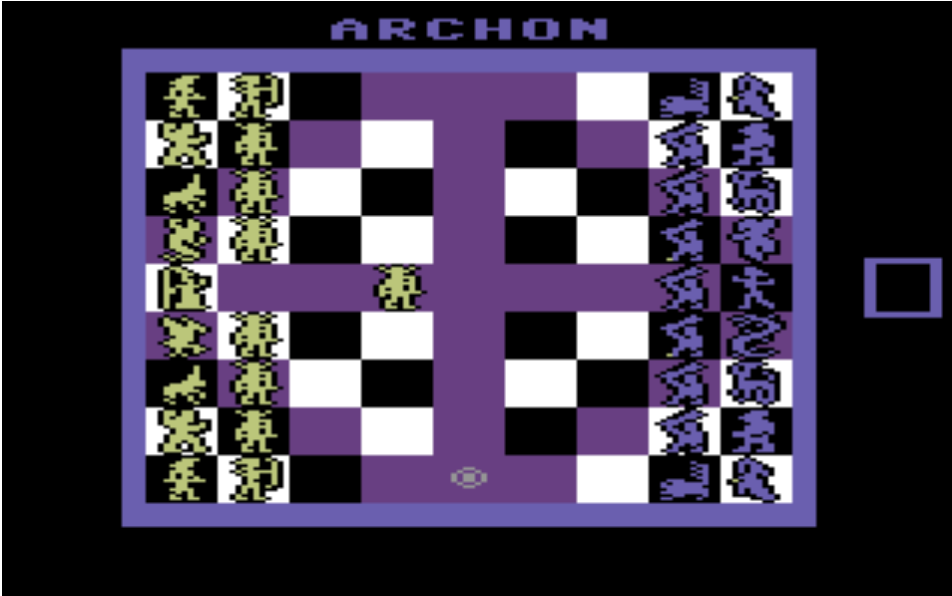
// ARCHON: The light and the dark C64 1983: A chess like game but the battles are real battles open-ended. Picture: https://en.wikipedia.org/wiki/Archon:_The_Light_and_the_Dark
Action-packed games, on the other hand, are available on almost all platforms. Action-puzzle-arcade games range from Puzznic (1989; moving platforms) and Salomon’s Key (1986) to Puzzle Bobble (1994).
Action puzzle computer games have been available on home computers since the days of games like Tetris, Rockford 1984/Emerald Mine, Deflektor 1987, and Atomix Amiga 1990 D.
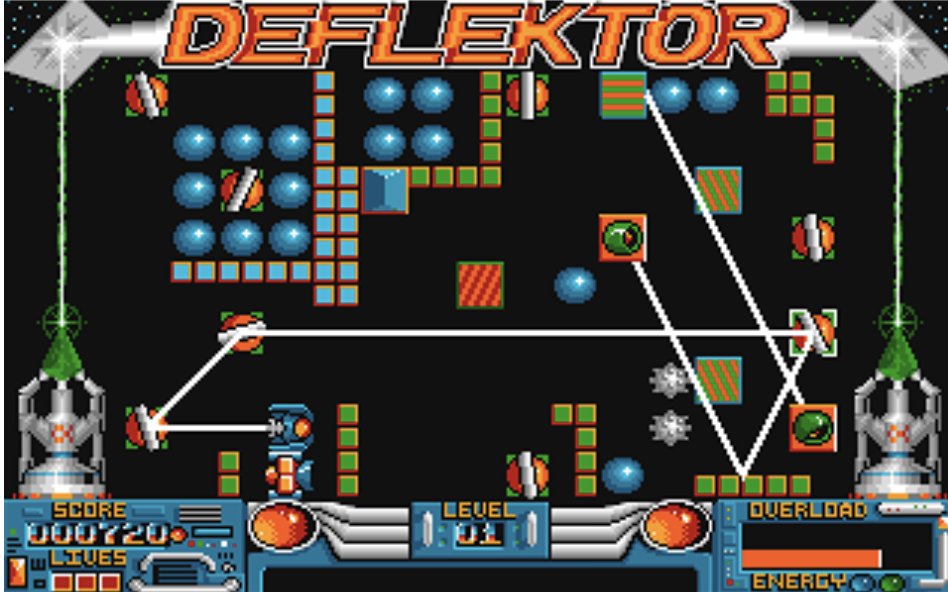
// Deflektor 1987 Amiga. Picture: https://en.wikipedia.org/wiki/Deflektor
Boulder Dash 1984 ist das erste Homecomputerspiel, das auch als Arcade herauskam. Supaplex CH ist dabei eine Weiterentwicklung von Boulder Dash und verfügt auch über mehr Spielmechanik und fast unendlich viele Levels.
In addition, there are also games like Wizball C64 (1987) that skillfully blend skill-based gameplay (mostly action) with puzzle elements.
Later on, several games were released in which the puzzles had to be solved by switching between the avatars of multiple characters in the game, such as Head Over Heels (1987), Maniac Mansion (1987, US), Gobliiins (1991, France), and Lost Vikings (1993, US).
Genre: Graphic Text Adventures
Text adventures became really popular again during the home computer era, thanks to (mini-)computer games like ZORK 1977 (https://en.wikipedia.org/wiki/Zork). This was because they could now be enhanced with high-resolution text and images. As a result, they shed the stuffy image of a text-only product. The images framed the text and, in doing so, helped expand and guide the imagination. For example, ROBOX 1986 CH was developed on the C64.
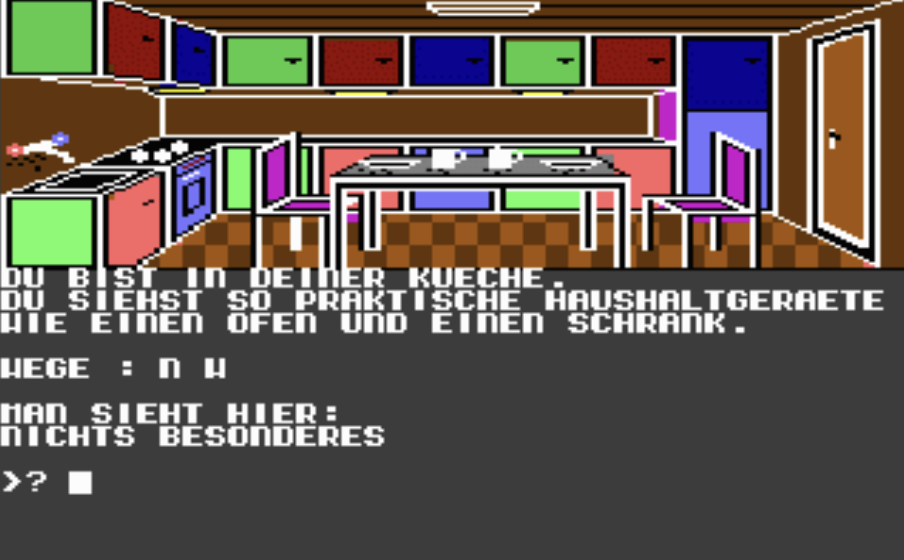
// Robox 1986 a graphic text-adventure. Picture: https://www.c64-wiki.de/wiki/Robox
With much higher resolutions and a wider range of color options, games such as Guild of Thieves for the Atari ST (1987, UK) and Ooze (1988), which had a Swiss Amiga port, were developed.
Often, the resolution was switched here as well, so that the text ran in a higher mode than the image. And the images were often enhanced even further by using a different color palette on each scanline. In that respect, these games are screen-mode hybrids, similar to those typically found on the C64.
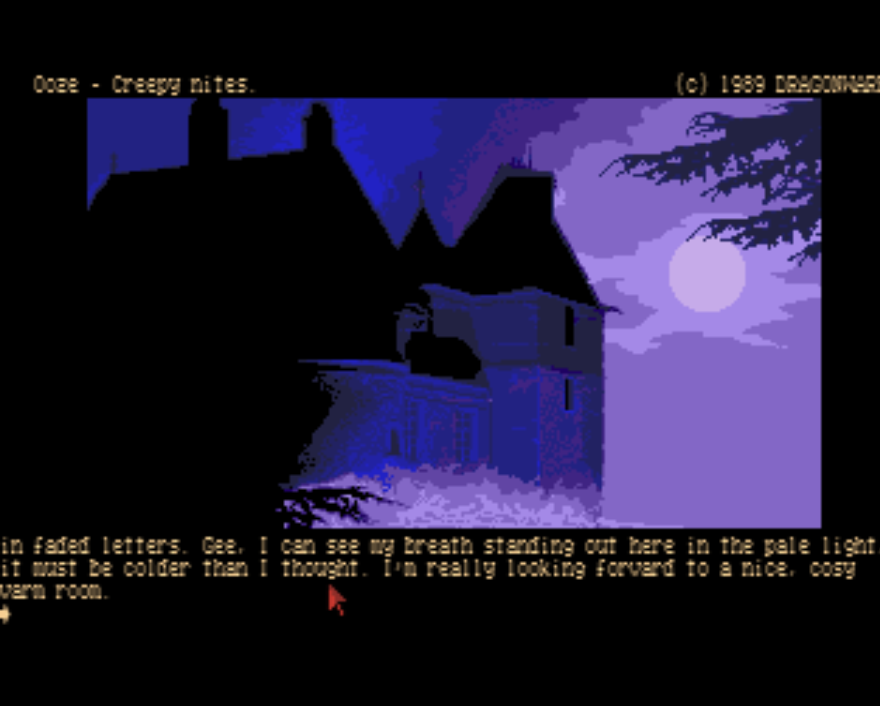
// Ooze Amiga 1988 Graphical text adventure. The images also spark the imagination, and vice versa. Picture: https://www.lemonamiga.com/game/ooze-creepy-nights
Genre: Movie-like Adventures
Many games have probably always wanted to be „movie-like,“ because back then, games were the little brother of big-screen movies and were merely tolerated as a break from TV, played on the TV with a console. Conversely, on computers, games served as a break from work on (office or home) computers in the afternoon, early evening, and at night.
Nevertheless, most games (arcade games in particular) for consoles and computers had game-specific interfaces (GUIs). These allowed players to quickly see their progress, which often made them feel even more like a “game” visually. Of course, there were exceptions, especially in the adventure genre, such as the Atari 2600 game Adventure 1980*. (https://en.wikipedia.org/wiki/Adventure_(1980_video_game) ). However, other film-like elements were missing, such as cuts, different camera angles, zooms, and text.
It also lacked a GUI, and the avatar was relatively large. However, other film-like elements were missing, such as cuts, different camera angles, zooms, and text. You can also find a film-like style with game frames in games like King’s Quest 1 (1984). Here, too, the character takes center stage. Maniac Mansion (1987) makes the characters even larger and places them front and center. Players can also switch between different characters, creating a sort of multi-perspective experience. Mehr zur Avatargrösse hier: Dimensionen: Point&Click-Adventure – Riesensprites [In Arbeit] Aber klar ist sowohl Kings Quest wie auch Maniac Mansion verwenden sehr viel Text und so wird man aus dem „Film“-Feeling dann doch visuell rausgeworfen (Filmimmersion).
The new capabilities of 16-bit computers also made new 2D display formats possible, such as vector graphics and polygon graphics. Games began to adopt a more cinematic style to create a more immersive experience. One example is Another World (1991) for the Atari ST and Amiga F.
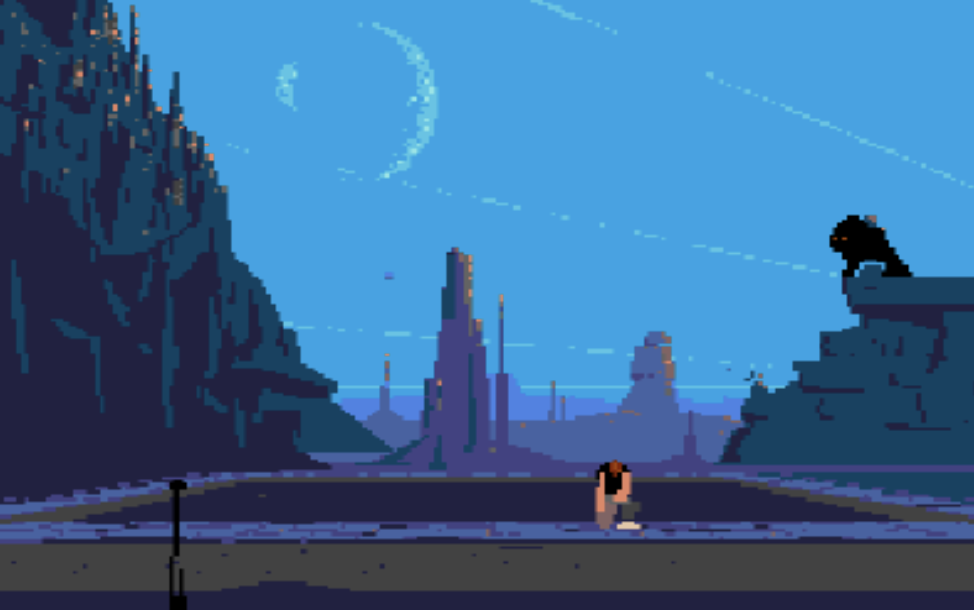
// Another World 1991 F – a film like game with even close-ups. Picture: https://en.wikipedia.org/wiki/Another_World_(video_game)
It was an action-adventure game, had no GUI whatsoever, relied on vector graphics, and featured cutscenes and close-ups. It played like a movie.
Yet the individual players are probably not aware of the full extent of the game designers‘ influence. E. Chahi (Another World) at least in visuals:
Mainly science fiction or fantasy art. Illustrator, like Michael Whelan, Frazetta, Chris Foss. Comics from Richard Corben like Den, I really love the raw force of his universe. The polish painter Beksinski had a strong impact on me too. Flemish painter like Vermeer or Rembrandt. […] I have been strongly influenced by movies, but it was more about some elements like laser guns in Star Wars, or in Akira Toryama’s Dragon Ball manga, the kamehameha energy ball and the fast motion suggested by thin lines. At the time, I was also influenced by reading Dune and Hyperion. But for the plot I don’t see a specific influence, except maybe the lion creature in Den 2 from Richard Corben, and also some life experience.(https://cheesetalks.net/ericchahi.php)
Other cinematic games included the earlier Prince of Persia for the Apple II (1989) (which always used the same perspective) and Flashback for the Amiga (1992), the sequel to Another World*. In 1994, there was even a Sega port of Another World titled Heart of the Alien*. Prince of Persia was acquired by Ubisoft and later became a 3D console game.
Another game definitely worth mentioning is Full Throttle (1994)—one of the last LucasArts adventures. (https://en.wikipedia.org/wiki/Full_Throttle_(1995_video_game))
Genre: Adventure Games and Point-and-Click Adventure Games
The fusion of (text) adventure games and interactive graphics gave rise to a number of unique titles. In some of these games, players could directly control the heroes as avatars using a joystick or keyboard, as was the case with the first King’s Quest games and similar titles on the IBM PCjr in the U.S. in 1984.
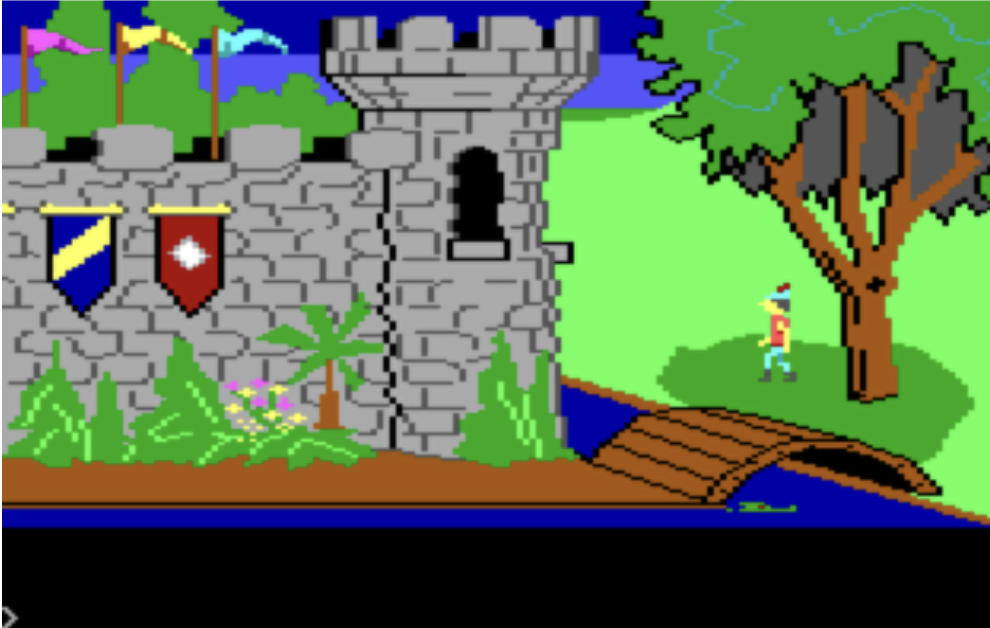
// King’s Quest 1984 control with keys or joystick. Picture: https://en.wikipedia.org/wiki/King%27s_Quest_I
The introduction of the mouse brought about significant changes, as the input method was no longer the keyboard but the mouse itself. One example from Switzerland is certainly the very locally inspired Züri Amiga 1993.
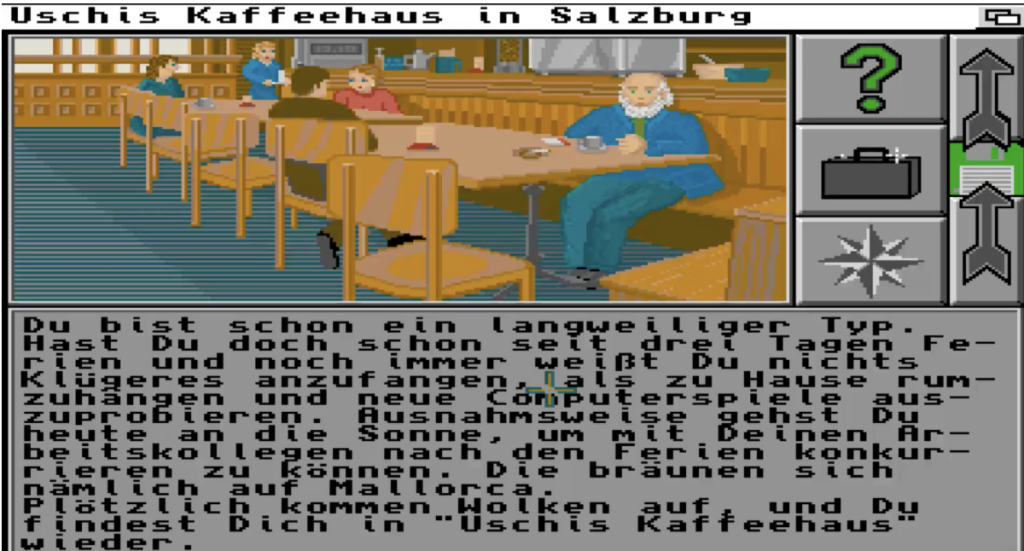
// Zueri is a game about Zurich. Picture: https://www.youtube.com/watch?v=od9WOALixqY&t=292s
The Short Gray 1993 CH follows more in the tradition of Lucasfilm’s point-and-click games, such as Maniac Mansion and Monkey Island*. Here, you essentially piece together voice commands using words, objects, and places. The interface has thus become a surface.
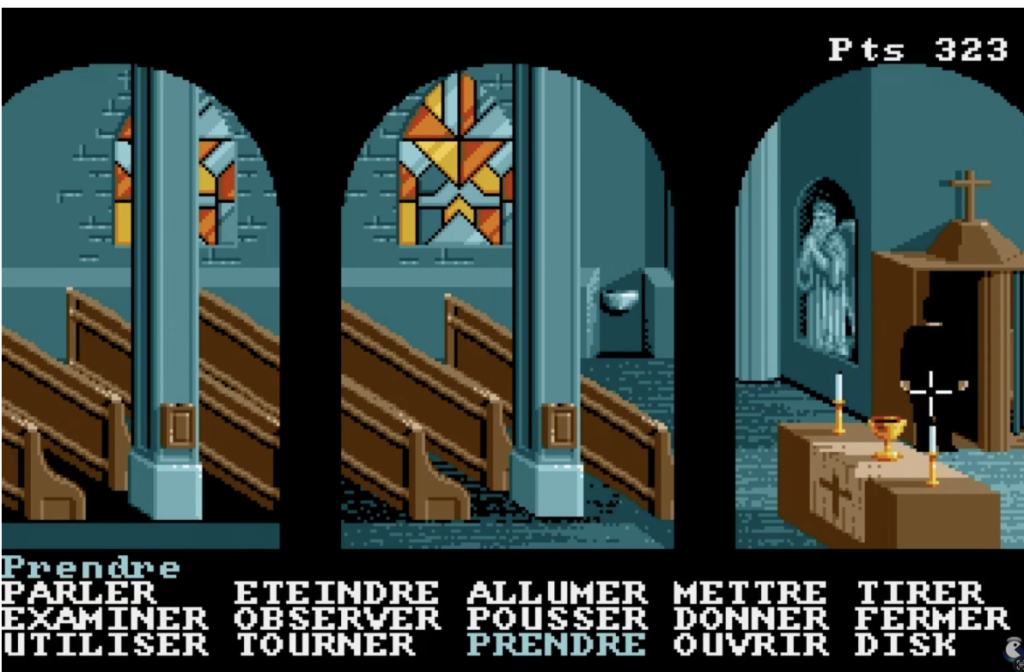
// The Short Gray a Lucasfilm-like Arcade. Picture: https://www.youtube.com/watch?v=1vDnAeD4c2w
Genre: Role-Playing Games – Dungeon Crawlers
The history of role-playing games is long, dating back to Dungeons & Dragons in 1974 and even earlier. For a very long time, role-playing games on consoles were kept simple or featured turn-based combat.
From Ultima I for the Apple II in 1981 through Ultima V*, these early games continued in the tradition of games like the PLATO games. They were mostly played from a top-down perspective and otherwise followed in the footsteps of games like D&D and Pedit*.
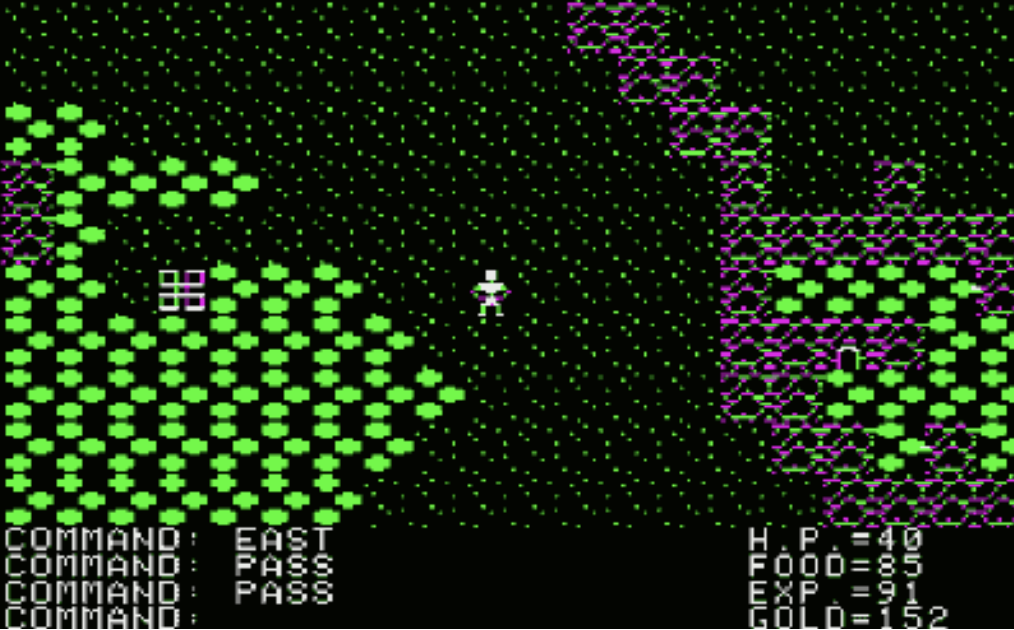
// Ultima I 1981 Walking on the ground. Picture: https://en.wikipedia.org/wiki/Ultima_I:_The_First_Age_of_Darkness
Games like Dungeon Master FTL 1987 US then took it a step further and turned it into a 3D experience with a first-person perspective and developed also the Cursor and Mouse at the same time controls further.
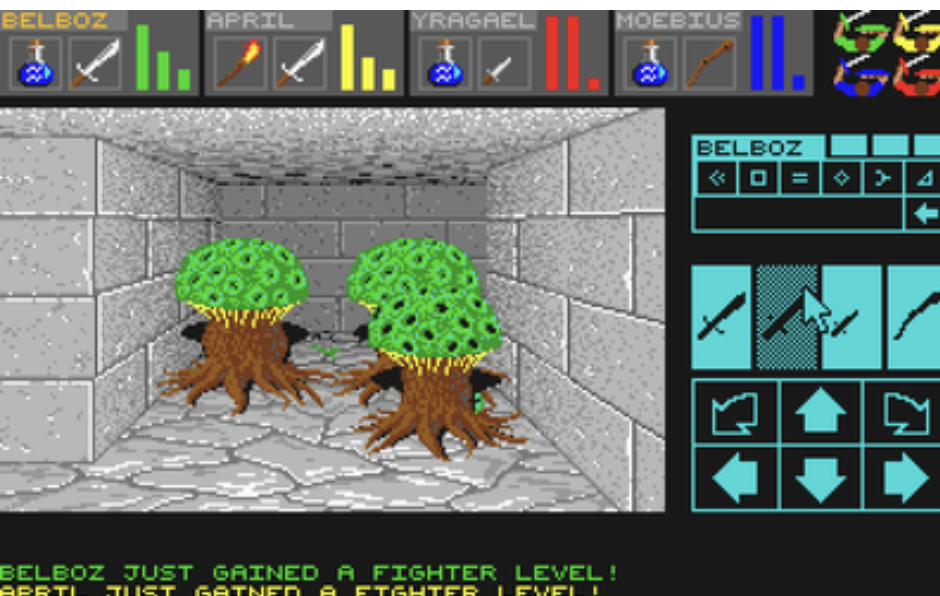
// Dungeon Master: Realtime Dungeon Crawler with 3D-Step Graphics. Picture: https://en.wikipedia.org/wiki/Dungeon_Master_(video_game)
It was now possible to walk through the corridors step-by-step in real time. The experience was completely different and new.
W. Holder (FTL, Dungeon Master): Doug has worked out ideas for keeping the entire simulation running in real time. At that point, most RPGs were adaptations of board games. We wanted the entire game to be a true simulation, and that’s what consumed so much of our time.” (https://www.amigalove.com/viewtopic.php?t=739)
The complexity of the characters—their traits—had reached an entirely new level, enabling a new kind of real-time immersion, including sleeping.
CH ventured into space with Antares 1989 Amiga CH.
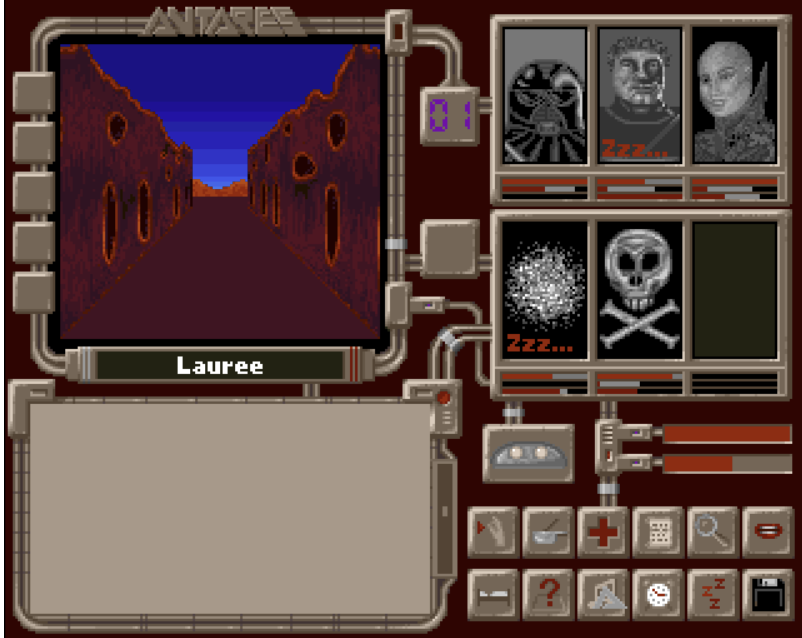
// Avantares and its “DungeonCrawler”.
In contrast, Doom (1993 US) in particular sought to distinguish itself as a pure action game.
Genre: Simulations
Simulations are an important area that was primarily handled by mainframe computers. Simulations are something computers were always meant to do. There were quite a few of them, for example on Plato Games as exercises for chemistry classes or even as a game for the advertising industry—“The Advertising Game” from 1975. In all of these games, a lot of calculations could be performed, and what was simulated could usually be calculated using models and numbers.
One area of simulation games is particularly interesting: artillery games. In the early days, these games had no visual display. The first well-known visual artillery game was undoubtedly Potshot BASIC with a Plotter (1969), which was developed as an educational game for physics from A. Luehrmann. (https://www.atariarchive.org/an-interview-with-arthur-luehrmann/)

// Picture: https://www.atariarchive.org/an-interview-with-arthur-luehrmann/
It was a kind of „hit-the-enemy“ game where you could set the angle and speed of a cannon. The whole thing was then simulated. Of course, the first version was set in space. This idea later gave rise to a series of games: Ballerburg for home computers, followed by Atari ST in 1987, Gorillas in 1990, and, a bit later, Worms in 1993. [https://www.gamelab.ch/?p=12019]. There were also console versions, such as Artillery Duel in 1981.
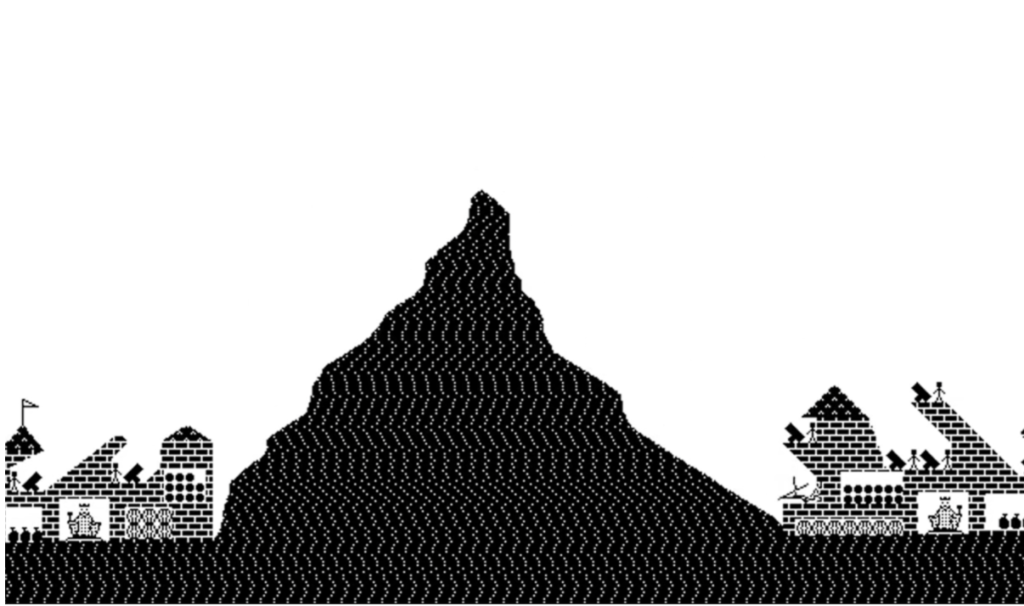
// Ballerburg Atari ST 1987. Destroy the enemy turn-based by shooting in his castle. The gamemechanic is pixel based! Picture: https://www.youtube.com/watch?v=Vx39xy4Zp8s&t=22s
Another popular type of (physics) simulation game is the „thrust“ game. They first appeared on electromechanical arcade machines, later in Luna Landar (Arcade, 1979), and then on home computers with Space Taxi (C64, 1984), Thrust (BBC Micro, 1986), and Oids (Atari ST, 1987); these games ultimately revolve around gravity simulation, often combined with rescuing objects or items.
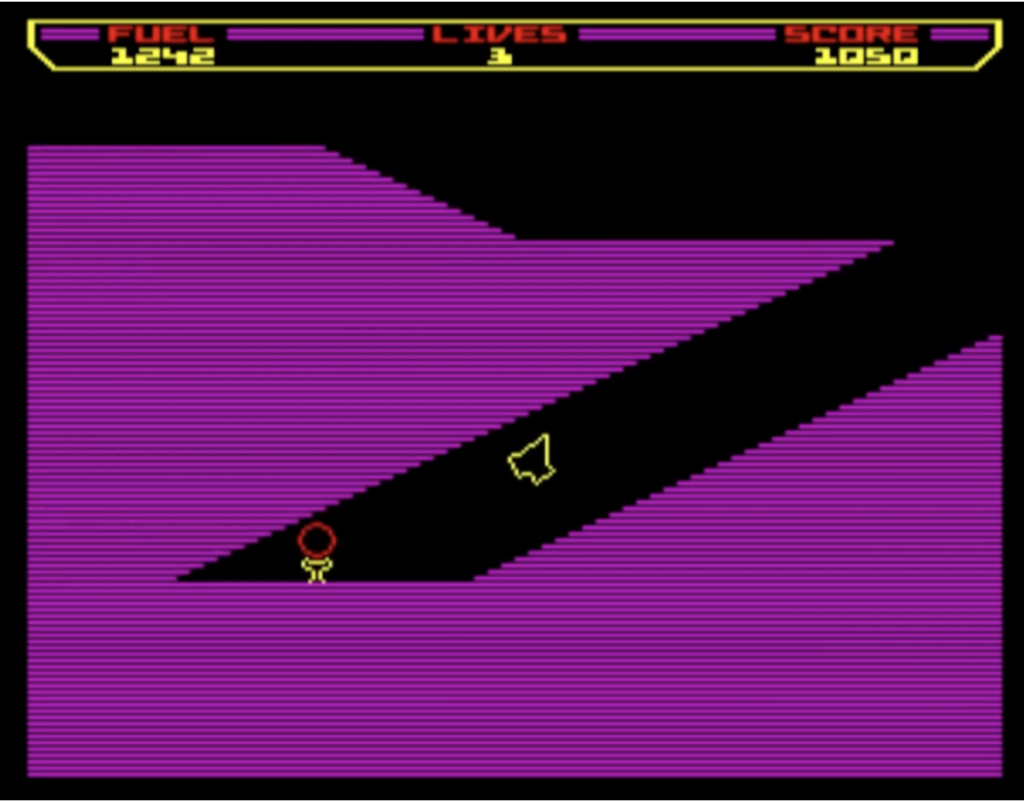
// Thrust BBC Micro 1986. Transport and Rescure under gravitation. Picture: https://youtu.be/l4SSt_jnwRQ?si=lfc4cCHk5oBvaxEx&t=103
The simplest gravity simulations can actually be found in games like RockNRoll (Amiga, 1989) or Spindizzy World (1991; also ported to consoles). In these games, the focus is more on skill rather than on 1:1 physics simulations.
However, many simulation games often transition directly into strategy games (especially when it comes to trade), depending on what they simulate.
Elite (1984) is a spaceship simulation and was one of the first games to feature an extremely large number of procedurally generated star systems; by 2048, there were systems to explore and exploit, and trade could even take place between them.
The situation is similarly open-ended in SimCity for Amiga and Macintosh (1989). Here, players must build a city without any specific goal.
Genre: Living Digital Beings (Research & Viruses)
Games in which you could observe digital life or experience it firsthand are also a classic mainframe genre. Whether it was Conway’s zero-player game LIFE or the many variations in which you simulated epidemics, these were often featured in programming courses as well. See also The Game of Life (MS-DOS, 1992, CH). This game expands on the classic Game of Life. This involves protocells that must gradually become specialized in order to grow specific „organisms“ with nerve cells and eyes.
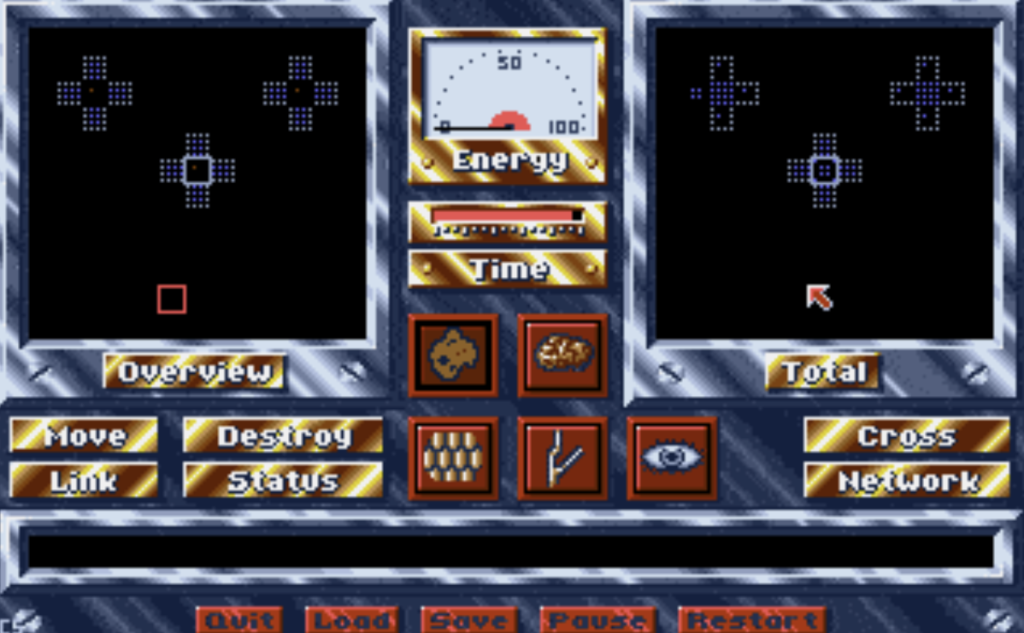
// On the right is what you need to reproduce; on the left is the work window. For example, you can use the Move command to drag the prototype cells (blue ones—select the yellow icon) to a different location. After that, you can make them grow. If you want to get rid of the skin cells, for example, click on the pattern and then click [Destroy]. In the first level, you simply have to recreate the organism on the left. Picture: https://www.myabandonware.com/game/the-game-of-life-2jd/play-2jd
Play here: https://www.myabandonware.com/game/the-game-of-life-2jd/play-2jd
The 1985 C64 home computer game Little Computer People (LCP) took it one step further. In this game, as part of a research project, you can watch a man (he was one of several possible characters) living inside the computer. You could even communicate with him via text, asking him questions or requesting help. Without “please”—it doesn’t work. It was something like a real person. D. Crane (Activision Co-founder) wrotes about this: “There was a great deal of AI in Little Computer People. The fun part was in giving the LCP a personality, and allowing him to have moods. And when he was in a mood not to interact, there was no way to tell how much of what you typed was understood by the Sim. As a result, people gave the LCP much more credit for intelligence than he really had – sort of like we do with cats. It was so easy to believe that he understood everything but simply chose to ignore you. One funny technical detail on the Commodore 64 was that the C64 couldn’t access the floppy disk without turning off the display sprites. The LCP game was designed to auto-save progress on the floppy disk, and he had to disappear to do that. So his bladder was tied to his need to save.”
The meta-game “Viruses” actually belongs in the same category. These are, in fact, the only organisms that do not live in a cage—to paraphrase von Neumann. From Switzerland come the “virus games” SCA Boot Sector Virus (1987) for the Amiga, as well as at least three other viruses from that era. Read more here >
Genre: (Action) Strategy Games
Oregon Trail 1971/19775 was later ported to the Apple II in 1987 and expanded. Plato’s game Empire also seems to have had an influence on the later scene with Galactic Empire CH and Galactic Empires CH , though perhaps not directly.
Games like M.U.L.E. (1983) play a major role here and have also helped shape the genre. Strategy games are currently experiencing a resurgence, particularly with mouse-controlled computers such as the Atari ST and Amiga. The reasons for this are obvious: better graphics, greater processing power (16-bit), more memory, easier programming in higher-level languages, and mouse control (Graphical User Interface). However, the mouse control was also prone to „stuttering“ due to dirt on the ball (action).
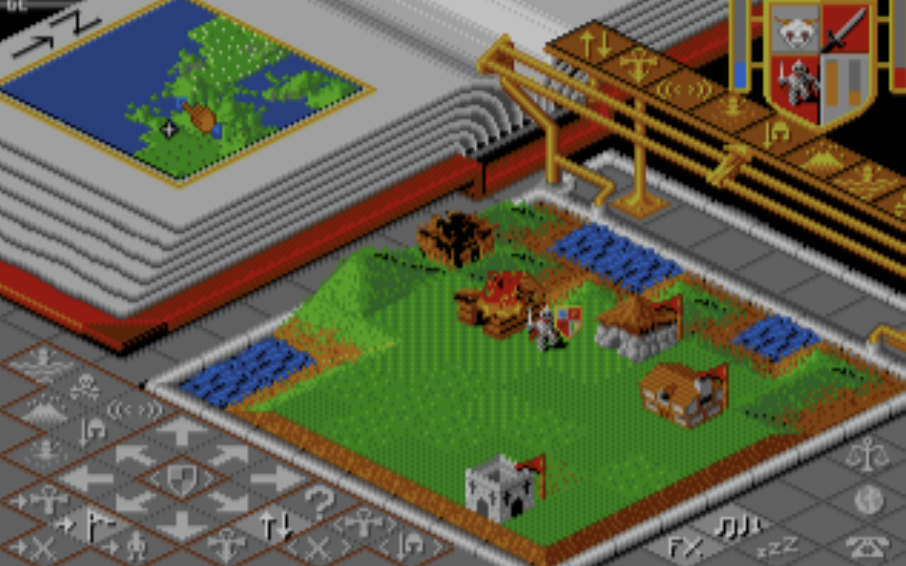
// Populus Atari ST 1989. One of the first god-games of Peter Molyneux. Player can change the terrain and control so the population and development. Picture: https://en.wikipedia.org/wiki/Populous_(video_game)
Some of the varieties originating in Switzerland include Traders 1991 CH , Kaiser 1988 CH , Hannibal CH, and Weingut CH.
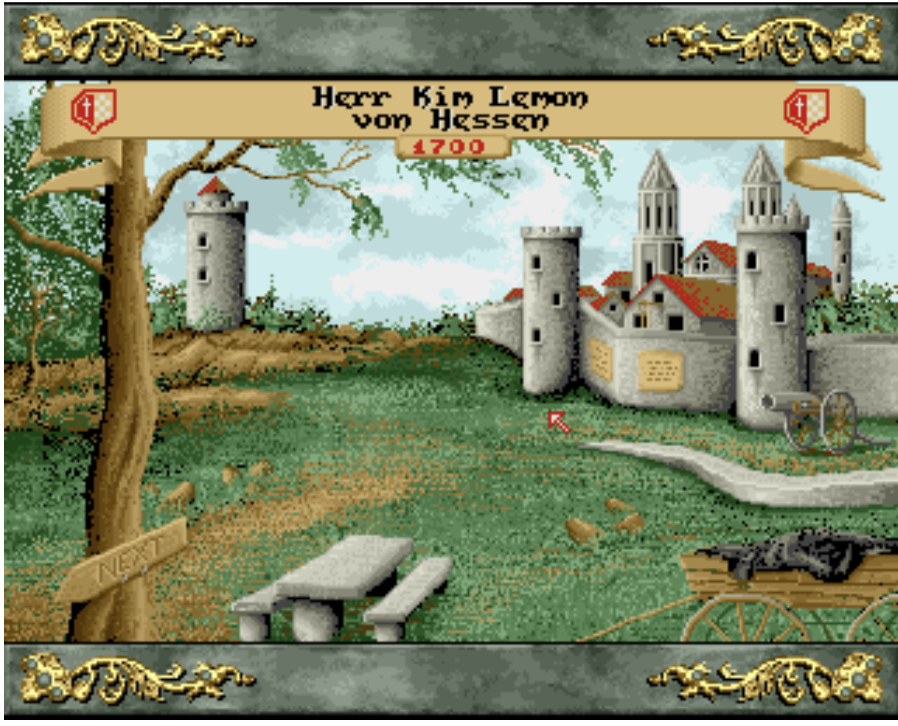
// Kaiser. Manage an empire. Picture: https://www.lemonamiga.com/game/kaiser
These games not only allow you to make strategic decisions and calculate the results, but also let you directly carry out actions such as traveling, fighting, and selling items. This is very evident in the games mentioned above, as well as in games like Starglider I/II or Carrier Command*, and is all combined in Rings of Medusa for the Amiga (1989 Swiss port).
Genre: Games with generative elements
Algorithms are the true power behind computers—essentially their core. And so, worlds and graphics can be created using formulas. This didn’t start then, but it became visible with the Mandelbrot set in 1978, a structure into which you can zoom in infinitely.
Rogue generated random levels on a Unix minicomputer around 1980. In 1979 Unix got the function to now get the last getkey without waiting for a return.
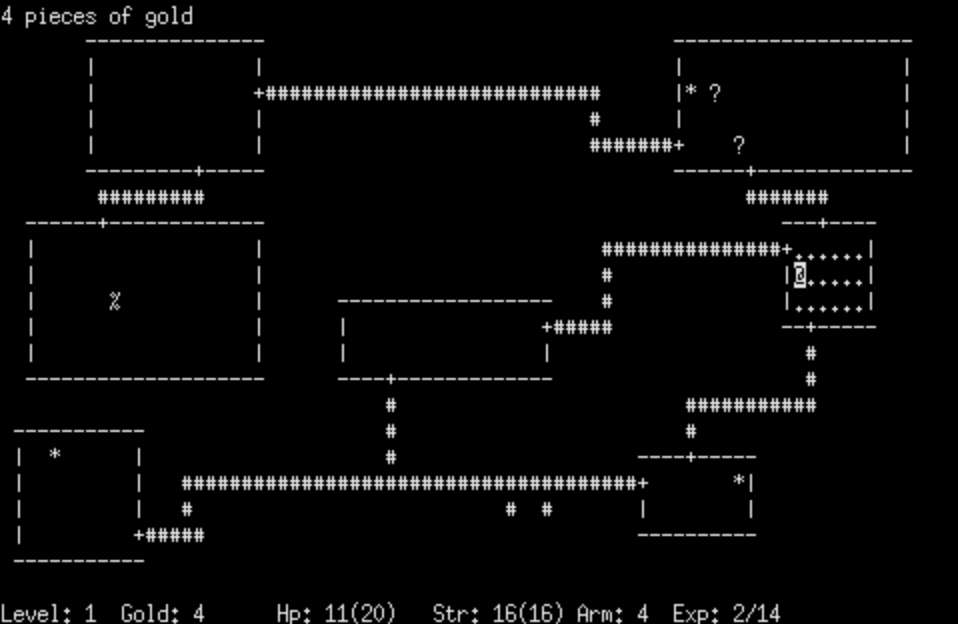
// Rogue 1980 Unix 1980. The game generates on every play another level.
Lucasfilm (which, with Star Wars and other titles, is a leader in creating worlds in film) also experimented with generative fractals in games, which become increasingly refined—for example, in the 1985 games Kronis Rift and The Eidolon for the Atari 800. (Note: Film Games – Compuerspielarchäologische Betrachtung zu den Debüts von LucasFilmGames. Höltgen Stefan in This is my Labyrinth, and you are mine. Forever. P89. R Inderst, M. Stübecke. Oldib Verlag. 2026)
The advantage is clear: it looks like nature, and not every detail has to be designed by hand.
When it comes to game mechanics, most games from that era weren’t designed around generative levels, such as randomly generated levels. The designers*—and thus the games themselves—aim to guarantee a fun gaming experience, and randomness in the levels cannot perfectly guarantee that. This even applies to the limited randomness in Diablo for Windows 95 from 1996.
Modding & Game Design
Genre: Games with Level Editors
Suddenly, level editors were also possible. This allowed players to create their own worlds and share them via floppy disk. As a result, the longevity of a product increased and online communities were strengthened. It is a precursor to the later mods released starting in 1993 with Doom 3D.
Games like Crack Amiga CH (1988) and MURI CPC CH took advantage of these capabilities. For other games, such as Insanity Fight*, this feature was planned.
Genre: Game Design
P. Molyneux UK [Populus, Black&White] (about him in the Age of 17): “Biantone Pong was a rubbish game. […] I had some Pong variations, but I just wanted more. There it was, it was the future of entertainment for me, and I just wanted more. I set my whole imagination firing off.”
Britsoft – An oral history. Wiltshire, Alex. 2022. Page S33
The hardware of many home computers is already a kind of game engine, just like on consoles. The best examples here are certainly the C64 and the Amiga, with their sprites, collision detection, and scrolling. The big difference: Home computers could be programmed, so it was even possible to create an entire game yourself. Many programming courses also ended with a game—usually a quiz or Hangman—as the highlight. Unfortunately, they almost never showed how to directly read keystrokes, which is a basic requirement for modern games.
There were various ways to get started, ranging from BASIC (the typing-out games were helpful here) to C and even assembly language. In addition, there were specialized BASIC dialects such as STOS in 1988 and AMOS in 1990. Other options included construction kits such as the Shoot-’Em-Up Construction Kit (SEUCK) or the 3D Construction Kit in 1991.
Since many games were necessarily written in assembly language to run fast enough and get the most out of the hardware, these games could also be converted back into code (disassembly). As a result, there were effectively no secrets for developer cracks. The whole thing was a kind of “hidden open source” for assembler. This, too, made it possible to master games faster than on consoles. This know-how was also available throughout the cracker scene.
Commodore’s attempt to establish a console based on the Amiga and its many games—the Amiga CD32 console, released in 1993—was not a success. There is also prototype material from Switzerland here.
Communication & Multiplayer
Genre: Computer-versus-computer duel games and multiplayer games via MIDI
Unlike multiplayer games on mainframes, games were now being developed in which two independent home computers could play against each other. The simplest of these were null-modem games, in which two people played against each other either in the same room or over the phone. Well-known examples included Populus (1987) and Stunt Car Racer (1989).
The 1987 Atari ST LAN shooter MidiMaze took things a step further. In this game, players could actually compete against each other (up to 16 players in a MIDI ring) in a Last Man Standing match using the built-in MIDI interface.
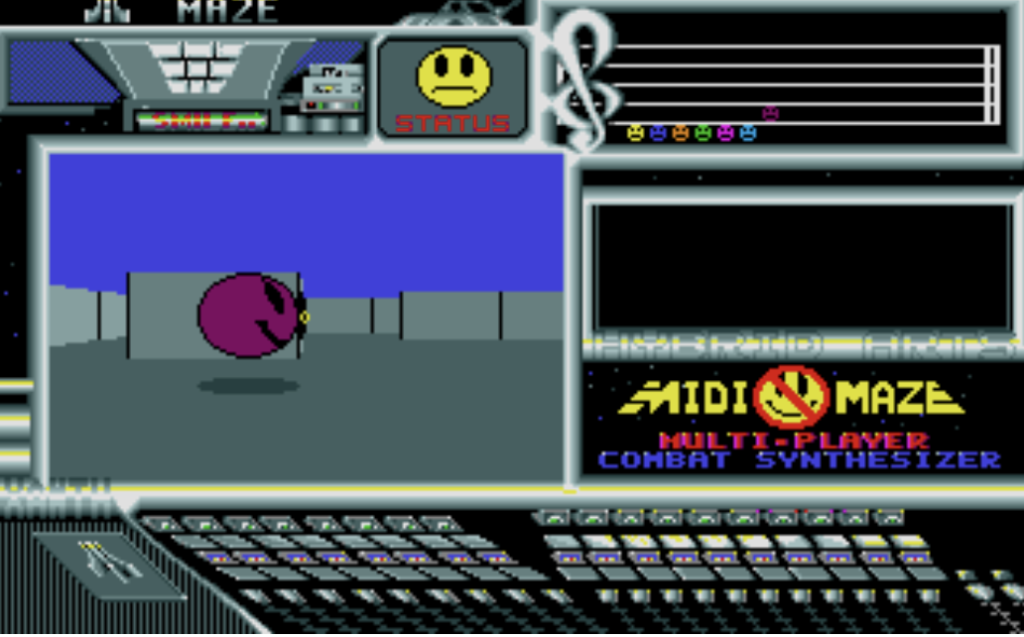
// MidiMaze – Last man standing with smilies over a Midi-Network. Picture: https://en.wikipedia.org/wiki/MIDI_Maze
In Switzerland Galactic Empires PC 1995 runs on a LocalAreaNetwork (LAN)
Genre: Gateway to the World – Games via Modem
Back then, the home computer—equipped with an expensive, separate modem—was also a gateway to the world, such as to the BulletBoardSystems BBS with their sometimes embedded games (DoorGames). The Atari ST even controls the internal text via a VT52 protocol (one of the terminal protocols).
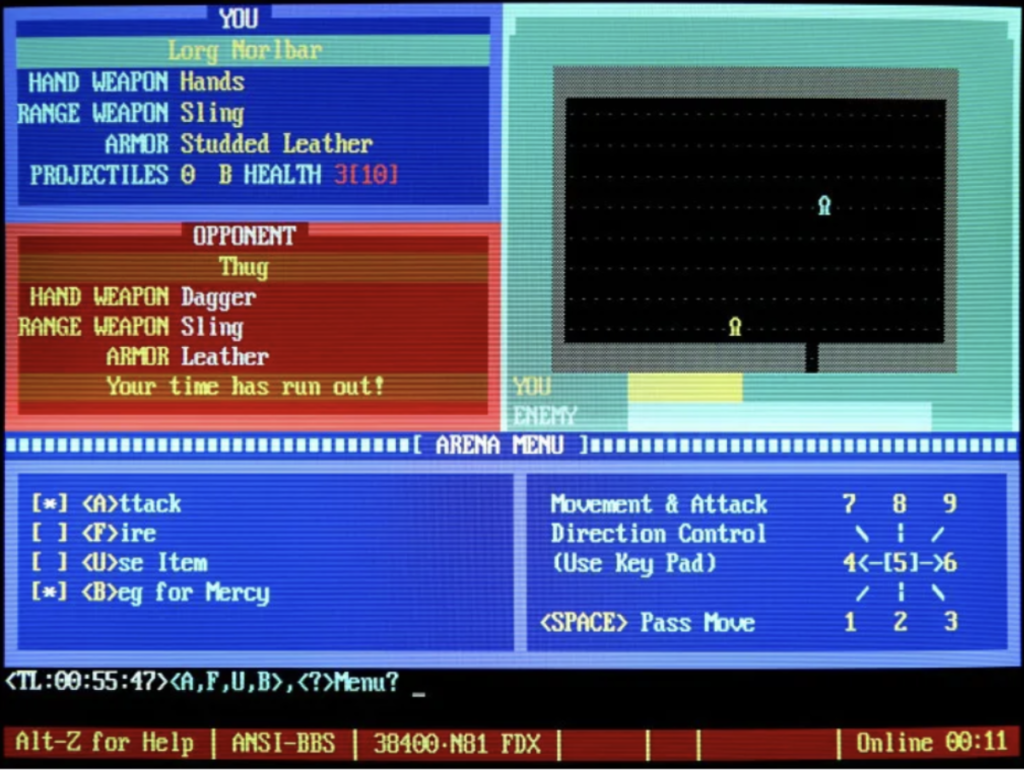
// The pit. Playing through a BBS 1990. Picture: https://uk.pcmag.com/migrated-84555-gaming/74471/the-forgotten-world-of-bbs-door-games
Learn more about DoorGames here: Don’t Forget the Door Games (https://uk.pcmag.com/migrated-84555-gaming/74471/the-forgotten-world-of-bbs-door-games)
The computer may also have served as the gateway to the mainframe LPMUDs in 1989, such as Ancient Anguish CH in 1992 at ETH Zurich, which was so successful that the operators had to move on. The game is still around today! and continues to be successful.
Genre: Web Games
Roger Sieber’s Galactic Empire was also available with a web front end back then. Galactic Empires, which included registration and a forum, can still be found on archive.org dating back to 1997 and is a further development of a game previously offered for Telnet and BBS.
It thus falls into the genre of web games (and is turn-based), which began to enjoy great success starting in 1997, particularly during the Asian financial crisis, when people—now unemployed—would go to internet cafes every day to play web games that were mostly free but could be played in real time. In Europe, the game OGame (https://en.wikipedia.org/wiki/OGame) became particularly well-known starting in 2002.
Homecomputer games & Violence
Genre: Violence and (Home) Computer Games
Today, most 8-bit and 16-bit games are perceived as “charming” or “cute.” This has partly to do with the display, as you can see above. They must have high contrast, a limited range of colors, and a specific color palette. For a long time, the sound could only produce envelope-modulated sounds, which resulted in a kind of tonal background music. On the other hand, it has to do with the content. While violence was allowed, bodies were generally not to be dismembered. In other words, there was a trend in games from the ’70s and ’80s to avoid dismembering bodies or showing blood. This had to do with the internal culture of the games; they had to be approved for release, and in West Germany in particular, authorities scrutinized them closely when it came to indexing. Games that glorified violence, in particular, were banned. This was a consequence of the Nazis’ glorification of violence, and indeed, World War II was still fresh in people’s minds in the 1970s and 1980s. Blood and mutilated bodies were simply off-limits. And the Cold War was, at least in Europe, still very much a reality.
When characters die in home computer games, it’s usually bloodless; spaceships are typically destroyed in an explosion. In Ikari Warrior*, the slain spin around as if they were tipsy, but in most games, the dead simply vanish without a trace. There are exceptions, though. Barbarian made a big splash—in that game, you could use a sort of “fatal move” to chop off an opponent’s head, and blood would spurt out. In general, violence was portrayed—as it is in the movie—as a necessary evil, but not as a defining feature or something to be glorified. Shooting directly at digital characters (from a first-person perspective) was not well received during the home computer era. Operation Wolf*, for example, was quoted as follows in Powerplay 2/1989: “Anyone who buys this game shouldn’t be surprised if computer games come under even more fire from critics. […]” (https://www.gamelab.ch/?p=10203)
The 1986 arcade game Chiller (US version) took it a step further back then; in it, you find yourself in a torture chamber and have to search for keys on dying people. More on this here: https://en.wikipedia.org/wiki/Chiller_(video_game). The game is still hard to stomach today and was actually ported to the NES as well.
In later games, this trivialized portrayal of violence—or rather, the lack thereof—was also challenged in the mainstream by titles such as Wolfenstein 3D, Doom, and its countless, extremely gory sequels—but also, of course, by games like Mortal Kombat. Not surprisingly, Germans came to Switzerland to buy Mortal Kombat in Basel. Switzerland had no index.
Enemy, Tempest of Violence Amiga 1997 was developed in Switzerland. In an interview, the developer even admits that he was fascinated by violence back then.
“In ‚Persian Gulf Inferno‘ I was surprised from the undisguised presentation of the violence, I have never seen this before in other games. All these games were brewing in my head to something new.” Andrew Wütrich (https://www.gamelab.ch/?p=10203) Andrew Wütrich was also the developer of Locomotion Amiga.
But even in this game, the whole thing still seems to trivialize the issue. It also seems here that the developer hadn’t quite moved beyond the culture of home computer games.
More on this topic can be found in the following blog post: https://www.gamelab.ch/?p=10203
Open & complex gamemechanics
Genre: Hybrid Game Mechanics
The longer computer games evolved, the more processing power and memory became available, and the longer playtime became, the more it was possible to develop more complex games—and with that, it also became possible to create an increasing number of hybrid-genre games. This was aided by better processors, more memory, and the evolution of the gaming community, which also evolved alongside the technology and was able to “play” more complex games—beyond the simple mechanics of arcade games.
You can also see this trend when games get sequels. The ambivalence is evident, for example, in Speedball . M. Montgomery (Bitmap Brothers) says the following about this: “I think each version has it merits, but the biggest problem is people’s expectations. There are three main camps: old speedball players who want no changes, old speedball players who want changes and players who never played speedball. It’s very hard to get all three right. Satisfying one camp disappoints the others. We always tried our best to balance everyone’s expectations. Of course, the original gameplay is so good, it’s very hard to make it better!”
These were games designed for long gaming sessions at home, to be played for weeks and months on end. Naturally, this also marked the emancipation of home computer games in general from arcades. In a sense, in terms of resource management and complexity, they are catching up to and even surpassing the PLATO games, both in terms of content and visuals.
And that starts with the very idea of trying to categorize games into genres in the first place; it’s no coincidence that many games appear multiple times in the genres listed above.
Games like Traps And Treasures from 1993 are more than just platformers; they’re actually action-adventure games with a story. Finally, Rings of Medusa (ported in Switzerland) is a full-fledged strategy game (written in GFABasic) focused on production, production, and more production, all set in a vast world. The 1991 Version 2 also integrated a dungeon crawler into the game.
There may have been many reasons, but here’s the reason as told by Dungeon Developer T. Bubeck told in an interview (original in german)
„So, Rings of Medusa 1 was a huge success. […] What could we do next, or build upon that? […] At the time, I really liked Dungeon Master. […] It would be great if we could incorporate a bit of Dungeon Master at the beginning.“ (44:40 https://www.gamersglobal.de/video/rings-of-medusa-entwickler-interview-mit-tillmann-bubeck)
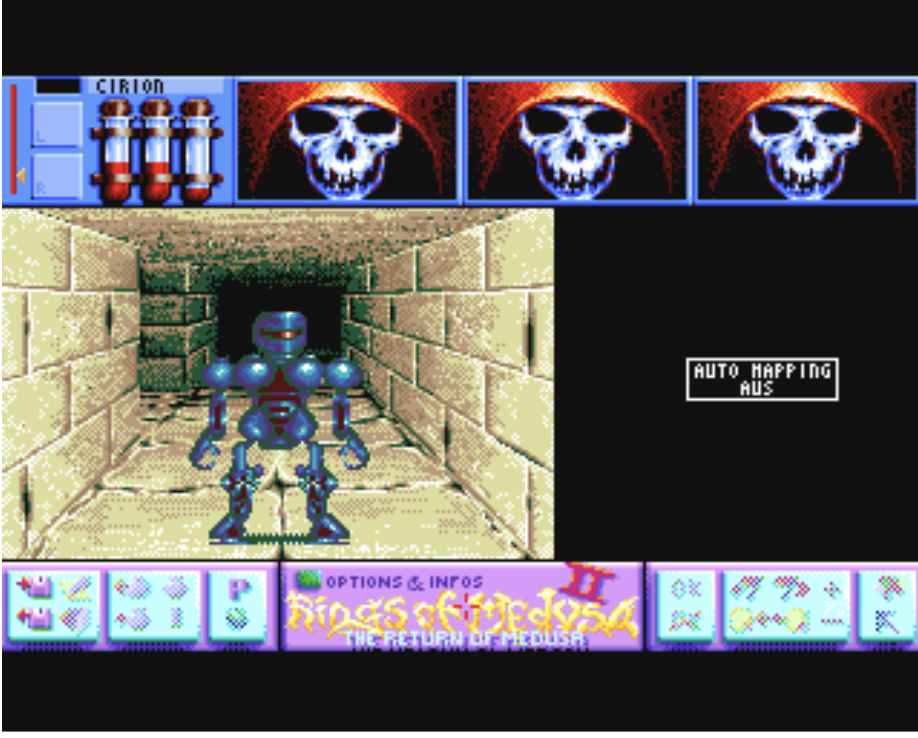
// Rings of Medusa 2. Even a Dungeon crawler is integrated. Picture: https://www.lemonamiga.com/game/rings-of-medusa-2-the-return-of-medusa
But even shoot-‚em-ups got shops (Xenon 2) and thus became more tactical or even offered a multilinear experience (Necronom). You can find more information here: Necronom (CH), Linel, Amiga, 1991. A multi-linear shoot-’em-up role-playing game created using HRGiger’s design method
However, this trend also applies to games like Lemmings (Amiga, 1991), which combine both puzzle and strategy elements and also benefit from mouse controls. These are all developments that are taking place—not only, but primarily—in the home computer gaming industry.
That’s a very hard question. I think each version has it merits, but the biggest problem is people’s expectations. There are three main camps: old speedball players who want no changes, old speedball players who want changes and players who never played speedball. It’s very hard to get all three right. Satisfying one camp disappoints the others. We always tried our best to balance everyone’s expectations. Of course, the original gameplay is so good, it’s very hard to make it better!
Genre: Open World
As you can see above, open-world games also have a long history, dating back to the PLATO Systems.
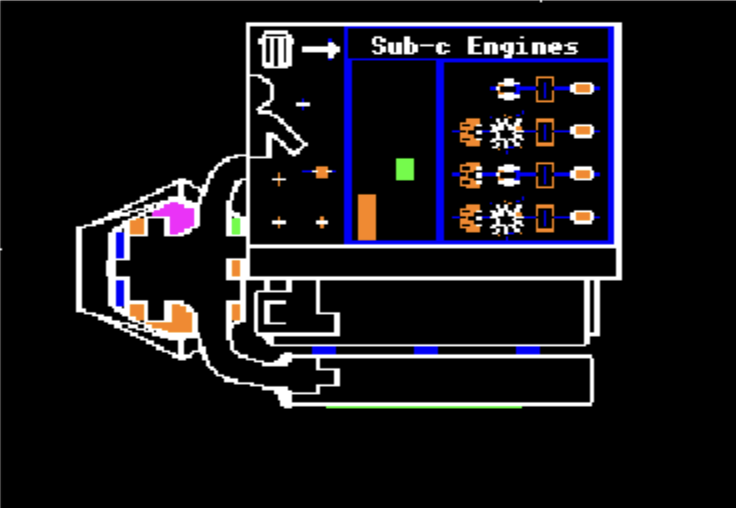
// Sundog Apple II 1984. A lot of things have to be fixed here. Picture: https://en.wikipedia.org/wiki/SunDog:_Frozen_Legacy
Nevertheless, this genre is being rediscovered and expanded with games such as Elite (1984), The Seven Cities of Gold (Atari 400, 1984), Sundog (Apple II, 1984, FTL), Starflight (MS-DOS, 1986), Sid Meyer’s Pirates (1987), Hunter (Amiga/Atari ST, 1991), and Mercenary III (Amiga/Atari ST, 1992).
Another interesting aspect of Sundog is the inspiration—or, to put it another way, where the elements were rooted. So it was definitely about being able to continue exploring existing fictional worlds. W. Holder tells about SunDog: “Sundog was an adventure game inspired by Han Solo from Star Wars. You controlled a small ship traveling around the galaxy, trying to make a quick buck. It used a top-down perspective and a first-person view out the window of the ship when you were fighting pirates. You could also land in cities and travel around..”
https://www.amigalove.com/viewtopic.php?t=739
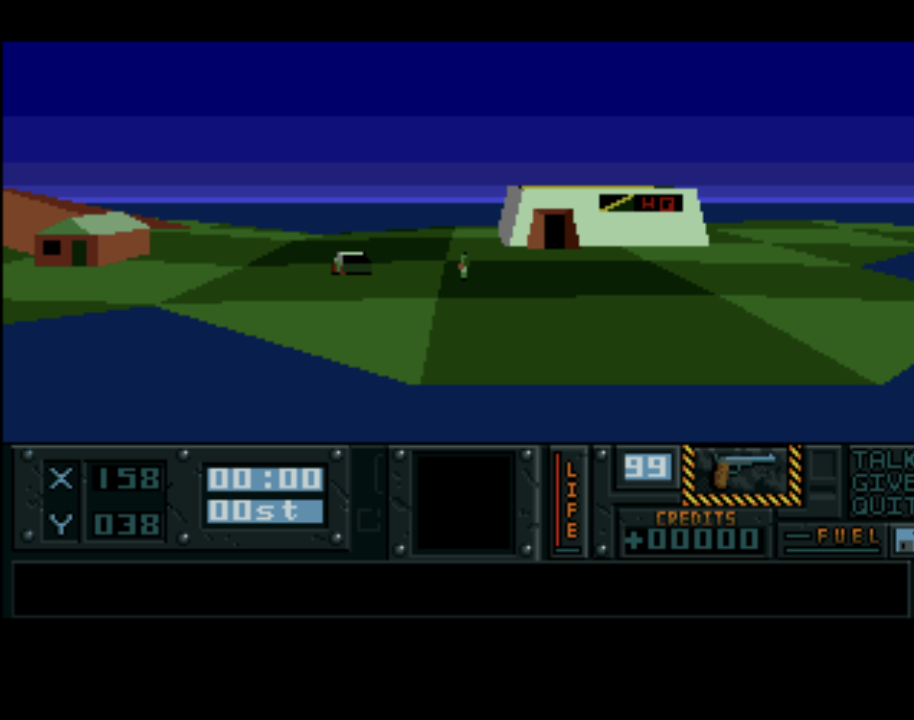
// Hunter Amiga/Atari ST 1991. Run or drive through an open world. Picture: https://en.wikipedia.org/wiki/Hunter_(video_game)
For some of the developers, open-world games were even a way to start without much of a story and focus instead on a space of possibilities. P. Wayne: „Initially I had a meeting with Colin Fuidge at Activision, with an early version of what became Hunter, it was not much of a game at that time but had the landscape and a few objects, including a couple of vehicles.[…] you get to take various vehicles, travel round and blow things up with various weapons, in 3D […] I guess there was a little more scope for creativity and innovation back then, but then it was far cheaper and less risky for publishers to fund a development than it is now.“ https://amiga.abime.net/articles/amiga-lore/the-story-behind-hunter
This genre is currently experiencing a real resurgence in the home computer sector and is demonstrating its future potential.
Phenomena or direct relationship to the Hardware
Genre: Type-in Games (Listing games)
Because computers were entirely digital and many 8-bit systems came with a BASIC interpreter, games that players had to type in for their respective platforms began appearing very quickly in computer magazines. This genre is quite unique. The games have to be short, and the effort required to type them out has to be worth the result. However, the games also need to be easy to understand. For this reason, there are many adaptations of well-known arcade classics—or at least variations on them. That way, there’s no need to explain the gameplay. But, as is common in the home computer sector, there are also entirely new ideas. Examples (featuring familiar game mechanics) from Switzerland included CaveFlight 1981 CH (shoot ’em up), Top Tennis Atari 400 1985, Jagdscene Chicago 1985, and MURI CPC 1987 CH (Arkanoid).
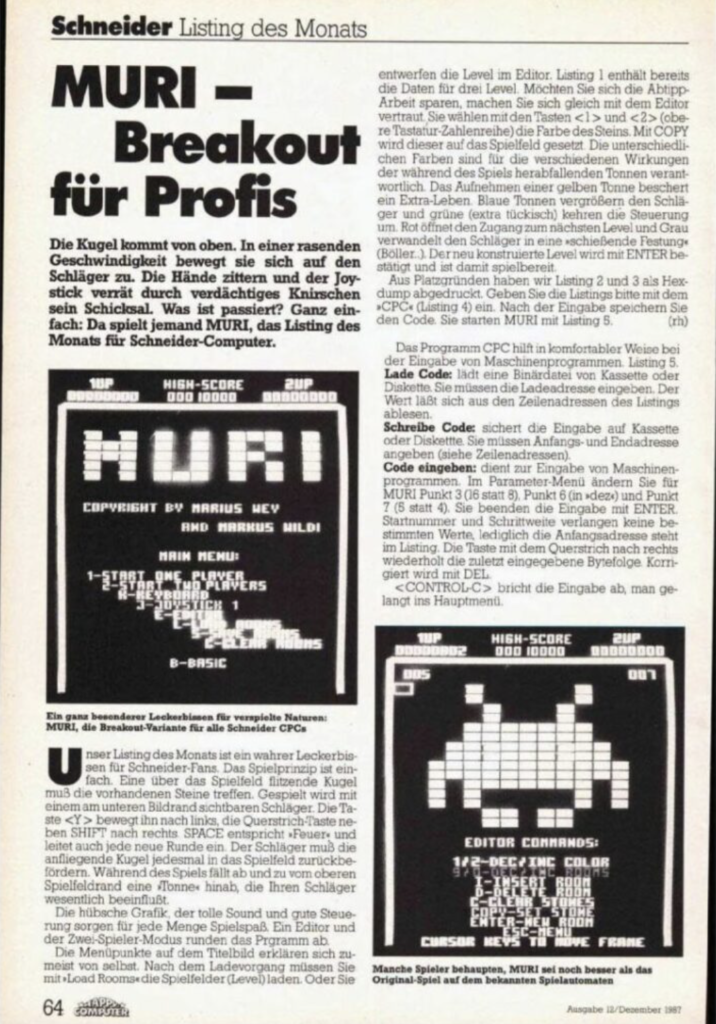
// MURI CPC 1987 CH – Happy Computer Listing for an arkanoid version with editor. Of course the name is a joke: MURI is the town, where the developers come from. And it means ins swiss german “Mauer” or in english “Wall”. Picture: XYZ
One of the authors of this article typed in the code for a Space Invaders game, played it, and turned off the computer. And so the day in a week.He was young and didn’t know you could save the game on the pc of his father.
For a while, listings could even be monetized through features like “Listing of the Month,” as seen in Happy Computer*. Later on, there were also game booklets that came with tapes or floppy disks.
Genre: Inspiration from own game hardware
We’re now also seeing more and more references to the new hardware used in the games—essentially, what they run on. More and more computers, floppy disks, joysticks, and Amiga balls are popping up. So the scene is becoming aware of its own reality—including how it sets itself apart.
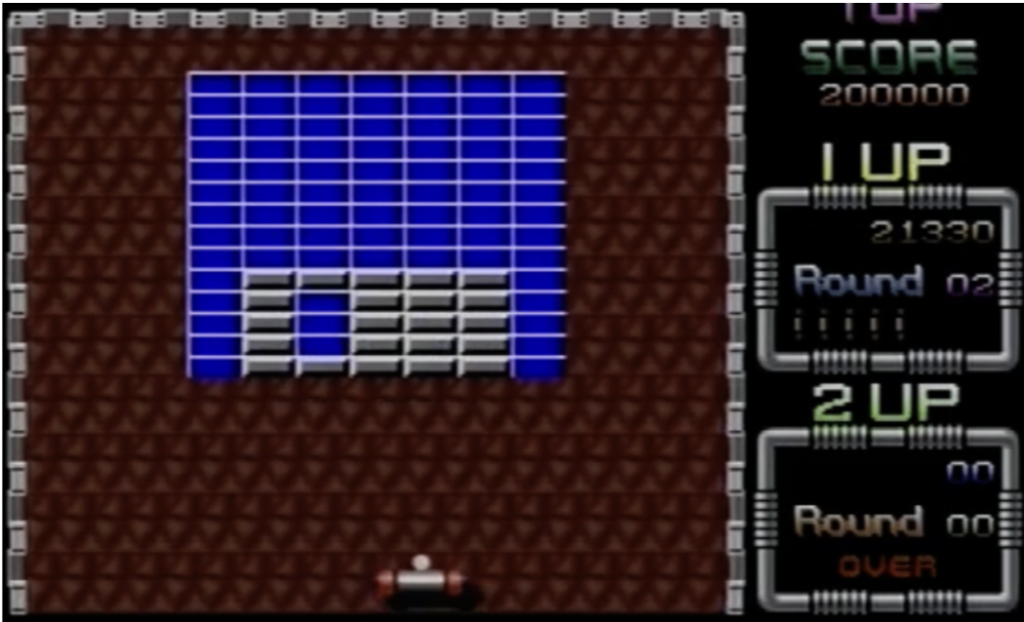
// General graphics created from game pieces in Arkanoid were released on floppy disks or the Amiga computer by Giganoid Amiga CH in 1988.
The Vyrus Amiga 1991 CH also features shooting gameplay on the computer board.
In Supaplex, the setting is entirely the circuit board, and the main character is a sort of Pac-Man (game character).
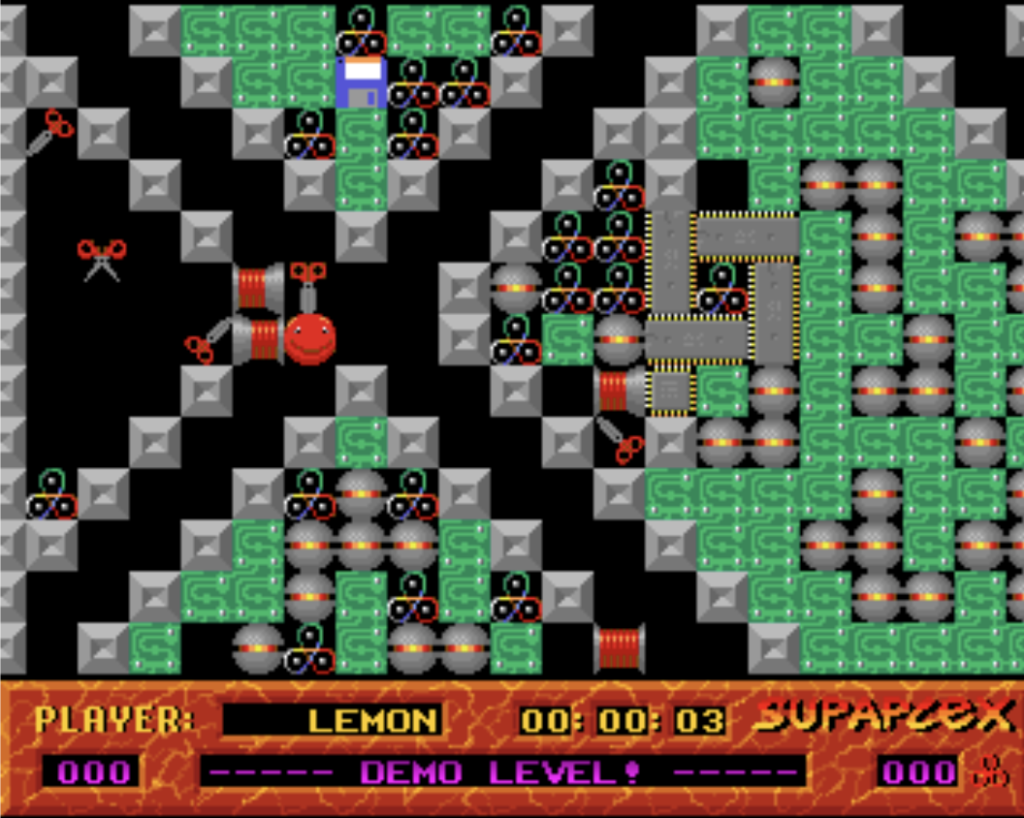
// Supaplex Amiga – extends the idea of boulder dash and let come together pacmen, disks, chips, circuits, bombs, scissors … Are the scisors a reference to the atari 2600 porn x-men? Picture: https://www.lemonamiga.com/game/supaplex
Category: Games with a connection to the analog world
Genre: Games with a local focus
Self-publishing these games also made it possible to develop games that were very locally focused, featured local themes, or were named after a village (MURI) in Switzerland. Many of these games can no longer be found today because—it is presumed—they were used only locally, within personal circles or at computer clubs. Nevertheless, there are games like “Züri” that, unlike typical games, aren’t aimed at the global market; instead, their very names start with dialect words, and they’re point-and-click adventures created by someone who travels to Zurich to visit Needle Park, and so on. See also the next category, which features the game “The Last Eichhof.”
// Destroy the enemy bear with your last Eichof bottle. Play online here: https://www.playdosgames.com/play/the-last-eichhof Picture: https://demozoo.org/productions/286262/
Genre: Games with Political Messages
There are few political games—much like games with a local focus. Presumably, many were simply too localized to have a broad impact. Moreover, they naturally competed with games that were purely for fun. The following games from Switzerland convey specific messages: Züri—see above—then The Last Eichhof 1993*, a game about the takeover of the Eichhof Brewery by Heineke and War Heli, in which you were penalized with point deductions if you shot down civilian vehicles or even the ambulance (resulting in a score of 0).
The satirical board game KREML 1986 CH also received a digital expansion for the Atari ST, which revealed more details about the struggle among half-dead officials for the post of General Secretary of the USSR. The Atari ST version can be played here: https://urs.fatamorgana.ch/atarikreml/ (Cancel the KML dialog to play)
Genre: Experimental and Art Games
Of course, new media aren’t just important for entertainment. Art (GameArt/ArtGames/author-driven games) can and should engage with them as well. However, as far as we know, this hasn’t really been explored. Purely digital worlds like these had a doubly hard time gaining recognition back then. For one thing, they were technical, artificial, and—on top of that—playful—a toxic combination for the cultural and artistic establishment of that era and our own. And there were no analog representations (area, museum) for this new form of art.
// In Lifespan 1983 Atari XE/XL play through a human life. Picture: https://www.mobygames.com/game/173431/lifespan/
Lifespan 1983 Atari XE/XL. The player plays a whole lifespan of a human.
https://en.wikipedia.org/wiki/Lifespan_(video_game)
Dolphin’s Rune, The poetic odysee 1985. Look through a dolphins ‘eye’ in 3rd person More about this game you find here: https://www.lemon64.com/game/dolphins-rune
A let’s play of this two games by todays game artist “Molledindustria” you find here:
The game that is best known worldwide from that era is, above all, Deus Ex Machina 1985 UK ZX Spectrum*. It is a collection of various mini-games centered on life and also experiments with a variety of aesthetics.
Further goes the artist A. Hahn and created one of the few explicit and art games in Switzerland at the time: “A Young Person’s Guide To Walking Outside The City” (TI99, 1983). It seems that this artwork discuss gaming on a meta layer.
Modding & Game Design
Genre: Games with Level Editors
Suddenly, level editors were also possible. This allowed players to create their own worlds and share them via floppy disk. As a result, the longevity of a product increased and online communities were strengthened. It is a precursor to the later mods released starting in 1993 with Doom 3D.
Games like Crack Amiga CH (1988) and MURI CPC CH took advantage of these capabilities. For other games, such as Insanity Fight*, this feature was planned.
Genre: Game Design
P. Molyneux UK [Populus, Black&White] (about him in the Age of 17): “Biantone Pong was a rubbish game. […] I had some Pong variations, but I just wanted more. There it was, it was the future of entertainment for me, and I just wanted more. I set my whole imagination firing off.”
Britsoft – An oral history. Wiltshire, Alex. 2022. Page S33
The hardware of many home computers is already a kind of game engine, just like on consoles. The best examples here are certainly the C64 and the Amiga, with their sprites, collision detection, and scrolling. The big difference: Home computers could be programmed, so it was even possible to create an entire game yourself. Many programming courses also ended with a game—usually a quiz or Hangman—as the highlight. Unfortunately, they almost never showed how to directly read keystrokes, which is a basic requirement for modern games.
There were various ways to get started, ranging from BASIC (the typing-out games were helpful here) to C and even assembly language. In addition, there were specialized BASIC dialects such as STOS in 1988 and AMOS in 1990. Other options included construction kits such as the Shoot-’Em-Up Construction Kit (SEUCK) or the 3D Construction Kit in 1991.
Since many games were necessarily written in assembly language to run fast enough and get the most out of the hardware, these games could also be converted back into code (disassembly). As a result, there were effectively no secrets for developer cracks. The whole thing was a kind of “hidden open source” for assembler. This, too, made it possible to master games faster than on consoles. This know-how was also available throughout the cracker scene.
Commodore’s attempt to establish a console based on the Amiga and its many games—the Amiga CD32 console, released in 1993—was not a success. There is also prototype material from Switzerland here.
Cheating
8-bit games, in particular, were always open to modifications. They were loaded into memory using the C64 BASIC command “LOAD,” for example, and could then be altered using BASIC commands such as POKE. This allowed a memory location to be overwritten. It was possible to “cheat” your way to more lives or to disable collision detection. Later, hardware modules such as Action Replay, The Final Cartridge III, and Expert Cartridge were introduced, all of which made this possible while the game was running.
Another category of modified games was certainly cracked games. These could then be freely copied, which strengthened the communities, and built-in cheats often allowed for infinite lives or the ability to skip to specific levels. This also made it possible to finish the games. Take, for example, the “brutally” difficult games like Rick Dangerous for the Amiga from 1989. This game was even harder than many Japanese arcade games.
Display – Graphics & Sound
Genre: Home computer visuals and sound
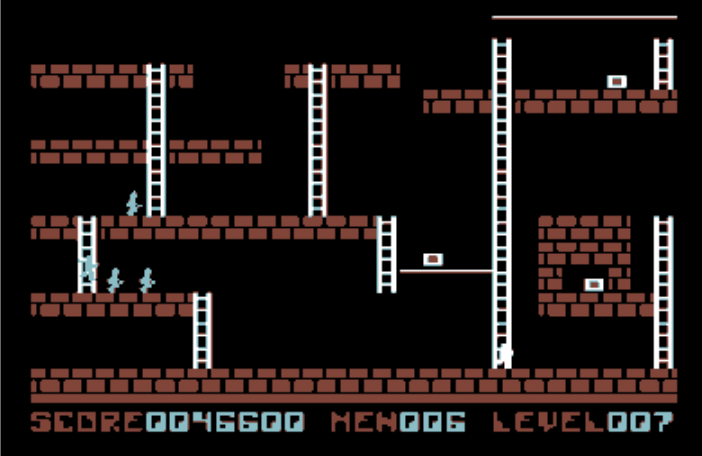
// LodeRunner C64 wie viele Spiele anfangs der 8Bit Area – einfarbige Flächen bestimmen die Grafik. Picture: https://en.wikipedia.org/wiki/Lode_Runner
The graphics in 8-bit games have gradually evolved from flat, low-color graphics (which look symbolic) to hand-shaded 3D graphics with light, shadows and dark gradients for 3D rendering. Each computer is like its own paintbox with its own set of colors—about 16 fixed colors on the C64, for example.
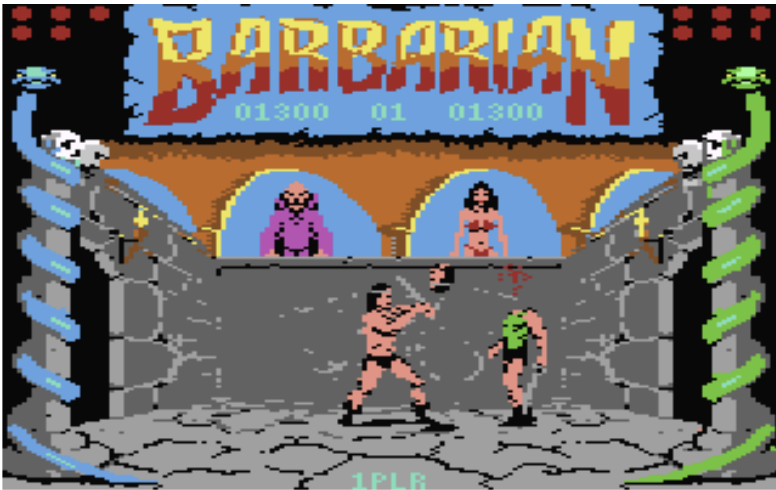
// Barbarian C64 shows a 3D-Scene hand shaded . Picture: https://en.wikipedia.org/wiki/Barbarian:_The_Ultimate_Warrior
The same applies to 16-bit computers. The color gamut—that is, the maximum palette—is also very limited here, at only 512 (ST) or 4,096 (Amiga), compared to 16 million today, and only 16 or 32 of these can be selected. This usually results in there being few pure red, blue, and green colors—namely, 7 or 8.
White is almost always included as the brightest color, especially for reflections. This results in highly reflective images that can come across as almost kitschy or slightly plastic-looking—for example, in Zynaps*, Nebulus*, Turrican*, Xenon II*, Cadaver*, and Traps & Treasures*.
But this is also helpful because many TVs and monitors weren’t particularly bright, and large white areas were hard to see. Even games with less “glitz” in their design clearly show their 16-bit home computer style—for example, Defender of the Crown (1987), Shadow of the Beast*, and Immortal (1990).
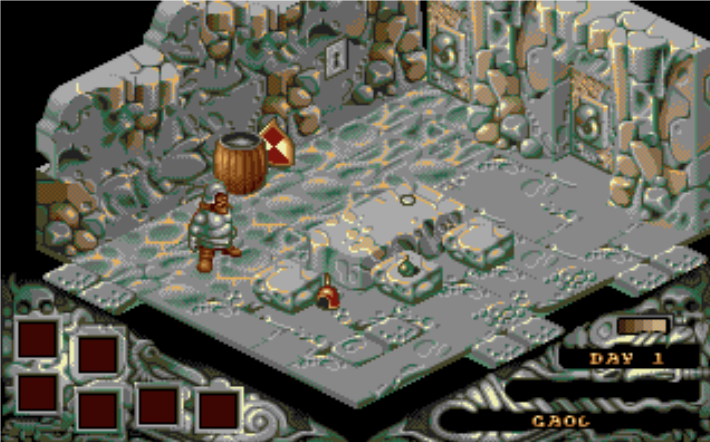
// Cadaver Atari ST/Amiga uses a defined Palette and antialising Picture: https://en.wikipedia.org/wiki/Cadaver_(video_game)
In the former case, attempts were made to work solely with intermediate colors and generate anti-aliased transitions; in the latter, dithering was often used, which is more in line with a classic digitization technique and can produce a more analog-like effect, since it was—and still is—used in the halftoning of newspaper images.
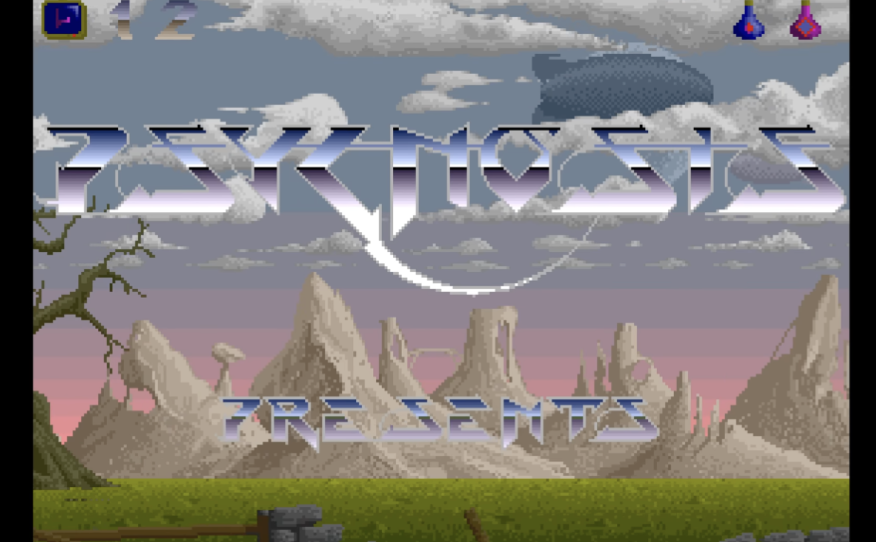
// A more „Digthering“-style look—see the clouds, zeppelin, mountains, and meadow—with few solid areas. Of course, the colors were even more washed-out on a CRT.
Unlike later games such as Diablo, most of these games appear very colorful and rarely gloomy, even though they deal with dark themes, such as Cadaver*.
Another visual hallmark of home computer games is the use of color gradients in the background—or, to put it another way, effects from the cracker and demo scenes, in which some of the developers were also active. This also created a connection for those in the know and showcased what they were “capable of.” These were relatively easy to implement on the Amiga (unlike the Atari 2600 color gradients) and, just like in the cracker and demo scenes, demonstrated that you can achieve a lot with very little code.
This can even break the screen border. Color gradients are commonly used in games, typically for the sky, as seen in Turrican D, Nebulus UK, WAR HELI CH, Rolling Ronnie CH, TrapsNTreasures CH, or Starbirds 1996 CH. Some games, such as Turrican, The Killing Game Show 1990, and Nebulus, also used water effects with reflections, which were also very popular in the cracker and demoscene.
Another important feature was that, for memory reasons, many games were created using tiles—meaning they were essentially made up of repeating blocks. It was often crucial to design these blocks so that they were seamless. The transitions had to be invisible, and the blocks couldn’t appear to repeat too obviously. Ultimately, it was a fine art: creating the most “realistic” means unique and different world possible using just a few blocks. Of course, technical settings help here, since things are usually mass-produced there rather than „grown.“
When it comes to sound, it’s even clearer: here, every platform is effectively its own instrument—and usually quite distinctive, like the C64 with its SID chip.
Most computers have envelope generators. So the sound has to be generated artificially. It wasn’t until the Amiga and digital sound that the sound changed and, in a sense, became digital as well. And so it’s no surprise that many games are announced by a digital voice (Turrican, WAR HELI […]).
Read more here: Music—the First Medium to Be Digitized, Now with New Original Content [Brief Discussion]
Genre: Games with 3D vector or polygon graphics
Following SPASIM 1976 on Plato, a whole series of 3D vector games (wireframe models) were developed. Unlike the Vector Arcades such as Star Battle Zone 1980 or Wars Arcade 1983, these were based on standard CRT screens and merely simulated vector graphics.
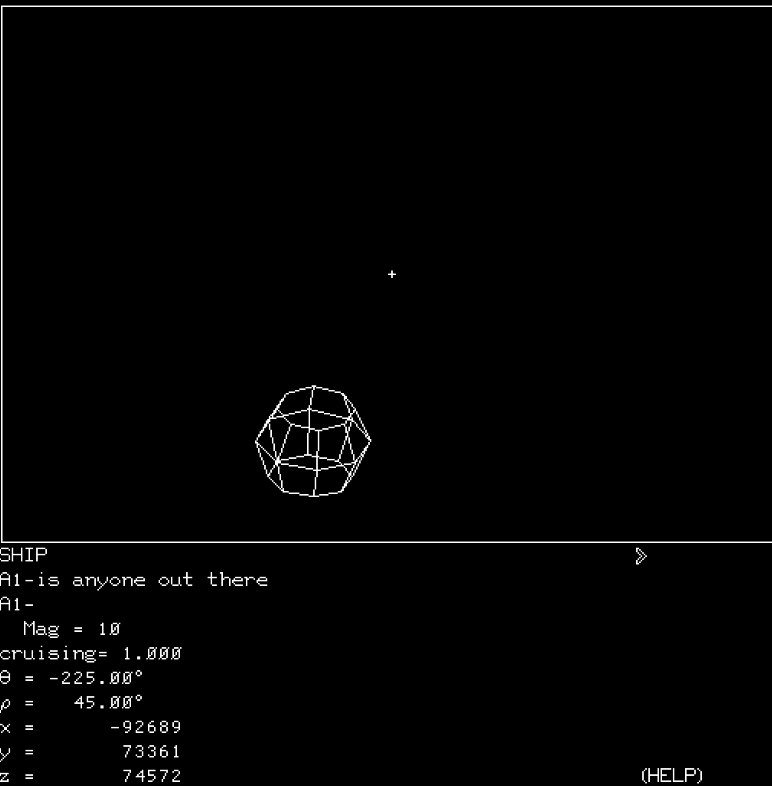
// SPASIM Plato Systems 1976 the new space wireframe. Picture: https://www.gamelab.ch/?p=7400
There was a great deal of experimentation involved, and vector graphics were used extensively in other genres as well, such as Elite (1984), Starglider (1986), and Eco: A Game of Survival (1987).
The visuals were very technical and also heavy on vector graphics, especially in the sci-fi genre—for example, in ALIEN (1979) or MAX HEADROOM (1985).
Later on, 3D games featuring filled polygons also became very popular. This era saw the release of games such as Capture the Flag for the Atari 400 in 1983—a split-screen Capture the Flag game—and the first polygon arcade game, I, Robot Arcade*, also in 1983.
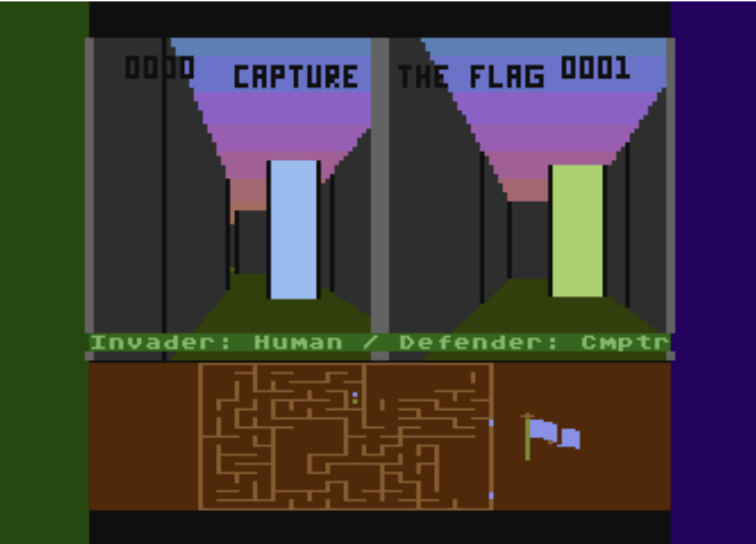
// Two persons are playing in polygone graphics – Capture the flag 1983. Picture: https://en.wikipedia.org/wiki/Capture_the_Flag_(video_game)
Here, too, it was the 16-bit consoles in particular that expanded the possibilities of arcade games, leading to titles in other genres such as Test Drive (1987), Starglider 2 (1988), and Carrier Command (1988).
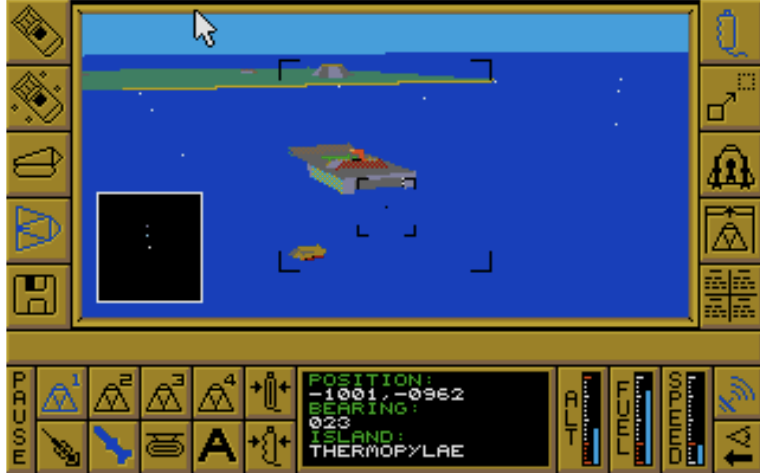
// Carrier Command simulates a war—including drones—using polygonal graphics. Picture: https://en.wikipedia.org/wiki/Carrier_Command
This, in turn, gave rise to some very unique and highly abstract graphic styles, such as those seen in Zarch/Virus Archimedes (1987) or the very similar game in style Aldebaran Archimedes (1992) from Switzerland. Of course Aldebaran is not only a Shootemup it is a strategy game too.
Free Software or the Offshoots of Open Source
Genre: Public Domain
On mainframes, software was often in the public domain as well. In many cases, the software was even distributed in source code (since the processors running Unix were often diverse). As is well known, this changed radically with the advent of personal computers, which featured standardized processors in every system (such as Intel). And so the public domain soon emerged.
In other words, software that was open-source and could be freely copied. The best-known project is Aminet, which was founded in Switzerland in 1991 by Urban Müller and continues to serve the Amiga community to this day. (Incidentally, he also invented the esoteric programming language Brainfuck.) Back then, the project was a BBS/FTP project; of course, today it also runs via a web interface.
An example of a public domain game would be Megaroid for the Atari ST from 1988.
The games here ranged widely, from prototypes to finished games. Often, the mechanics were well-developed, but the graphics frequently lacked polish or skill. It’s safe to assume that many of these projects were solo efforts. There were also many games here that were no longer supported by the mainstream—that is, for which there were no new, up-to-date versions available.
Conclusion
There was a huge mentality shift from about 1995, where we’ve gone from ‚anything is possible and we can take anything in real life and we can turn it into a game,‘ to ‚we’ve got to take a game and turn it into another game.”
J. Hare. Britsoft – An oral history. Wiltshire, Alex. 2022. Page 394
Following the era of mainframe and mini-computer games on one hand, and arcade and console games on the other, the home computer game represents a liberation for games and their developers; at the same time, it also poses a challenge in the sense that so many games are being released. This liberation occurs on multiple levels simultaneously.
Computers offered the ability to design games entirely on one’s own and were open to developers. They stood in stark contrast to the closed-system arcade games and, above all, console games, which emerged at the same time as computer games. In both cases, the technology was based on 8-bit processors. Home computers then brought computers to the masses at an affordable price. The 1983 video game crash can also be seen as a reflection of the rise of home computers.
We were inventing new game genres every other month back in the ’80s and ’90s. The only reason it stopped is people stopped wanting to pay money to take risks on people being highly creative, whereas in the early days everyone was being creative, and it was new, so the people investing money in it from the publishing side were willing to take risks because it was their only way into the market
J. Hare. Britsoft – An oral history. Wiltshire, Alex. 2022. Page 394
The home computer scene is developing a wide variety of games. This diversity is evident not only in the number of games being developed, but also in the evolution of existing mechanics into more complex and sophisticated games. This is giving rise to unique styles and distinctive approaches to themes, with local elements now coming to the fore. The games are becoming longer and are also breaking away from familiar arcade and console concepts. The home computer scene develops new ideas, which are then ported to systems with much lower standards—such as the MS-DOS platform of that time and its clones.
It’s also clear that with the advent of PCs—and especially home computers—games can become much more action-packed. This gives rise to interesting new hybrids that are permanently changing game design and our very conception of what games are.
Very modern user interfaces—such as the mouse and the GUI on 16-bit computers—also contributed to the development of new concepts. And 16-bit computers, with their ample memory and wide range of colors, likewise served as drivers of innovation. In this regard, home computers were certainly at the forefront of mass-market development from 1985 to 1990—a revolution ushered in by the LISA and Macintosh office computers. This then gives rise to specific genres such as standalone shoot ’em ups, skill-based games, strategy games, point-and-click adventures, dungeon crawlers, open-world games featuring extensive playtime, innovative uses of 3D vector and polygon graphics, and the ability to save and load games, use level editors, play against each other, or play via MIDI over a LAN. It’s interesting to note that many of these developments can also be found in the Swiss scene, and vice versa.
Home computer gaming was a space for experimentation that is not better known simply because historical accounts have tended to focus on the increasingly established, read-only (and thus more easily archivable) arcade/console tradition. In this arena, game mechanics, IPs, and narratives were driven—especially after the video game crash—by Japanese companies in particular, and new players were constantly being introduced to the familiar brands.
What would the world look like if we could still play the updated sequels to those home computer games—from Switzerland, for example—today? That’s why many Japanese game designers are well-known, while only a few names from the home computer scene—such as Peter Molyneux—are widely recognized. The same is true for computer musicians like Hülsbeck, Whittaker, or Hubbard.
Home computer games are ultimately also a political statement in that they occupy a space that was previously unoccupied—one that first had to be created. In doing so, they expand the reality of the analog world by as many spaces as there are games. As a result, cyberspace has been growing continuously ever since. Unfortunately, it’s also clear that many of these new worlds are modeled after analog worlds. Nevertheless, there are a few experiments here and there.
R. Hubbard (Composer, ACE II): “I liked the Amiga. It was a real shame. If they had put MS-DOS on it, it would have succeeded, but they got killed by the IBM clones. The Amiga, like everything else, was way ahead of its time. One of the things that was appealing was that the Amiga was still a home computer, so there were great creativity products there, like Deluxe Paint and Instant Music. So it was in this phase of being really innovative with software, not just games.” (Britsoft – An oral history. Wiltshire, Alex. 2022. Page 350)
Many histories of video games tend to begin after the end of the home computer game era and its reliance on television. In other words, they continue the history of the platform that won the race for personal computers: MS-DOS. Today, for example, many computer science students are unaware that the first PC did not come from IBM but from Apple, Commodore, or Shack.
On top of that, many people were first introduced to computers through Windows 95 and thus didn’t come into contact with computer games until Windows 95. So it’s a tradition that only became apparent then but continues to this day. The previously technologically lagging, expensive MS-DOS platform with its PC clones now has 640×480 VGA as its minimum requirement, requires its own monitor, and is upgradeable—for example, in terms of the processor or 3D graphics cards. This allows the hardware to be adapted as needed.
There are no longer alternating platforms. Games are now either “fake” (Myst, 1993) or “real” (Doom, 1992) 3D. This expensive hardware (which doesn’t feel expensive, though, because individual components can be upgraded) once again makes it harder to access games and game design. One of the most used Framework for 3D Games was then OpenGL released in 1992 (https://en.wikipedia.org/wiki/OpenGL). From then on, 3D cards did all the work, thereby massively speeding up 3D games with textures coded in C or C++.
G. Penn (Zzap-Journalist UK) describes this turn:
The worst shift was definitely 3D, which was amazingly hard. I mean, it destroyed developers, a lot of the British teams. They suddenly had to go from playing in small bands, almost, then suddenly they needed these big teams, and this American mentality starts pushing its way through, of everything having to be bigger. 3D is 10 times the work of producing something in 2D, so it was worse. (Britsoft – An oral history. Wiltshire, Alex. 2022. Page 274.)
And this was during a time that was hostile to technology. From then on, there were no longer any affordable alternatives for gaming except for the consoles from Sega—later Microsoft, Nintendo, and Sony—but those were, after all, read-only.
This also marked the end of the era when perspectives were “drawn” by hand and, much like in a board game, there were often a wide variety of representations. From then on, everything was often drawn in a single perspective by 3d cards—either isometric or central perspective. As a result, the games became less symbolic and more of a simulation of the real world: https://www.gamelab.ch/?p=10109