Beeindruckende Liste von Sega (es gibt ja noch Nintendo, wo man auch viele findet), die wiedereinmal klar macht, dass viele Themen schon lange vor den elektronischen Arcades bewirtschaftet wurden etwa Sport, Schiessen, Militär und und und …
Neuste Funde = Bilder im Rahmen von CH_Ludens zeigen „Spielhallen/Events“ mit elektromagnetischen Arcades auch in ZH.
Veröffentlicht unterUncategorized|Kommentare deaktiviert für Liste von Segas „Electromechanical Arcades“
„Elektromenschliche Arcades“ und Co mit und am Fernsehen
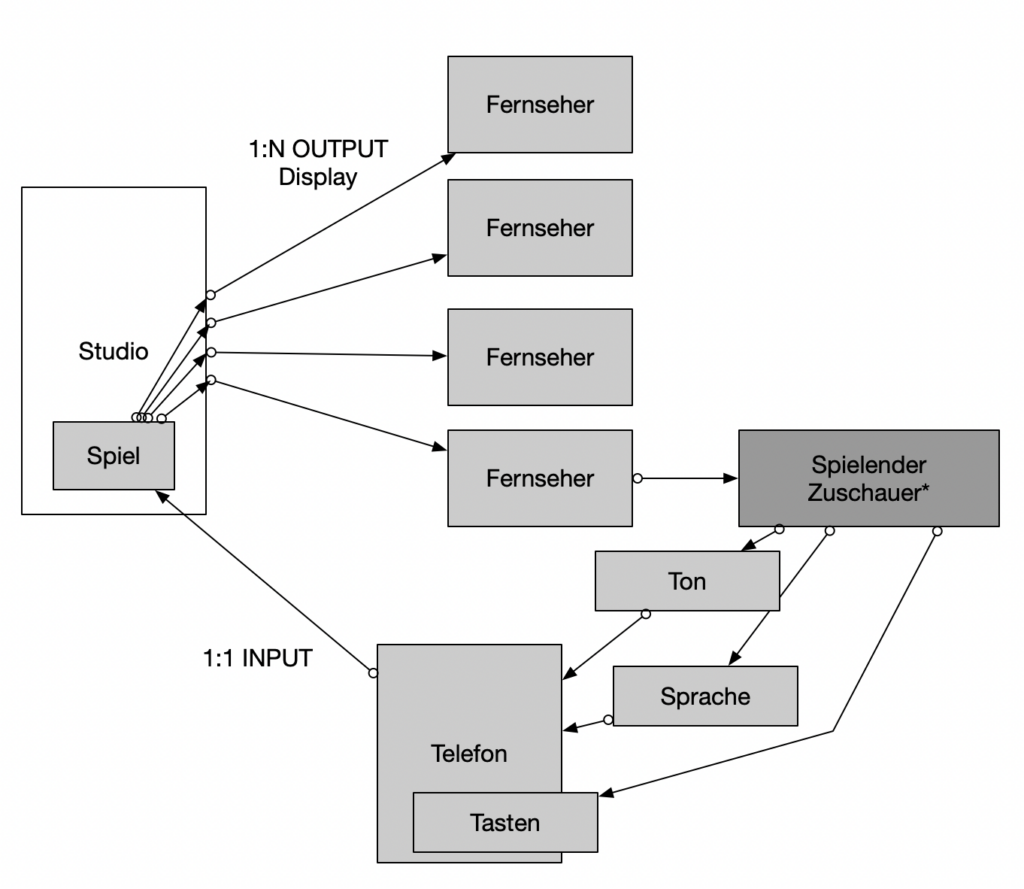
Eine interessante Videospielkategorie und -genre sind die TV-Analog-/Digital-Spiele. Es scheint als fange alles damit an, dass es Spiele gibt, die im Studio gespielt werden und dann übertragen werden.
Ein ganz neue Qualität erreicht das Ganze mit den TV-Telespiele aber damit, dass die Spiele nun interaktive Echtzeitspiele werden. Erstes bekannteres Beispiel ist dabei der „Goldene Schuss“. Allein schon der Titel lässt erahnen, dass das Ganze schon sehr früh ausprobiert wurde. Siehe dazu auch die elektromagnetischen Arcades >
Der goldene Schuss 1964+
Die Erfindung eines Schweizer Producers erweitert konsequent das Studiospiel zum interaktiven analogen TV-Videospiel mit Stimminterface. Das Erstaustrahlungsjahr 1964 ist dabei auch sehr früh, wenn man es mit den aufkommenden analogen Arcades dieser Zeit vergleicht.
Der Task ist klar und bedient sich bei Tells Apfelschuss-Mythologie. Es muss mit einer Armbrust die Schnur getroffen werden, an dem ein Apfel hängt. Der Spielende* weisst den Operator an mit „links/rechts/rauf/runter“ zu zielen. Das Ganze wird aus der Firstpersonperspektive gefilmt. Das Videospiel wird hier offensichtlich menschlich vermittelt. Viel Symbolik (an einem Faden hängen) ist hier zu finden in dieser Sendung, die immerhin 50 Mal ausgestrahlt wird. Der Name muss aber bald schon für eine andere Tragödie herhalten.
Dadurch entsteht ein interessantes recht komplexes Setting für das Spielen eines Videospiels.
Statt eines 1:1 Mediums (wie es das Videospiel werden wird) ist dies hier ein 1:N Medium im Display bei dem genau eine Linie benutzt wird, um zu spielen. Dabei werden viele dieser Spiele für das Setting Fernsehen entwickelt.
Stimmgesteuertes Fernsehspiel – Telespiele bei ZDF
Die Töne sind schrill und gehässig. Es ist k=ein epochaler Kampf. Zuvorderst wandeln konservative, reaktionäre Parteien und daneben auch lautstark heruntergewirtschaftete Medien wie die NZZ. Und es scheint, um viel zu gehen. Und tatsächlich, es geht letztlich – nicht nur philosophisch – um alles!
1. Die Welt des Diskurses
Auf der Metaebene ist dabei nicht viel passiert: lediglich die Idee/Erkenntnis, dass unsere soziale Welt (und damit fast alles) in Diskursen strukturiert und gemanaged wird, ist schlicht und ergreifend von den Universitäten der 80er/90er Jahre nun im Alltag angekommen (Das hat auch mit den konkreten Copy-Socialmedias zu tun, die ein Teil der Theorie defiktionalisieren).
Der Diskurs als „Kontrolleur“ ist nicht Neues – das war schon immer klar. Aber: Spätestens seit der Herrschaft der Nationalsozialisten ist klar, Diskurskontrolle ist auch Kontrolle von Gesellschaften und ihren Möglichkeiten (Handlungs-, Entscheidungsmöglichkeiten) oder als Spiel: „Aktionsmöglichkeiten“ – Gameplay. Wer* die Diskursmöglichkeiten kontrolliert, der* kontrolliert einen Teil des Denkens bis hin zur konkreten Handlung. Gewisse Gedanken und Aktionen werden vom System (ganz im Sinne kybernetischer Systeme) belohnt und andere eher ‚bestraft‘. Und so fahren wir auf belohnenden Diskursautobahnen und wandern teilweise auf gefährlichen Wanderwegen mit Ausblick durch/in/mit dem Diskurs. Schön defiktionalisieren gerade AIs diese Diskurspfade. Mächtig ist, wer Diskurs(e) shapen kann – das war „schon immer so“. Und so lange man* den Diskurs shapen kann ist alles offen.
Es gibt immer wieder interessante Welten – auch in Büchern, die alleine mit ihren Regeln/Settings Welten entstehen lassen, in denen zwangsläufig interessante Dinge ‚passieren‘ (Narrative Mechaniken). Die Geschichten darin entstehen dabei fast schon aus dem Spiel dieser Regeln/Setting-Regeln – einer Art Play und Anwendung der Weltregeln. Die Welt der Wandler* in Wood- wie Seawalkers ist so eine. Dabei geht der Text nicht soweit, dass er wie etwa DeSade-Texte – alle Kombinationen von Protagonisten-Protagonisten-Konflikt-Kombinationen und Möglichkeiten ausbuchstabiert, sondern der Text spielt eher mit den Überraschungen aus den narrativen Regeln.
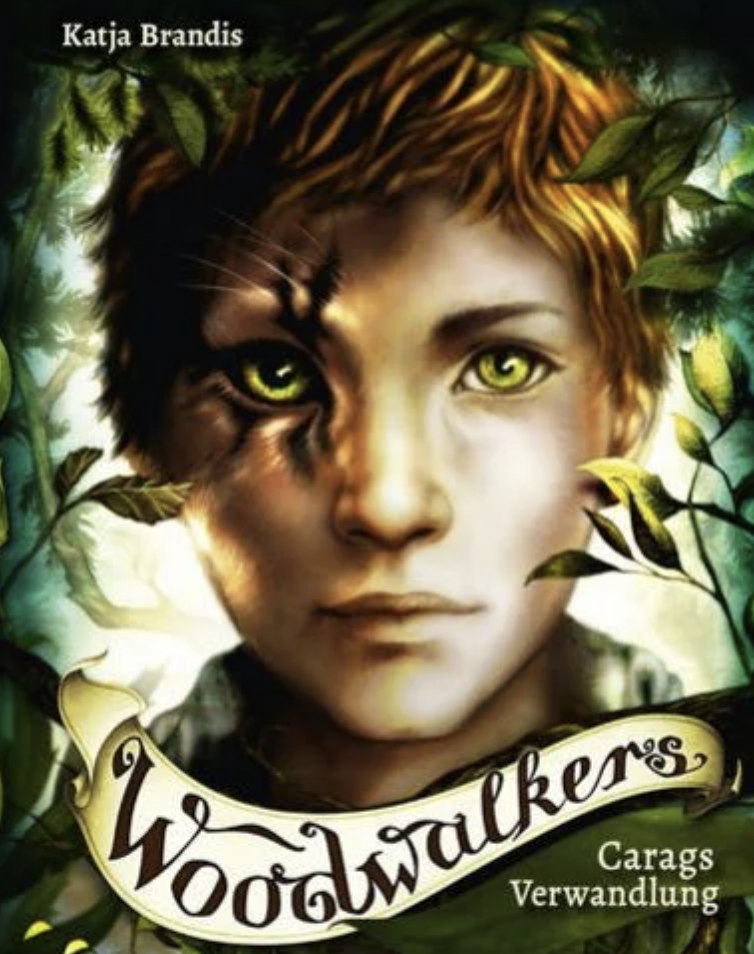
Woodwalkers und Seawalkers 2016+
Woodwalkers (ab 2016) und darauf aufbauend Seawalkers (ab 2019) ist eine deutsche Jugendbuch-Fantasy-Buchreihe der Autorin Katja Brandis (Pseudonym). Die Serie bzw. ihre Welt ist mit mehreren Millionen verkauften Büchern erfolgreich. Hier findet sich die Webpage der Macherin >
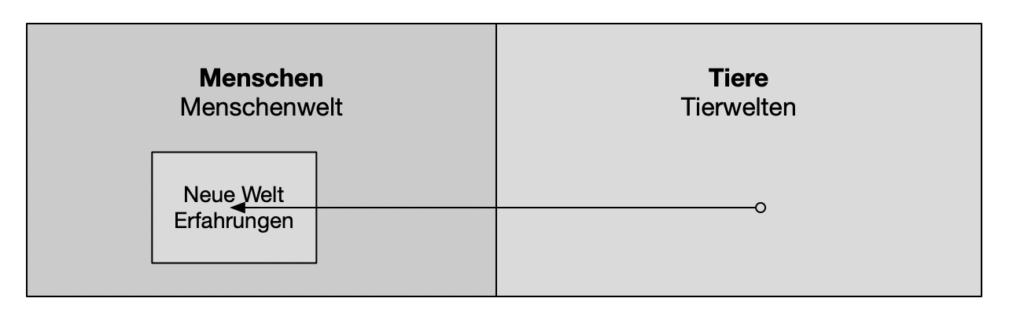
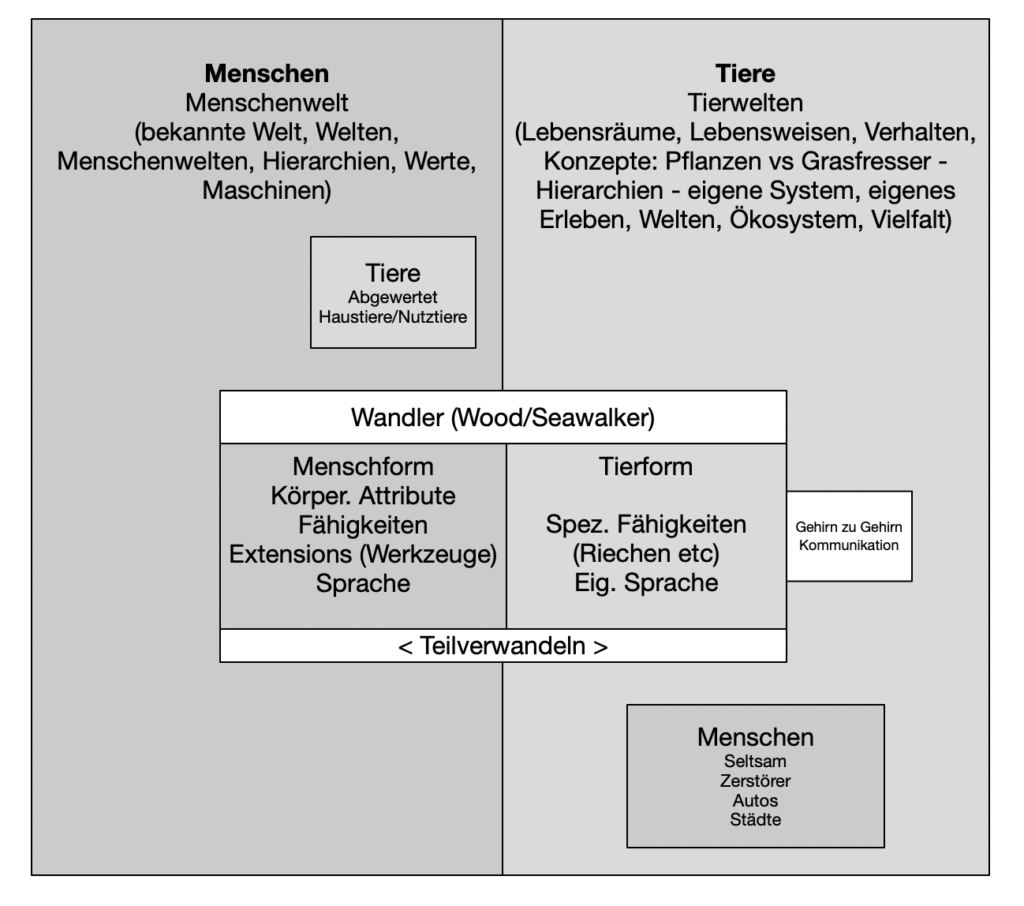
Die Welt der Woodwalkers/Seawalkers ist in der Jetztzeit (so 2000+) angesiedelt in den USA (YellowStonePark & Florida). In dieser normalen ‚Welt‘ gibt es Wandler*, die können zwischen einer Menschengestalt und einer gegebenen/angeborenen Tiergestalt hin- und herwechseln – allerdings muss dies gelernt werden, um es bewusst machen zu können. Es gibt also eine Art Parallelwelt, die die Protagonisten* und Leser* mit ihnen entdecken. Dass es Gestaltwandler gibt, ist dabei nicht bekannt in der Menschenwelt und in der Tierwelt werden sie teilweise gemieden. So handelt das erste Buch von Carag einem Puma, der im Yellow Stone Park lebt mit seinem Rudel.
Menschen waren geheimnisvoll und mächtig. Manchmal stanken sie auch, oder sie benahmen sich wie Kaninchen, denen der Kopf fehlte. Zum Beispiel kapierte ich beim besten Willen nicht, warum sie es so toll fanden, wenn irgendwo heißes Wasser aus der Erde schoss. Gerade sammelten sich dort beim Stützpunkt im Tal – bei einem dieser heißen Orte – wieder mehr Leute, als ich zählen konnte, setzten sich auf längliche Holzstücke und warteten geduldig auf das Ereignis.
Garantiert hatten sie auch wieder diese flachen, handtellergroßen polierten Steine dabei, aus denen ich nicht schlau wurde. Die Leute streichelten die Dinger oder unterhielten sich mit ihnen; manchmal deuteten sie damit auch auf irgendwas oder auf sich selbst …
He, Carag, du bist gerade dermaßen langweilig. Enttäuscht verpasste mir Mia einen Hieb mit eingezogenen Krallen. Blitzschnell schlug ich zurück und zeigte ihr die Zähne. Und du bist kindisch. Käferschubsen? Das habe ich mit fünf gespielt!
Meine Mutter schob sich zwischen uns. Schluss damit, wir gehen jagen. Los jetzt!
Er entscheidet sich dann aber als Mensch zu leben (und seine Pumafamilie hinter sich lässt) und als 10 jähriger Junge ohne Gedächtnis in eine Pflegefamilie kommt. Dabei muss er natürlich alles neu lernen, diese Sitten/Rituale/Regeln der Menschen. Es bleibt auch unklar, wieviele dieser Wandler* es gibt, wer das ist und warum.
Dabei wird selbstverständlich ähnlich vorgegangen wie bei den grossen Klassikern wie Der abenteuerliche Simplicissimus und co . Alles kann neu beschrieben werden, wie die Sozialisierung immer schon funktionierte: Es ist seltsam und eben nicht gewohnt. Die Menschenwelt wird aus der Tierwelt beobacht- und erlebbar. Ein neues anderes Regelset muss angeeignet werden. Und selbstverständlich auch umgekehrt. Dabei werden Wandler* in eine Menschenwelt oder eine Tierwelt geboren. Eltern können, aber müssen auch nicht Wandler* sein. Sie können, müssen es aber auch nicht wissen.
Micromechanik – Verwandlung
Selbstverständlich ist das Verwandeln in der Menschenwelt keine gute Sache, denn so etwas existiert einfach nicht und kommt eher in Horrorfilmen vor. Aus diesem Grund ist Verwandlung eigentlich immer ein gefährlicher Akt und weil nicht immer gewollt auch immer eine gut nutzbare narrative Mechanik.
Und so wird die Erstverwandlung dann vielleicht zum seltsamen Ereignis etwa hier Seawalkers:
Eigentlich wollte ich nicht aus dem Wasser heraus. Es fühlte sich so gut an, obwohl ich angeblich allergisch gegen Meerwasser war. Andererseits hatte sich meine Haut irgendwie grau verfärbt, das war garantiert nicht gesund, außer man war ein Elefant. Besorgt starrte ich auf meinen Arm, während ich weiterschwamm.
Dann fiel mir auf, dass mein Rücken juckte. Während ich mit halb untergetauchtem Kopf weiter in Richtung Strand schwamm, griff ich nach hinten, um mich dort zu kratzen, wo es am meisten kribbelte. Und bekam den Schreck meines Lebens. Dort war irgendetwas Festes, das dort eindeutig nicht hingehörte! War das eine Rückenflosse?
O mein Gott! Hatte mein dämlicher Kumpel mir die irgendwie angeklebt? Aber das hätte ich doch merken müssen! Instinktiv drehte ich mich um, sodass das Ding – was auch immer es war! – nach unten ragte, und schwamm auf dem Rücken weiter.
Die Charakteren sind auch immer hin und hergerissen zwischen den zwei Welten in denen sie Leben könn(t)en (wenn sie davon wissen). Als Tiere brauchen sie etwa kein Essen zu verdienen, sie können es sich selbst beschaffen, als Menschen dagegen brauchen sie als erstes Geld etc.
Dies kann auch bei geeignetem Einsatz spezielle Momente und Dramaturgien eröffnen. Denn jede Gestalt hat so ihre Eigenheiten: als Eule kann man fliegen, als Wolf gut riechen etc. Und alle Zusammen können von Kopf zu Kopf sprechen oder flüstern. Aber das können dann auch alle Wandler*. Besonderes Augenmerk liegt auf der Möglichkeit teilverwandelt zu sein, was am Anfang problematisch ist, aber dennoch auch genutzt wird.
Das ergibt dann ein recht komplexes Spiel mit Systemen, Wertungen und Switches und der Möglichkeit und diese machen die Bücher fast immer: Es lässt sich sowohl als Gesprächsdikussion wie auch in der Geschichte diskutieren. Wie zähmen etwa die Tiere in ihrer Gestalt als Tier ihre ‚angeborenes‘ Verhalten? Die Tiere leben natürlich in sehr eigenen Regelsets leben – etwa eine Spinne und so sind Dinge dann ’nussig‘, ‚katzig‘ etc. Am Ende geht es aber um die Integration in eine Community oder anders gesagt, das Anwenden von Homo ludens: Regeln für bestimmte Situationen.
In Seawalkers wird vieles noch radikalisiert, handelt es von Wassertieren und spielt in Florida. Hier ist die Verwandlung natürlich noch zusätzliche aufgeladen: Verwandeln endet hier einfach mehrheitlich mit dem Tod etwa bei Delfinen, Haien, Rochen oder Seesternchen während die Mitschüler als Alligatoren besser weg kommen.
Interessant ist hier auch der körperliche Aspekt der Verwandlung. Verwandelt sich ein Mensch zu einem Tier, ist das von harmlos bis gefährlich. Ist das Tier kleiner als der Mensch dann bleibt einfach ein Haufen Kleider übrig, die dann versteckt oder irgendwie mitgenommen werden müssen. Ist es umgekehrt, sind danach alle Kleider kaputt. Das heisst sie müssen vorher ausgezogen werden. Noch Konflikt bzw. potentiell Schambeladener ist das umgekehrte vom Tier zum Menschen. Dies wird aber – Jugendbuch – recht aussen vor gelassen. Meist liegen dann schon kleider rum. „Ist halt so“. Aber auf jeden Fall ein interessanter Punkt.
Alles ist ein Intertext – das ist heute eine banale Feststellung und meint, dass alle Texte und damit auch Bilder miteinander verwoben sind in unterschiedlichsten Konstellationen. Sie bilden je nach Nutzung und Wissen wiederum eigene Plateauxs (Deleuze/Guattari) und eigene Bedeutung, aber am Ende hängen die Texte/Bilder/Töne – nicht zu letzt über die Gutenberggalaxis und seit 30 Jahren übers Internet/WWW – miteinander zusammen – im Bereich des WWW gibt es nicht nur wie beim klassischen Text Koordinaten (Titel, Ort, Zeit, Autor) sondern eine Unique Ressource Location (URL).
Sofort beginnt nun natürlich die Frage der Verhältnisse all dieser Texte. Wie stehen sie zueinander, was grenzt sie ab, wo ähneln sie sich, was entstand wo, wie, warum. Dies führt im kulturellen Kontext schnell zu wertetenden Auseinandersetzungen, geht es doch um Urheberschaft bzw. um die Frage, wer war zuerst da, wer hat die Innovation in die Welt gebracht. Siehe dazu auch Palimpseste von Genette.
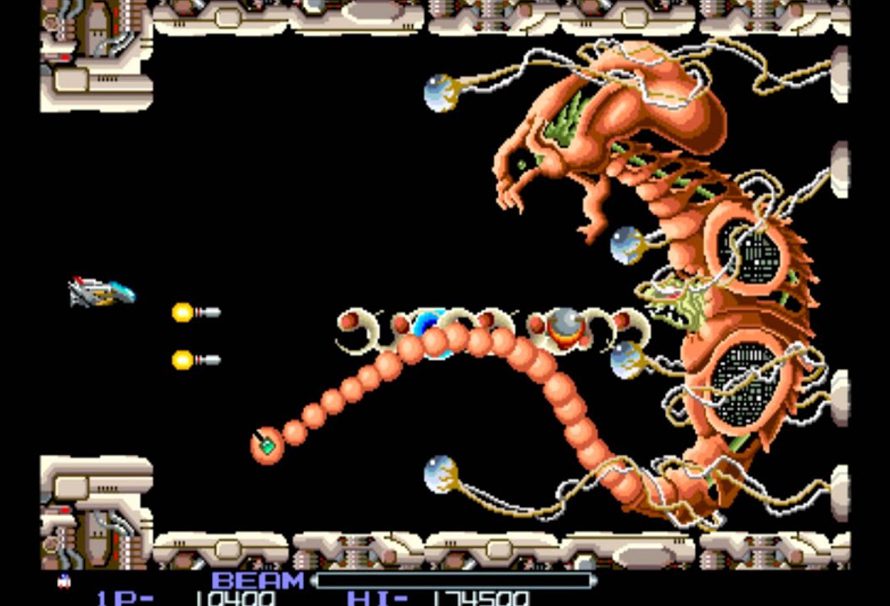
Betrachtet man dann die Spiele als Intertext, ist schnell klar, sie sind massiv mit ihrer kulturellen ‚Umgebung‘ verwoben, sei es in die Allgemeinkultur oder wiederum in die Spielkultur. Und ihr Game-Intertext ist oft auch mehr als nur zufällig sondern bewusst gestaltet und bewusst sind Referenzen eingangen worden. Im obigen Fall ist klar – inspiriert bei Giger und Alien (Insekt, ausbrechendes Inneres, Schwanz etc) und anderen. Die Referenzen werden im Laufe des Spiels noch mehr.
„Abgekupfert, Kopie, Clone“
Aus heutiger Sicht wurde hier stark ‚abgekupfert‘ bzw. ‚kopiert‘. Das heisst es wurden Elemente genommen und direkt eingesetzt und milder: teilweise angepasst. Dabei bewertet der Label-‚Kopie‘, dass keine Eigenleistung vorgenommen wurde. Im vorliegenden Fall wäre es eine visuelle Kopie. Es sei also eine 1:1 Adaption des visuellen Stoffes.
Die Arcade, 8-Bit und 16-Bit Homecomputerphase ist in sich geprägt von dieser Art des „Abkupferns/Kopierens“ von einzelnen Objekten bis hin zu Malstilen, Settings und Spielmechaniken. Dies verwundert nicht, da eine der ersten Mainstream Verwertungsketten war: Von den Arcades zu den Consolen und Homecomputern. Und so wollten die Leute auch zu Hause, das spielen aus den Arcades. Die Industrie regelte das über die Ports. Deswegen entstanden auch viele ‚unerlaubte‘ Kopien/Clones, die keine öffentlichen Ports waren, einfach weil die Leute zu Hause spielen wollten. Langsam entstanden aber auch unabhängige Spiele – andere Spiele gerade auf Homecomputern etwa für die Tastatur oder dann Maus.
Aber selbst bei R-Type wird klar, dass R-Type mehr ist, als nur eine Kopie ist, es „kollagiert“ auch viele Dinge und webt es neu zusammen. So kommt die Mechanik aus der Mainstream Gamekultur und verwandelt sie mit dem neuen Setting zu ganz was Neuem.
„Tribute“ – Hochachtung
Für die Entwickler* damals (hier muss noch weiter nachgefortscht und noch konkreter gefragt werden) war es allerdings oft meist keine „Kopie“. Sondern ein „Tribut“ an die „wundervollen“ Demos oder Spiele. Es ist vielleicht sogar ein Zeichen der Zeit, dass die Dinge erkennbar blieben, dass also klar war, auf wen man sich bezog. Anders als heute, wo man versucht im gesetzlichen Rahmen zu sampeln. Ein Teil der Crack-Intros lassen sich auch so – als Akt des Bewussten zeigens, woher es ist – lesen. Es wird geschmückt mit den interessanten Inhalten wie etwa Music und Grafiken. Anders gesagt die visuellen Anleihen bzw. Zitate waren ‚Opfergaben‘ an die Vorbilder. Man* zeigte damit, dass man* ihre Welten faszinierend fand und letztlich Teile davon weiterverwendete. Intertext pure. Oder im besten Fall: Die Stoffe wurden weiterverarbeitet etwa im Fall von Giger und verändert. Sie wechselten das Medium und waren etwas Neues in diesem Feld der Games. Sie kamen damit als Innovation in den „Game“-Markt. Es ist die Hochachtung für das ‚Orginal‘ (// Zitate raussuchen von Gamedevs). Viele liessen es dann bei solchen ‚Quotes’/’Anleihen‘ bewenden. Aber immer ist die Frage da: Wie fügt sich das Entlehnte ein als Grafik, als Sound, als Spielmechanik. Es gibt hier verschiedenste Formen von ‚Aneignung‘ oder anders gesagt Nutzung.
Eine Möglichkeit von Integration und Neukonzeption nennt man auch Mukokuseki. Es ist die Art und Weise wie man Elemente aus verschiedenen Kulturen nimmt, zerhackt und sie wieder neu zusammensetzt zu einem neuen Stil.
R-Type ist ein gutes Beispiel dafür. Es verwendet Alien im Kern und meandert dann in verschiedenen anderen Welten und Systemen, liefert aber dennoch etwas ganz eigenes gepolishtes ab, etwas also, dass wiederum für sich alleine steht und auch so wahrgenommen werden kann.
Aber sicherlich war es auch nicht abträglich, dass Alien ein Erfolg war und man damit an die visuelle Kultur anschloss.
„Verschieden Kapitalien“
Anders gesagt, die verschiedenen Anleihen formten nicht nur einen neuen Intertext und verstärkten Verbindungen, sondern zahlten auch auf verschiedene Arten von Kapitalien ein (Neuigkeit, Innovation in Sachen Stil, Grafik, Audio, Spielmechanik etc) bzw. bedienten verschiedene Communities. Und im besten Fall waren dann SciFi Fans und Arcade-ShootemUp-Fans im selben Topf.
„Das Neue“
Wie schwierig es ist, Kopie und etwas aus einer Kopie entstandenes Neues zu unterscheiden, zeigt sich bei Turrican. H. sagte im persönlichen Gespräch einmal, dass Turrican eh nur eine Kopie von Oscar sei. Nun kann man tatsächlich die Gemeinsamkeiten zwischen Turrican und Oscar schnell erkennen.
Sehr schnell aber erkennt man auch die Unterschiede in Grafik, Music und Gamemechanik. Oder anders gesagt: Das Konstrukt Turrican ist etwas ganz Eigenes und erscheint damit auch als Neu und nicht mehr als Hybrid oder klar heranführbar an Oscar. Anbei die verschiedenen Versionen von Turrican.
Wichtig scheint zukünftig, dass genauer hingesehen wird, wenn es um Wertungen geht im Designprozess und dass auch die Designer* zu Wort kommen mit ihren Ansichten und Vorstellungen.
Dies ist im Gamedesign umso wichtiger, da hier verschiedenste Traditionen zusammenkommen vom Visuellen bis zum Coding.
Veröffentlicht unterUncategorized|Kommentare deaktiviert für Tribut zwischen Bewunderung, Hochachtung, Abkupfern (Klones/Copy_cat) und Absatz?
Eine Antwort ist letztlich unendlich banal und hat doch mehr als ein Körnchen Wahrheit: Fantasy ist mehrheitlich einfach – darum ist sie ja auch eskapistisch.
Fantasy befreit – um Baudrillard zu folgen für Games – nicht von der Welt, es gibt uns viel strengere Regeln und diese Diktatur der Regeln befreit uns von der Komplexität der moralischer/ethischer Entscheidungen. Moral und Ethik ist in den meisten Fantasies banalisiert: Der Kampf zwischen Gut und Böse. Oft ein Hin- und her zwischen Ordnung und Chaos.
Und Ordnung ist meist informationstechnisch einfach: Es ist Hierarchie der Macht. Und Trees verkörpern in jedem Ast totale Kontrolle der Macht und deren Auslegung. Darin spiegelt sich massiv der Wunsch nach Vereinfachung der Welt. Eine Zuspitzung. Eine Klarheit. Auch selbstverständlich einen Naivität der Klarheit, denn die Welt ist nun einmal unendlich Komplex. Insofern ist Fantasy immer schon Biedermeier.
Politisch geht es mehrheitlich nicht um Demokratien oder das sich etablieren von Demokratie. Es geht um Könige und Völker. Die Zukunft ist nicht offen, sondern sie ist immer im Gestern – in der Restauration – in Mythen, in Voraussagen. Vorbestimmte meist eingesessene stratifizierte Gesellschaften. Die Helden* sind fast immer verstossene oder vergessene Figuren, die zurück in ihre Position wollen (meist als Heldenreise*) oder dorthin gestossen werden müssen. Es ist viel Gerede von Schicksal und Vorbestimmung. Der Faschismus sah ebenfalls seine Zukunft in der Vergangenheit legitimiert. Und so auch im Fantasy, in der die Vergangenheit (und sei es auch nur als Vision) legitimiert und der Leistung enthoben. Hier verdient man* sich maximal etwas, indem man sein Schicksal erfüllt. Als Held- oder Heldin oder dann als Unterstellte*.
Oder direkter: Es ist so, wie sich die Moderne das Mittelalter vorstellt – eben das Fantasiemittelalter mit Drachen, Elfen, Hexen etc. Und dann kämpfen dann gute Völker gegen böse Völker oder direkter Rassen gegen Rassen. Und das schlimmste ist – meist gibt es wichtigere Menschen, Rassen und Klassen und der Rest ist Masse.
Insofern sind die meisten Fantasyromane, -filme und Spiele keine grosse Auseinandersetzung mit der Welt bzw. können – es gibt ja auch viele mit Bezug – viel einfacher gelesen werden. Und hier kann rechtsaussen gut angesetzt werden – in diesen einfach banalen Lesarten. Das Reaktionäre als radikales Template für teilweise radikale ‚Modernitätsideen‘ – als das Morgen als Fortsetzung von gestrigem Gedankengut. Das findet sich dann in den SciFi-Fantasies.
Veröffentlicht unterUncategorized|Kommentare deaktiviert für Warum finden (etwa in Italien) auch Faschisten Fantasy – wie etwa Herr der Ringe – so cool?
Instruction Manuals – accessible and for everyone, but now obsolete
Most games in the 80s and 90s came on discs or CD-ROMs in artful cardboard boxes and contained an insightful instruction manual. The printed booklet was essential for teaching how to play the game, telling a story or prologue and making a player familiar with the computer system the game was made for. Instruction manuals were clear and detailed, often even extensive. The Swiss games of the 80s and 90s relied on them as much as any other game. These instruction manuals showed an interesting diversity of approaches from story booklets over cartoons to extensive strategy guides.
Part 3 — From Strategy Guides to Downsizing the printed matter
The extensive Strategy Guides
“Wer am meisten Schnecken besitzt, erhaelt von FatMike einen Preis. Und zwar einen GeldBetrag, oder – bei mindestens 70 Schnecken – ein zusaetzliches Land-Feld! Der oder die Sieger werden angezeigt, danach alle Spieler JOY-KNOPF druecken. […]” (Traders Manual 1990, p.30).
„Who owns the most snails, receives a prize from FatMike. Namely a sum of money, or – with at least 70 snails – an additional land area! The winner(s) will be shown, then all players press JOY-BUTTON. […]“ (translated by author)
Traders (1990) is a game that can keep up with the two clown games mentioned above in terms of humor, but it is an economic simulation game and thus belongs to a genre that is usually very serious and has many realistic components. Not so Traders: Here the goal is to give as many snails as possible generously and voluntarily to the most powerful ruler over all stars, the owner of FAT-STAR, Fat Mike. The science fiction setting is populated with aliens. We can control a so-called ‘plubber’ and have to try to work our way into a good position via trade, all the while paying taxes to Fat Mike, the powerful mutated snail. Markus Grimmer, André Wüthrich and Michael Tschögl have developed a funny trading simulation for LINEL, which is reminiscent of MULE, but very independent.
FAT-STAR, that is the earth in 2000 years, after all dinosaurs and vermin have died out, as the booklet explains on page 4. This future earth is populated by ‘plubbers’, aliens who have traveled here from an alien planet. Snails, on the other hand, are no longer plentiful; finding them is the players‘ task. The booklet is written very colloquially and tries to introduce the players to the story and gameplay with colloquial humor and lightly commenting sentences. It succeeds well. Nevertheless, the manual is comprehensive and includes descriptions of all game areas, sequences, menus as well as farming and trading on a total of 32 pages.
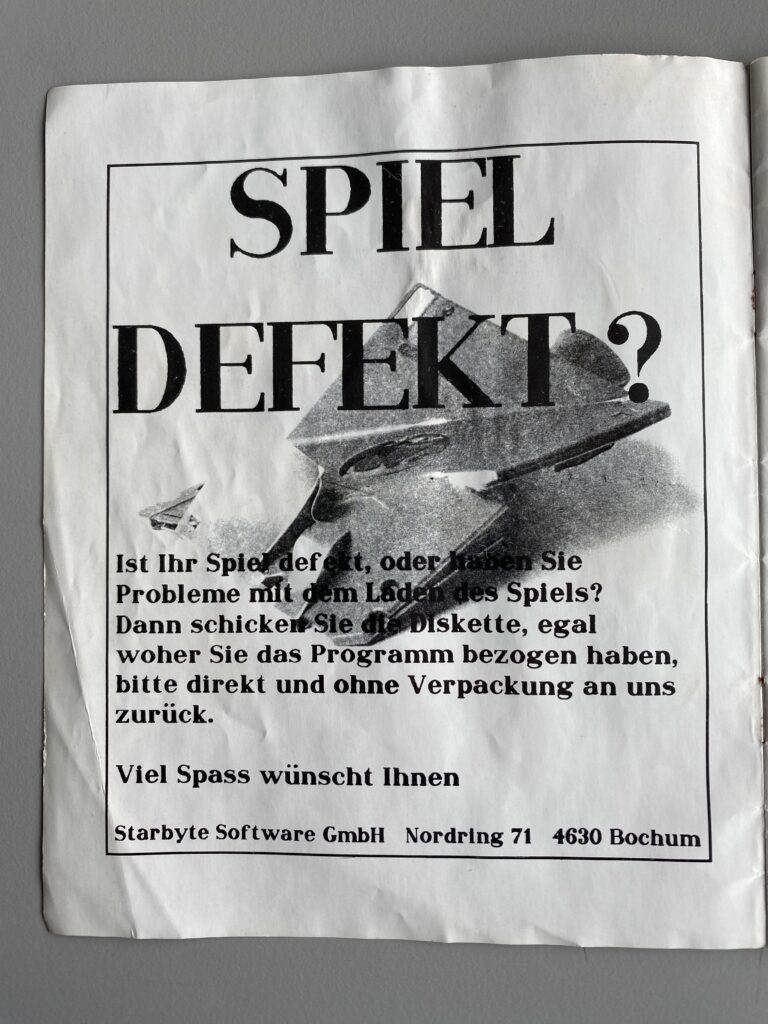
More in line with the genre is Transworld’s (1990) instruction manual by Starbyte. It uses the same format, paper quality and fonts as Rings of Medusa (1989). The glossy cover and back have a slight faded and yellowish look. The whole booklet is printed in black and white with rasterized grey tones on the cover and the inside of the cover that is used to let the player know that they can exchange a defect disk if they send it to Starbyte Software in Bochum (Figure 13). The manual starts on page 4 and continues all the way through the end in written text. There are no graphics, no lists, and no pictures!
Figure 14: All Starbyte products came with a guarantee to exchange defect discs. Photo: Suter
The chosen topic for the strategy game is somewhat surprising. “You are a young dynamic entrepreneur who is trying to build your own empire in Frankfurt in the area of local and long-distance transport.” (Transworld 1990, p.4) The player gets a starting capital of 50’000 DM and has to build their business with this. The economics and trading simulation is introduced to the player step by step. First with descriptions of the main elements of the game and then with a thorough explanation of all the menu points. Even the goal is a complex one since business success means a certain score that is combined from acquired cash, number of established branches, number of owned trucks and the frequency of punctual deliveries. The fall of the Berlin Wall in 1989 was like a cathartic new beginning for some enterprises. This may have been enough inspiration for the developers to start their transport simulation. But the road to success or failure involving the newly opened part of Europe was difficult. This fact is also recorded in the game.
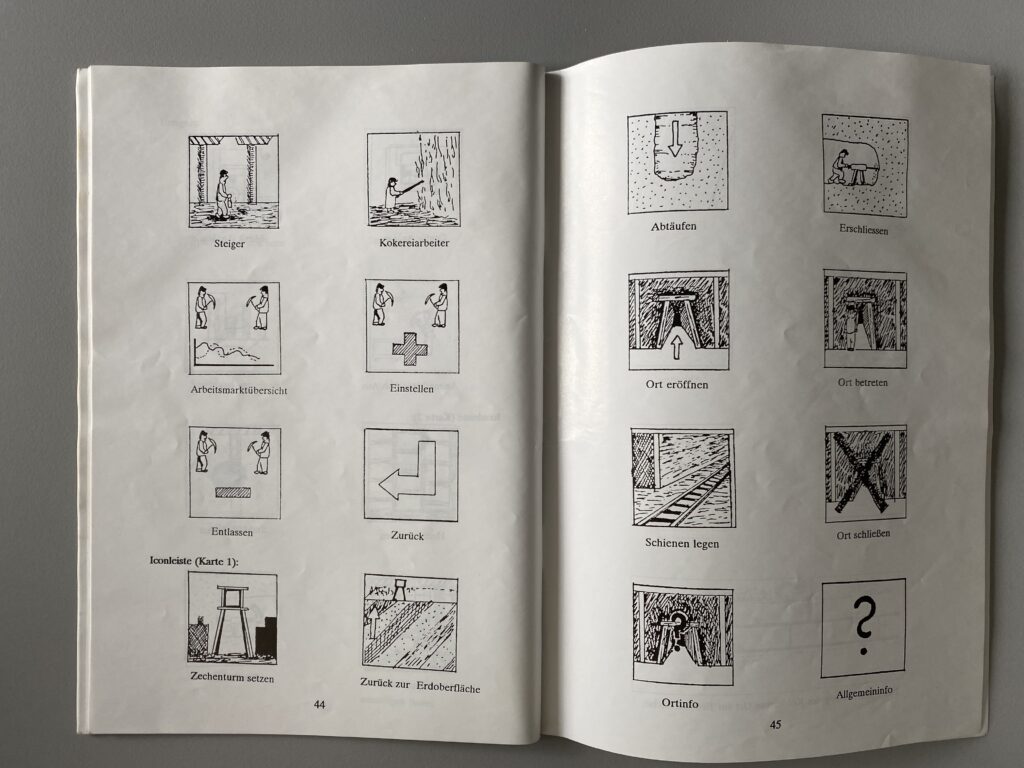
Striking is the direct addressing of the player in polite form. Like Transworld, the build-up and strategy game Black Gold also uses it to involve the player right away in topic and story of the game. And here too, the player inherits a company that has to be managed well. Becoming a successful capitalist apparently was more than just a dream of young people around 1990. Black Gold’s manual has 48 pages with a textual story and topic introduction on the first four pages. Then the extensive menu points must be explained over the next 22 pages. And after the specifics for the different computer systems, the game can be used with, there is an appendix of 12 pages that shows icons and symbols you encounter in the Ui as small handmade drawings (Figure 14). The last of those pages shows the main menu as a city or area map with the different areas you have to access for extracting coal, refine coal and trade with the commodity.
Figure 15: Black Gold’s (1992) manual shows a catalogue of Icon bar buttons. Photo: Suter
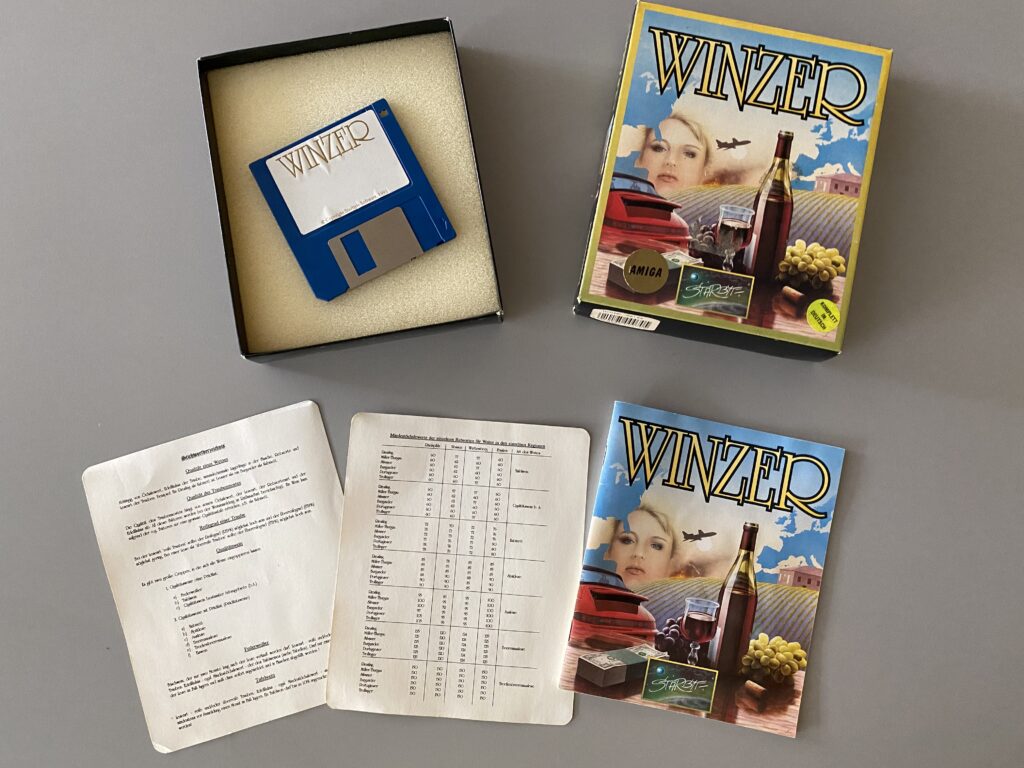
In terms of topic, Winzer (1991) is the most surprising strategy game of that time with Swiss participation. The player gets to know that they inherit a vineyard in Germany with a prospective 4 Mio. DM, if they cultivate more wine and take successfully part in a competition with other winemakers. Winemaking as a business game simulation? Quite a fancy occupation. The Cover of the box and the booklet show that it may be the dream of an aspiring millionaire, a successful entrepreneur. The wine is nicely presented as a luxury food item in midst of grapes, the vines in the background are plentyful with a plane (travel) and a woman’s face hovering over them. A mansion on the horizon, a Porsche and a wad of money are awaiting the player and suggest a lavish lifestyle (Figure 16). In the game, however, it’s a long way to get there. and the player has to work through many obstacles.
Winzer’s booklet tries to make you familiar with the wine business and is quite extensive. Story and gameplay options take up 27 of the 32 pages and are addressed to you as a city dweller that accidentally has to become a winemaker. The manual has two unusual features: It comes with two additional leaflets that are designed to help players get into the business faster. An index with explanations of the quality and types of wine. And a table with the minimum Oechsle scale values of the individual grape varieties for wines in the individual regions. The second additional feature of the manual is something that other games at the time used as well: A measure for copy protection. The printed manual had a second use as a password entry tool. At the start of the game, a mask is introduced as copyright protection, which requires a password. The assumption was that a pirated game did not come with a copied manual. The password could be found in the printed booklet bought with the game. The mask asks you to enter the seventh word on page 3 of the manual. And it alternates randomly. If you start the game again, you may have to enter the fifth word on page 6 or the third word on page 17. This was also done for new chapters or new levels. Each time, randomly chosen, you had to enter a certain word on a certain page to continue playing the game. A simple and nifty way of copyright protection with a printed paratext. But nevertheless, if you were part of the gamer community, you found a way to circumvent this measure as well.
Figure 16: Winzer (1991) is a strategy or economic simulation game with a surprising theme: winemaking. The booklet is accompanied by leaflets making you familiar with the not so familiar business. Photo: Suter
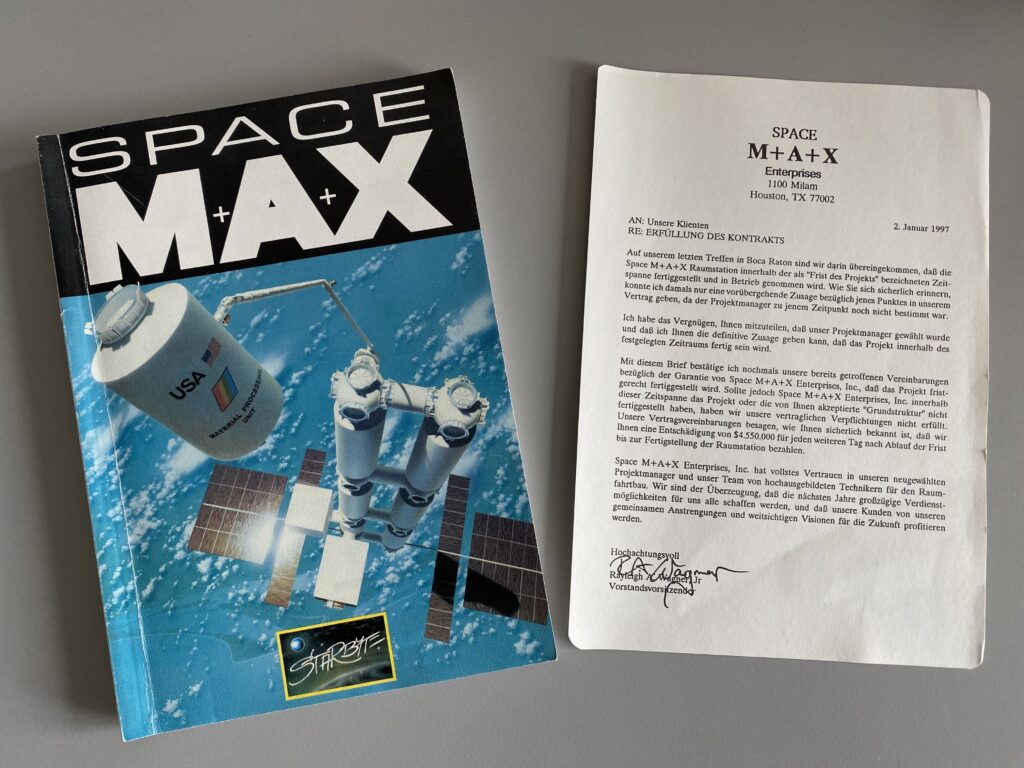
Probably the most comprehensive instruction manual Starbyte provided is the one for the game Space MAX (1992). The successful fictional production begins with a quote from US President Ronald Reagan from 1984 who saw outer space as humanity’s final frontier and as an opportunity for global leadership. Through the 80s, Reagan pumped a lot of money into the space shuttle program and started a decade of high activities in space what eventually led to a permanently manned international space station years later. This political awakening of space discovery mostly in the U.S. inspired Starbyte to build a realistic historical framework for the launch of a large space station by a private company (not a country) in the near future. The whole thing is nevertheless first and foremost an economic simulation, because even a spaceport cannot do without large financial resources and complex logistics.
It is fascinating how the developers spin reasonably realistic scenarios for a period of five years into the future and don’t let themselves be tempted to introduce any grandiose space scenarios. This is first framed in the booklet by the historical discussion of space exploration in the 1980s, which is followed by a very commercial orientation of a NASA space station. Thus, all the necessary means and systems are described in detail from project management to the assembly of individual space station modules as well as their habitation. For example, one of the safety precautions on the space station is described as follows: „Precautions shall be taken to monitor supplies of consumables. Timely replenishment of consumables shall be ensured.“ (Space MAX Manual 1992, p. 81, translated by author)
Figure 17: Cover of the booklet for Space MAX (1992) in color and a letter from the president of the board that states your hiring for the job of a project manager. Photo: Suter
After all the connections have been explained, the concrete manual of the game follows from page 95 on – again mainly textual and well structured. Finally, the specifications for the two systems PC and Amiga follow, as well as the appendices and a list with explanations of the acronyms used in the game. This brings us to a full 140 pages, printed in good quality on acid-free paper and bound by a color cover. Included, by the way, is a letter from the CEO of Space MAX Enterprises informing NASA that a trusted project manager has been hired and pledging to complete the space station on time (Figure 15). This separate staged letter skillfully completes the framework of the game’s story for the player. It’s a shame that this remained the last complete strategy game from Starbyte, as the company was dissolved soon after.
Downsizing
Traps’n’Treasures (1993) was initially published by Starbyte Software. The English version was released in 1994 by the British publisher Krisalis Software. While as the German manual by Starbyte is a sizeable 16 pages, the English version was shrunk to 8 pages. However, the English version comes in a well-planned professional layout and features an extra introduction that tells the player more about setting and what their role is.
The German version gives an impromptu and handmade impression, the pages all have a frame and titles in a gothic font like Germanica. And it starts with telling the player right away where their men are imprisoned by Red Beard. After this, the GUI gets explained, and then Joystick navigation and keyboard. Finally, we get to know important level elements and what the shop has to offer. So, the manual is somewhat downsized to explaining the elements of gameplay. After a short story summary as extra introduction (missing in the German version), the English version lays out the same information on just 4 pages. It is obvious that a large part of the story has been moved into the game itself. Thus, the game begins with quite a bit of text telling the back story of Jeremy Flynn, the captain of the Poseidon and his 37 sailors. The diary text of Flynn scrolls quickly from the bottom to the top of the screen automatically – and that for 2 minutes.
This trend of downsizing the manuals continued further. An important purpose of instruction manuals was to enhance the game’s lore and provide background information. As we have seen in the mentioned examples, manuals were often filled with additional details about the game world, its characters, and the story, offering players a deeper understanding and immersion in the game. This aspect of instruction manuals was where they truly excelled and showcased their value.
But their foremost and vital role was to teach players how to play a game. The mentioned games did this extensively, especially the economic simulations that could not rely on pictures and animations that much and impressed with a complex GUI. The manuals provided essential information on game mechanics, controls, and objectives. But, over time and with the rise of tutorial missions and in-game help systems, the task of teaching players how to play has been largely transferred to these interactive elements. And the instruction manuals became more and more obsolete.
And out they go – or not?
Looking back from today, you might state that the primary purpose of instruction manuals had become obsolete due to in-game information, tutorials and sometime later internet-guides, -videos and -walkthroughs. But what has been lost is more than just a chunky booklet, it is the art form of making an instruction manual that has an own value as a means of extending the game’s lore and providing additional tips, since instruction manuals were often crafted with care, featuring beautiful artwork and clever ways of presenting information.
“When done right, manuals felt like an extension of the game world itself. The pages could be designed to echo the setting, they could include maps, and they sometimes even gave context to the characters and world not found in the game. Of course, they often just contained pages of legal jargon, control guides, and told you how to turn on the console. But sometimes they went to extra mile, and it would be nice if they could again.” (Nelson 2021)
But physical game manuals with all kinds of information were produced much longer than we might think. Even though most of them became rather redundant through tutorials and in-game help, they were created for most boxed games up to around 2010. In the 00 years, PS3- XBOX360- and Wii-Games still had booklets with at least some tutorial, story, and extra information. But the next generation came without them. Ubisoft started saving money and claiming to become eco-friendly with abandoning printing manuals and publishing game information, stories, and extras online on their website in 2010. They stuck to it and other big publishers followed soon. But there was a big hesitation in the game industry to get rid of the booklets completely. Nintendo kept up the manual goodies and only stopped it with the release of the Nintendo Switch.
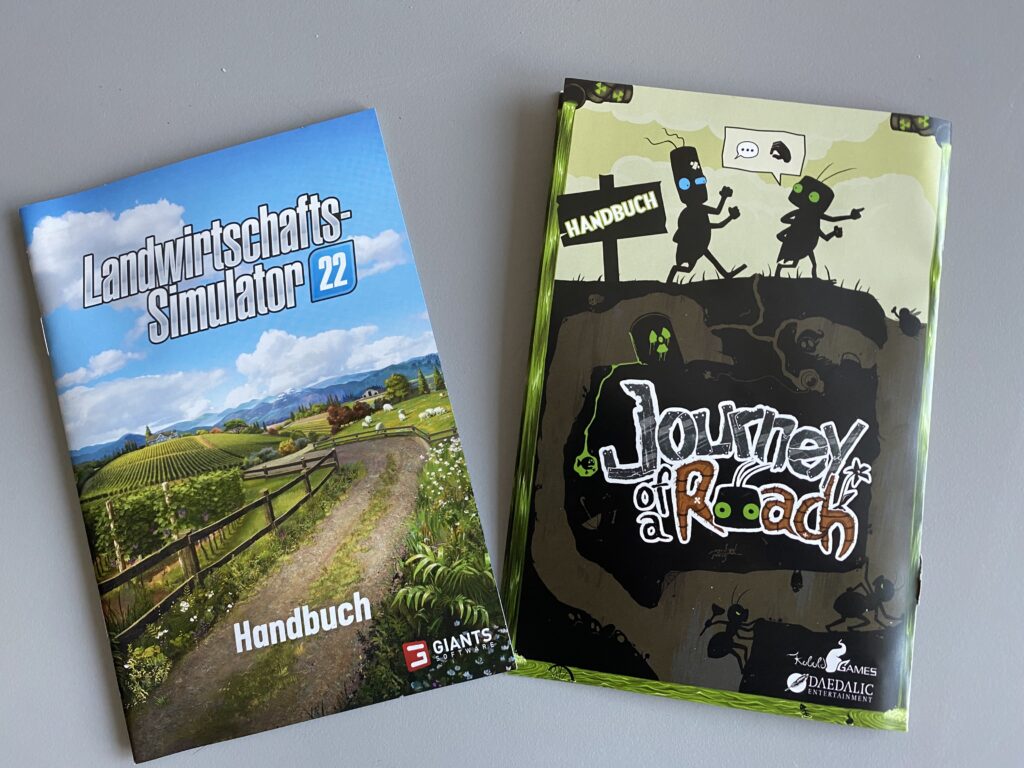
Figure 18: More recent booklets for the Farming Simulator 22 (2022) and Journey of a Roach (2013) were printed in color on glossy paper. Photo: Suter
Some Swiss games came with booklets even later than 2010. Journey of a Roach (2013), an innovative adventure game developed by Kobold Games and published by Daedalic had a classic twelve-page instruction manual in color that came with a description of the story, the menu, and the controls, nicely illustrated with character drawings and sketches for the UI and for the controls. However, the booklet seems to be put together in a hurry: The title page mistakenly features an ad for Daedalic’s popular game Deponia and only page 2 is the real cover page for Journey of a Roach. And the Farming Simulator seems to continue the tradition of printed manuals with some of their many boxed versions. The German version Landwirtschaftssimulator 22 (2022) comes with a 26-pages ‘Handbuch’. The color printed handbook starts with basic explanations for installations, an extensive list of all controls via mouse and keyboard and via controller. Then, it describes the player’s first steps and the Head-up-Dispay. On five pages it tells you the basics of farming, it continues with six pages of farming knowledge, three more pages for how to make money in the game and how to buy and look after your big important agricultural machines. Finally, there are two pages with information on multiplayer and mods. It really is a handbook that teaches unfamiliar players about all the possibilities in the simulation game. It compares to earlier booklets like Space MAX (1992) and offers the player a service they might not need unless they are new to the game.
„It’s funny, but I have a deep love for game-paratext that ultimately goes back to my childhood,“ says Eugen Pfister (2023), describing his journey back to the nostalgic world of paratexts. He remembers „big manuals“ and „maps of fantastic countries folded several times.“ For him, „touching, haptics […] was not only a matter of course, [but] […] a central moment of the gaming experience“ (translated by author). He formulates this under the impression of the practically disappearing printed inserts for videogames, because now less than 10 percent of games are still sold physically on carrier media and in boxes. For some years now, almost the entire distribution of games has taken place virtually via downloads and streaming. But that doesn’t mean that paratexts have disappeared altogether. They can now simply be found in the Internet with publishers, developers and, above all, on the streaming and sales platforms for games.
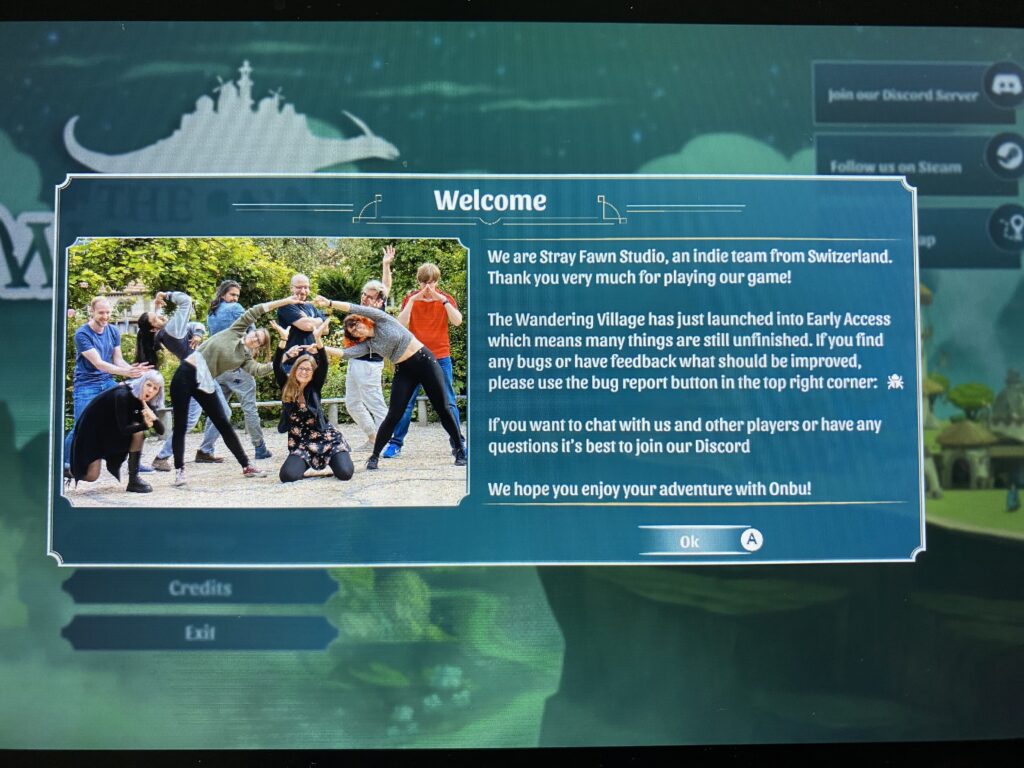
The game Far: Lone Sails (2018) by the Swiss developers Okomotive offers a very short intro of five lines on its Steam page. It is formulated as a minimal story and gameplay instruction. While this is standard on Steam, the info about the game further down is also kept very concise. The game itself then contains neither an intro, nor a tutorial and lets the players start playing immediately. So, you have to gather info and story in the game. The Wandering Village (2022) by Stray Fawn Studio, on the other hand, already offers a lot of information about the game world and its structure on their Steam page. Steam is a very popular contemporary platform for publishing and marketing independent games.
Figure 19: The Wandering Village (2022) by Stray Fawn Studio offers a lot of information about the game and conncects the players in a large online community. Over the Steam page and Discord forum channels, there is also a fruitful communication between game devs and players established. Schreenshot: Suter
As an Early Access game, The Wandering Village also offers its own Steam News Hub, where numerous events can be found, as well as access to a huge community that is involved with the game, both on the Steam platform and on the gaming chat platform Discord. These include walkthroughs of some areas of the game, for example, which have been written or filmed by players. The expanded virtual possibilities open up entire worlds of information about individual games as well as complex communication possibilities for the players and above all between the developers and the players, which also lead to new creations such as expanded content for the game or, for example, fan drawings. The Manual Instruction Booklet has exploded here and become a very dynamic and multifaceted communication tool – more than a worthy replacement.
Instruction Manuals – accessible and for everyone, but now obsolete
Most games in the 80s and 90s came on discs or CD-ROMs in artful cardboard boxes and contained an insightful instruction manual. The printed booklet was essential for teaching how to play the game, telling a story or prologue and making a player familiar with the computer system the game was made for. Instruction manuals were clear and detailed, often even extensive. The Swiss games of the 80s and 90s relied on them as much as any other game. These instruction manuals showed an interesting diversity of approaches from story booklets over cartoons to extensive strategy guides.
Part 2 — Story Booklets
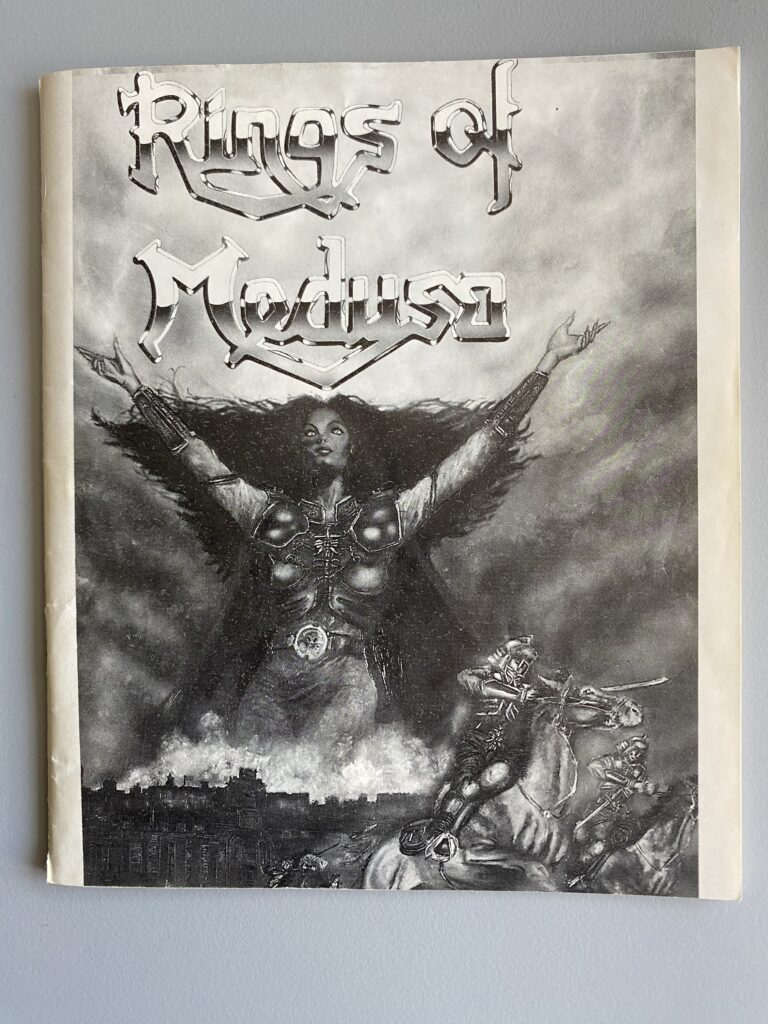
Rings of Medusa (Amiga version) came out a few years earlier than Hannibal. It had a black and white illustration on a much thinner and smaller cover page (Figure 6). The paper may not be acid-free as it has turned lightly yellow over the 34 years of its existence.
Figure 6: Booklet for Rings of Medusa (1989) – cover page turned slightly yellow. Source: Photo Suter
The thin paper inside lets the print from the side’s back shine through. The illustration was the same as on the game box, but now not in color anymore but in black and white in cheap offset printing like the rest of the booklet (Figure 7). The text on all pages was in a small font size (possibly 8) that looked like typed up on a typewriter. It wasn’t, but the text lines were much closer together to not waste any space in the 34-pages booklet. And the drawings were set in the text pages with minimal space to the text.
Figure 7: Booklet for Rings of Medusa (1989) – end of back story setting out the quest for the player. Source: screenshot Suter
Rings of Medusa’s booklet came in German, English or French. Many booklets were translated in several languages, but a box only contained the language that was used in the distribution country or area. If the content for the booklet was not too extensive, the publisher printed instructions in up to three or four languages in a single booklet as we will see in some of the following examples. We might say, they were localized. They were mostly produced in the publisher’s office on computers. Texts were not written by hand or with typewriters anymore, they were written with word processing software. But smaller productions often used Courier as their main font (as in the Rings of Medusa Booklet) that generates familiarity and indicates the transition from typewriter to computer.
The Story Booklet
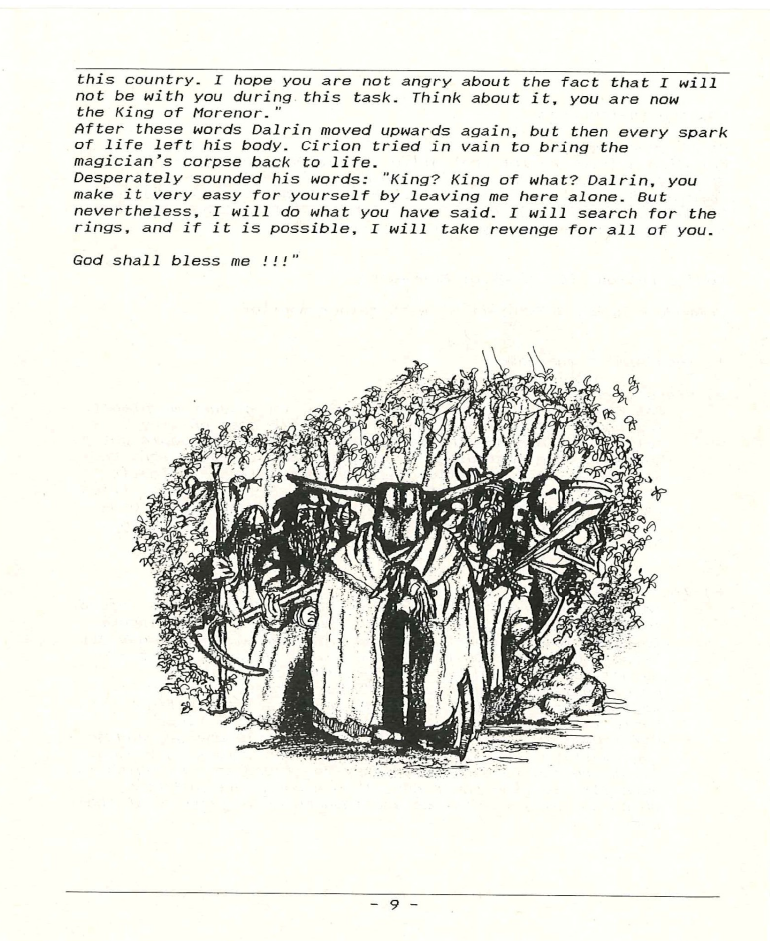
As Rings of Medusa (1989) is a narrative game, the story takes center stage in the booklet as well. Page 4 – 9 tell the story in classic prose. Fantasy prose that is. The title of the story reads as “Der Untergang des Königreichs Morenor” (Rings of Medusa 1989, p.4, “The Decline of the Morenorian Kingdom”.
The first section describes the sight of the capital to which the crown prince returns. On the hill outside the city, enjoying the evening sun, he thinks about his family and his father, who called him back from his great journey. On his way there, he was met by large refugee trains and only with difficulty he was able to find a ship back to Morenor. Still in thought, the crown prince and his guards are attacked by orcs and the prince only narrowly escapes on his horse. From there the epic heroic story takes its course. The wounded crown prince finds his way to the palace and meets his terminally ill father. The story is not written particularly well. In between, more is explained than told, and the events are not marked by great imagination. But it works. The crown prince must now defend the palace against the rebels. And the big battle is imminent. Dragons also appear! Finally, the crown prince, the magician and a few comrades-in-arms must flee. After the showdown between the dragon and the mage Dairin in the open field, the mage, dying, reveals to the crown prince that he can defeat the demoness Medusa, who is behind the attackers, with the help of five rings scattered across the land. The crown prince vows revenge. And as readers of the fantasy story, we now know what our quest for the game should be. Because, what we read, that was the entire back story for our exploration adventure game that now follows.
For everyone
Manuals were always written for anyone and everyone who would pick up the game, meaning there was a formula the writer needed to follow.
“It has to be accessible to everyone and it has to be gradual. So you start with the biggest concept: it might be the lead character or the storyline, and go from there.” (Indirect quote of Sangster in: Nelson 2021)
There needed to be an introduction to the storyline first for a game like Rings of Medusa. The character alone didn’t suffice since his character was being filled in by the player themselves. It is not easy to write a good intro or prologue for a game. Back in the 80s, the most efficient way was to do it as text and print it up in the booklet. You could tell a lot more than with a few pictures or text screens and it was optional for gamers. There were no videos possible and no other distribution channel effectively available like today where we have a plenitude of communication channels with and on the internet for disseminating essential and additional game information. Fortunately, there were plenty of young gamers that wanted to read the prologue in the instruction booklet. So, gamers expected a good manual with an intriguing backstory, since this was the first thing, they were reading on the ride home from the shopping mall in the back of the car – or when they were settled at home. After all, the printed booklet was a medium of transformation from the book culture to the digital world and was still quite attractive for the young readers. They also realized that the transmedia approach that these games imbued, meant that storytelling was often split in separate layers. Therefore, if they wanted to get familiar with all layers of story and story world, they could just lean back and read the manual.
After the prologue prose, on the next page, there are the loading instructions for the computer. And on page 11 a detailed game manual starts and lasts up to page 32. The first two paragraphs lay out prologue and quest again, but now as gameplay instructions for the player who needs to find 5 rings and assemble them in a temple. Only, since he has financial troubles, he must get some money with trading, heists, exploit resources or playing the casino first. Detailed descriptions of the possible actions follow on two pages. From page 15 on a very detailed description of the different game environments starts. It is not just a setting description but tells you every detail of actions, events, possibilities, what you face and what you might gain or lose. It comes with lists of characteristics for all races you can encounter in the game and all army personal that is available in the game. The sequence of events is furthermore described in detail all the way to possible endings. It reveals itself as a walkthrough that leaves a few minor gaps but not many.
The instruction booklet concludes with an example of a possible start of the game on page 32 and three appendixes (on 3 pages) that show as a simple graphic all preferences for the game and two management screens for trading and for managing the armies. The flap of the cover finally comes with an imprint for publisher Starbyte Software.
Classic Aliens Storyline
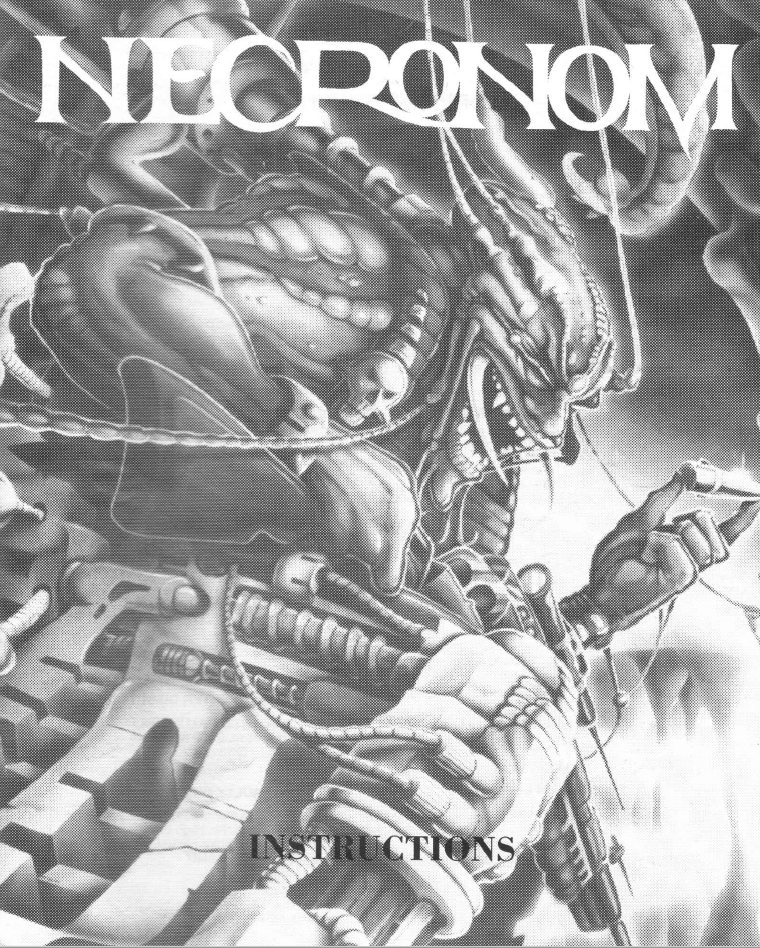
Necronom (1991) by Linel is a game with a different theme and gameplay, but the instruction manual comes as a story booklet as well. Its quality is slightly better with thin glossy paper and a more professional layout and look. It is still black and white but features some exciting concept drawings (Figure 8). Unlike Rings of Medusa, it comes in three languages and starts with a textual manual on what to expect in the game, how to choose weapon systems, changing shooting patterns, charging shields, how to get bonuses and that you encounter a monster at the end of each level. It does this very quickly and efficiently on a single page.
Figure 8: Cover of instruction manual for Necronom (1991). Screenshot: Suter
Not everyone seemed to like this short gameplay manual. Stuart Campbell reviews the game in Amiga Power and says: […] the next-to-useless manual doesn’t help a bit when it comes to deciphering the moderately complex system of weapon customising. But switch the autofire on, give it a couple of plays, and it sneakily hooks you.” (Campbell 1992)
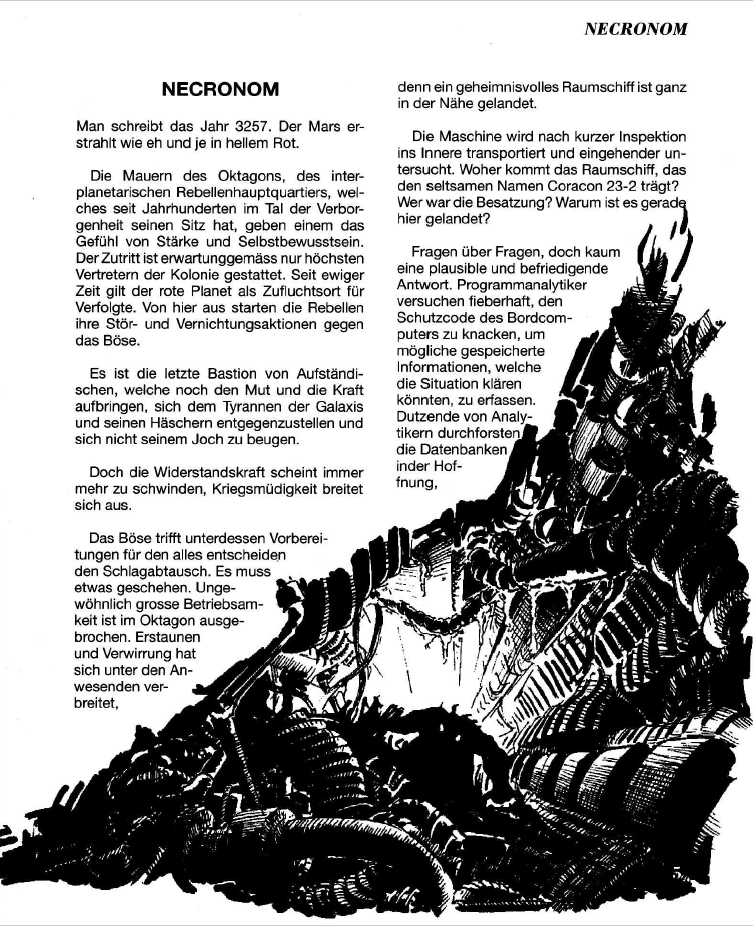
After the gameplay instruction page, the backstory begins: “A.D. 3257. Mart is shining with fascinating light red color.“ Over three pages with two illustrations, the space story is told and sets the frame for our gameplay with a spaceship of the 33rd century that has to complete its missions in the 28th century and destroy the headquarters of aliens that invaded the solar system. Again, it is a complete back story that is told for the player to get the gist of the space mission they must take on. Apparently, this is the history of a 500-year-old spaceship and the struggle of humankind against an alien invasion. The game loop turns out to be a time loop as well. Our mission is to go back 500 years and fulfil the mission the crew of the spaceship was not able to complete. We have to break the loop and rewrite history.
The teardrop-shaped spaceship is somewhat reminiscent of R-Type. And the alien creatures and some of their structures are clearly influenced by the Swiss designer H.R. Giger, who designed the Alien character and props for the movie Alien (1979). However, in the booklet, this is only visible on the cover that features a violent alien creature with prolonged skull, spiny machine extensions, infusion wires and weapons at the ready (Figure 8). The other concept drawings in the booklet show human perspectives and settings except maybe the first drawing on page 5 that shows half destroyed infrastructure with wormlike tubes and cables and tech debris (Figure 9).
Figure 9: Page 5 shows the begin of the backstory text in German and a concept drawing of a dilapidated structure of the aliens’ headquarters. Screenshot: Suter
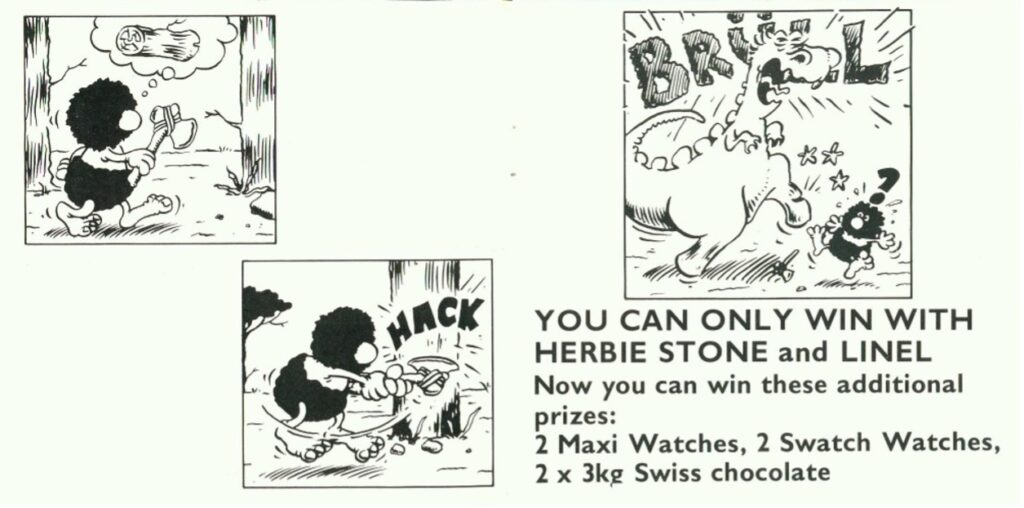
It’s comic time
Dugger’s booklet was completely different. The game is a Dig Dug clone that comes with an own comic character called Herbie Stone (Figure 10). His two enemies are Crunchy and Frugal. Herbie is a stone age human that has some everyday problems. He is the main character of two Linel games: Crack (1988) and Dugger (1988). The booklet shows them as funnies, short cartoons in one, two, three or more panels. Illustrations are done by Karl Bihlmeier. The cover page shows Herbie with his domestic dragon on a leash wondering about a sign that says, no dinosaurs allowed beyond this point. The funnies and the “Big Dugger Competition” may mostly serve marketing purposes. There was no need to explain how to play the digging game, but there was a need to get the attention for the character and background pictures with comical Herbie Stone that may have been an important selling point for the 1988 games Dugger and Crack. Herbie Stone, the prehistoric scatterbrain, was the protagonist of both games. In Crack, an Arkanoid clone, he had appearances in a start sequence and in a mini game in which he needed to catch falling coconuts, always after three completed levels.
“Its loading sequence is brilliant. Little caveman figures pop out and paint the game’s name on a wall. Suddenly there’s a sampled Tarzan howl and another one swings on a rope across the screen only to smack into the wall. Well it’s funny when you see it, anyway.
The jungle theme is carried through with more sampled effects and a native drone.” (Pattenden 1989)
Both games were published by the Swiss label Linel that was based in Vaduz, Liechtenstein, and had a promotional address in London as well. Author of the booklet comic was Karl Bihlmeier, a German cartoonist from Cologne who later got reasonably famous with his “Hermann, der User” Computer cartoons, that were published in Amiga magazines and many other publications. The colorful in-game graphics about prehistoric Herbie Stone were developed by Roland alias Orlando Petermann and Christian Haller while René Straub programmed 150 Arkanoid levels and established a construction set for 700 further levels. In Dugger, the graphics were made by Markus Grimmer and Jens Eisert, for the concept Markus Grimmer was responsible and Christian Weber programmed the game and made sound.
Figure 10: Herbie Stone cartoon in the booklet of Dugger (1988) – also featuring a competition in which you could win Swiss products! Screenshot: Suter
The Clowns that don’t want to be clowns anymore
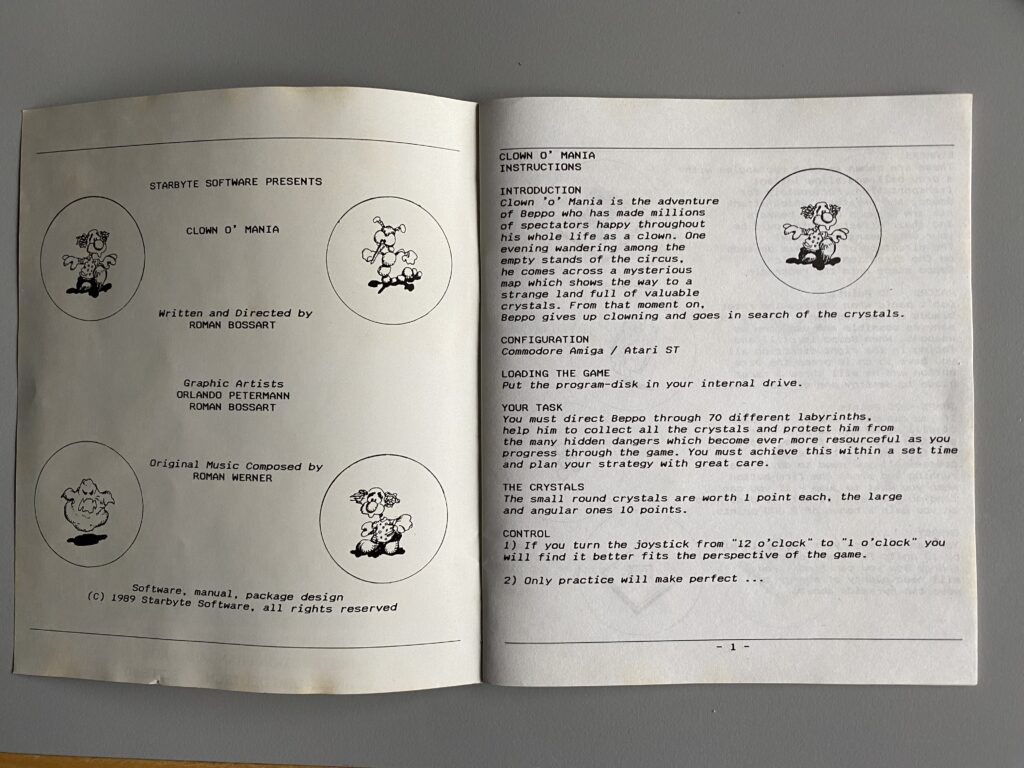
It seems rather strange that there are two early Swiss Amiga games with clowns as main characters. They come as cartoon figures with bright red hair and clown outfits. And both clowns break out of their normal circus life and become explorers or adventurers. Clown-o-mania (1989) is an isometric (dimetric) game with famous clown Beppo finding a mysterious map that “shows a strange land full of valuable crystals. From that moment on, Beppo gives up clowning and goes in search of the crystals.” (Clown-o-mania Manual, p.3) The instruction booklet offers the background story for the game in a short summary of 11 lines. Then it tells you what your task is: “You must direct Beppo through 70 different labyrinths, help him to collect all the crystals and protect him from […]” (dito).
After this, the controls and all the elements of the puzzle mechanics are explained on three further pages. Each element is shown with a drawing and its function explained in 10 or less lines of text. All the drawings come as small vignettes (Figure 11). The depiction of the somewhat confused Beppo and some enemies is cartoon-like. Instructions in English are followed by translations into French and German. All of it produced on the same paper as Starbyte used for the Rings of Medusa booklet. The glossy cover has turned lightly yellow and the text inside is printed in Courier and looks like done on a typewriter.
Figure 11: Clown-o-mania (1989) booklet with short story explanation and vignettes of Beppo and enemies. Photos: Suter
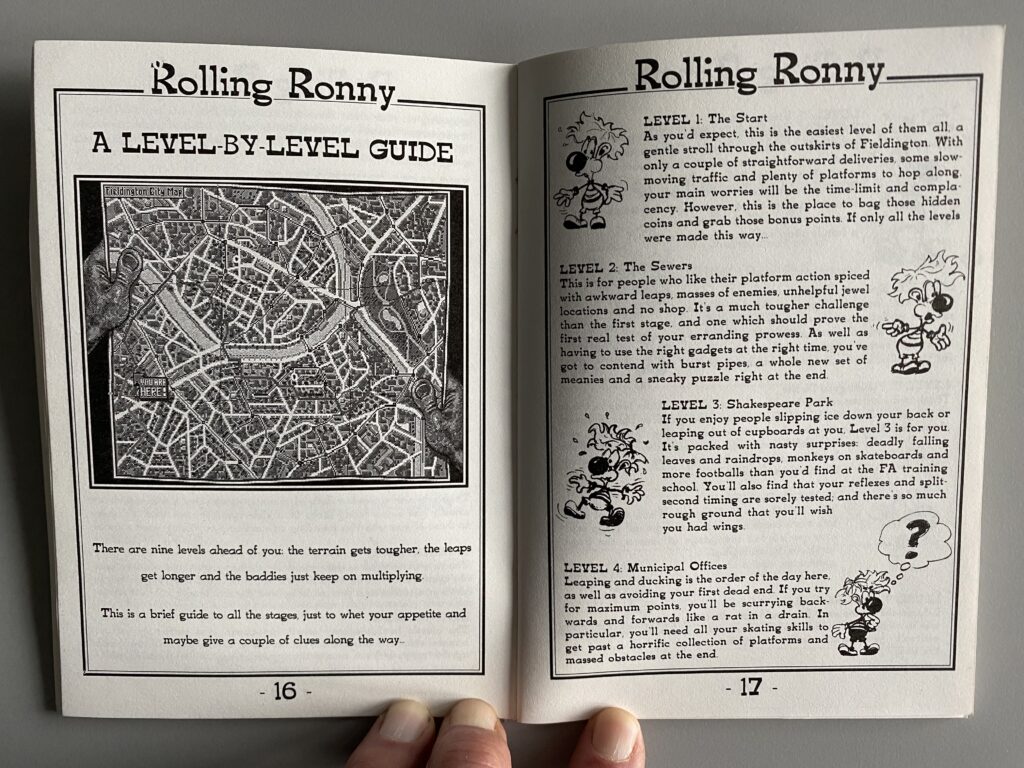
Rolling Ronny (1991) on the other hand has a booklet with better quality paper and print. For this game Starbyte worked together with British publisher Virgin Games and had a brighter commercial perspective. The Manual comes in English, French and Italian and features a bright color-printed cover and back with clown Ronny on his roller skates bouncing down main street (cover) and doing a stunt (back) alone in front of a sunny sky. The inside comes on heavier good quality paper and with a more elaborated design of page design, type face and layout (Figure 12). The Manual was done by The Word Factory in the United Kingdom for Virgin Games.
Figure 12: Rolling Ronny (1991) booklet with good layout and extensive gameplay and path section. Photos: Suter
Each page is framed with a thin and a bold line. The title Rolling Ronny is set as a header on top of the thin frame line in a comic-like font with large serifs, a capital R that has a belly in the rounded top of the R and an oval slanted that seems to roll against the flow of the other letters. The Manual is dubbed as “The Errand Boy’s Survival Guide”, written by Rolling Ronny for the player. In good old book fashion, there is an ex libris box on the inner title page that lets you put down your name as owner of this booklet. It might as well be a children’s book or belonging into a traditional book collection. Page two shows all the credits for game and booklet.
Page three comes with a novelty for a Swiss game: A personal letter from Ronny to the player, written in the town of “Dunrollin, Rollingdown Hill. Fieldington”. The player gets addressed as errand boy who needs to run errands in Fieldington. You must always keep your skates in good condition and wear a disguise to get enough delivery jobs. This means, you get hired as an undercover agent for Scotland Yard that wears a clown’s outfit and has to find the stolen Crown jewels of Fieldington. This is as much back story as you get. After Ronny’s nice letter, you get loading instructions for your computer system (1 of 4) and a short description of start, continuing the game and the “hiscores” (sic).
What follows now from page 6 – 18 is an extensive guide through mechanics, elements, and story path for the game. First, there is a summary of the errantry as a how to play section. Then, the game screen gets explained. It is divided in a playing area and an information panel that serves to observe Ronny’s progress or decline. Some of the mechanics are outright weird and funny, e.g., “your basic defence against enemies is a supply of stunted salami, produced by the Fieldington Butcher’s Guild. This collection of meaty missiles will give many enemies something to think about.” After a graphic of the controls and their functions, the main section with the “Errand Boy’s Survival Kit” starts with describing basic collectables, goes on with weird gadgets like “Powersneeze” that you can use as tools for gameplay. It continues with a section on help locations and a large list of bad guys and obstacles like “Banana Skins” that can also be on the move. And finally, you find a level-by-level guide that leads you through all nine levels of the game with some humor: “If you enjoy people slipping ice down your back or leaping out of cupboards at you, level 3 is for you.” (Rolling Ronny 1991, p. 17). This is only followed by a lined page for your own notes, as it is in the French and the Italian section of the booklet.
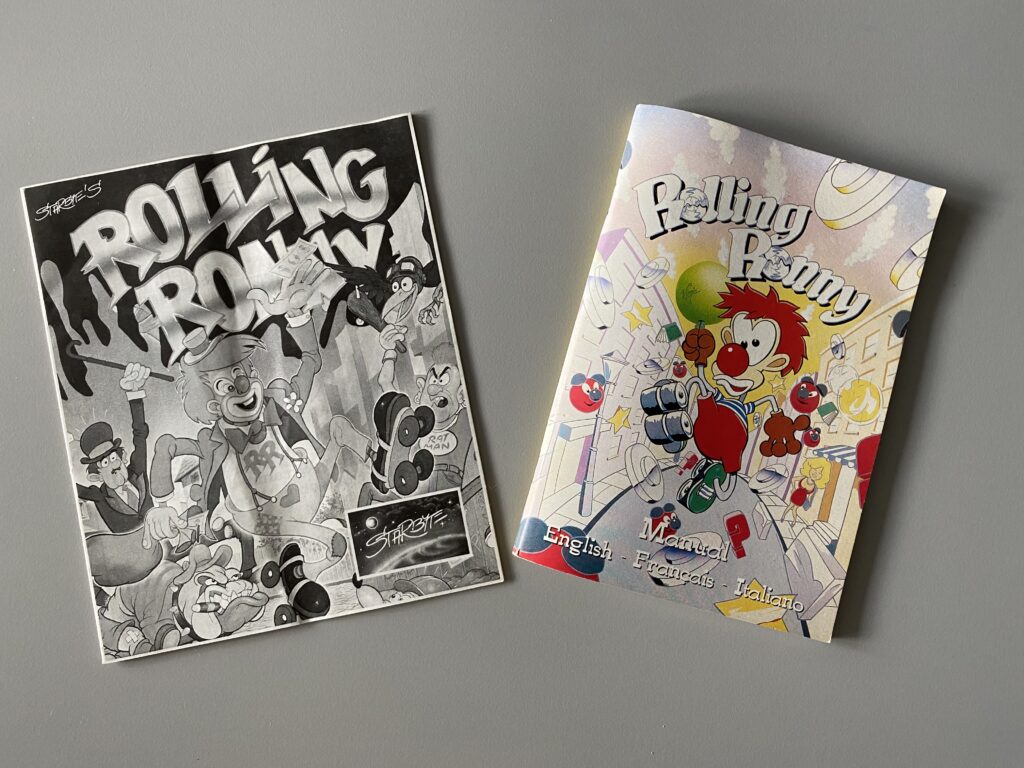
Figure 13: Two very different looking booklets for the same game: Starbyte’s German Manual in black and white (left) and Virgin Games‘ manual in three languages in colour and on high quality paper: Photo: Suter
There is also a German version of the booklet with Starbyte standard format in black and white. It comes with installation manuals for all systems (Amiga, Atari ST, IBM-PC and C64). But after all, it has not the storytelling and design quality of the British booklet. There is no letter from Ronny and no map, but a long explanation of the story and the what-to-dos. Each page is framed with cartoon objects like candy, shop sign, sand timer and Ronny on skates. There is still some humor transpiring. And the cover shows Ronny on skates in the midst of some shady characters in an unnamed city.
Instruction Manuals – accessible and for everyone, but now obsolete
Most games in the 80s and 90s came on discs or CD-ROMs in artful cardboard boxes and contained an insightful instruction manual. The printed booklet was essential for teaching how to play the game, telling a story or prologue and making a player familiar with the computer system the game was made for. Instruction manuals were clear and detailed, often even extensive. The Swiss games of the 80s and 90s relied on them as much as any other game. These instruction manuals showed an interesting diversity of approaches from story booklets over cartoons to extensive strategy guides.
Part 1 — A Serious Manual
“It is about Hannibal, but you already knew that … didn’t you?”
This is how a quick intro for the game Hannibal of 1993 starts, most likely written for people who did not buy the game through official channels. There was a prolific piracy (or warez) scene in those days: Not everyone could afford to buy the games from the stores. So, a lot of people didn’t use the boxed originals but copied them. This was possible because most of the games came on floppy disk(s).
The intro continues in a jovial manner resuming and shortening the storyline:
“Hannibal has a little argument with the Romans and cause he gets angryvery fast, he just decides to wipe out he entire Roman Race. Naturallythis didn’t work, so now you get this change (chance).” (Lemonamiga, with original mistakes)
The quick doc is written by a gamer called acid queen. What they mean seems to compare more to a behavioral description of a gamer than a reference to history: Hannibal gets angry very fast and decides to wipe out everybody. Since this did not work in history, you get the chance now in the game.
The next two lines refer to the booklet that accompanies the game when bought from an official dealer in a game box (presumably for DM 99 or CHF 80):
“If you want the FULL story-Line, just by (sic!) the Manual of the Game, or go to a Library ( A place where they Keep Books they Say ).” (Lemonamiga)
The early game developers of the 80s in Switzerland often started as Crackers. They cracked legal games, altered their intros, and distributed copies with their extra animations and messages among friends and within the warez community. In general, a manual or a quick intro was not included. But some pirated games were sold by warez groups and had some quick info for the game on a flyer that was folded over the duplicate floppy disk and stuck in a small plastic envelope. Without this quick instruction it was sometimes difficult for the player to find out how to operate the game.
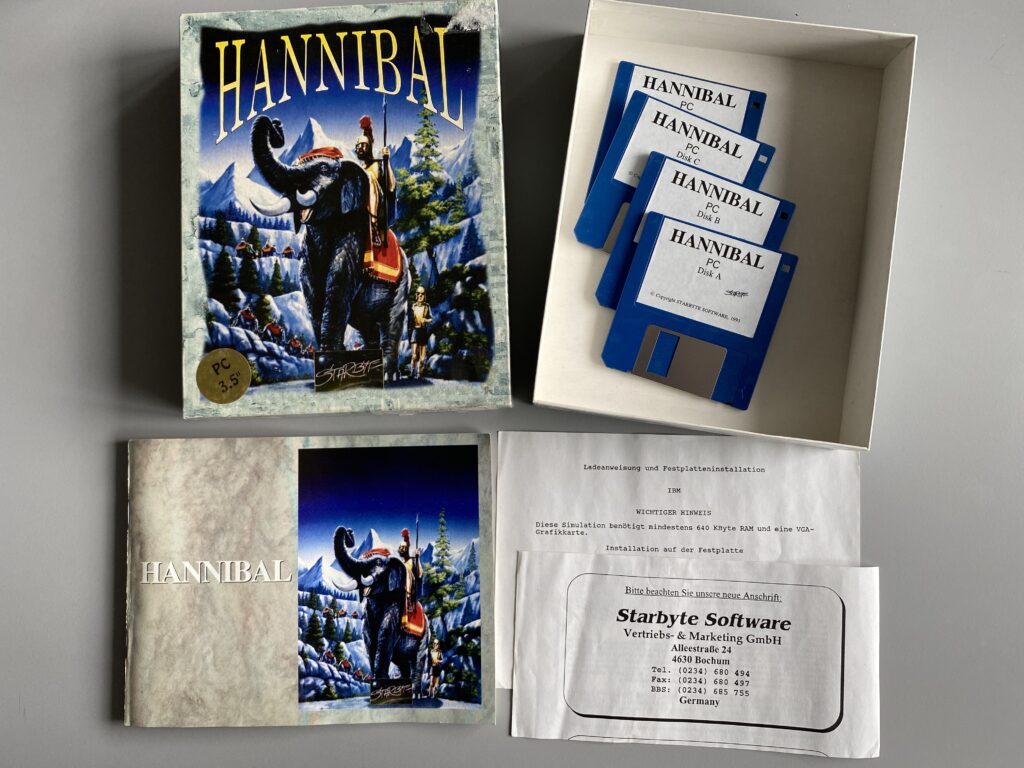
The official games came as cardboard boxes that were printed on the outside and contained a booklet as well as the disc(s) (Figure 1). Packaging designers used the large surface area of the box to draw additional attention to the game with their artwork. The cover usually featured a color printed concept art, and the back often contained a short promotional write-up of the game and some screenshots or drawings. Content creators took the opportunity to fill the game boxes with various things like goodies, fictive texts, posters, and stickers.
Figure 1: Hannibal (1993) came like most games of that time in a cardboard box with artwork, floppy disks, a couple flyers with additional information and an insightful booklet as instruction manual. Source: Photo Suter.
The Thorough Booklet
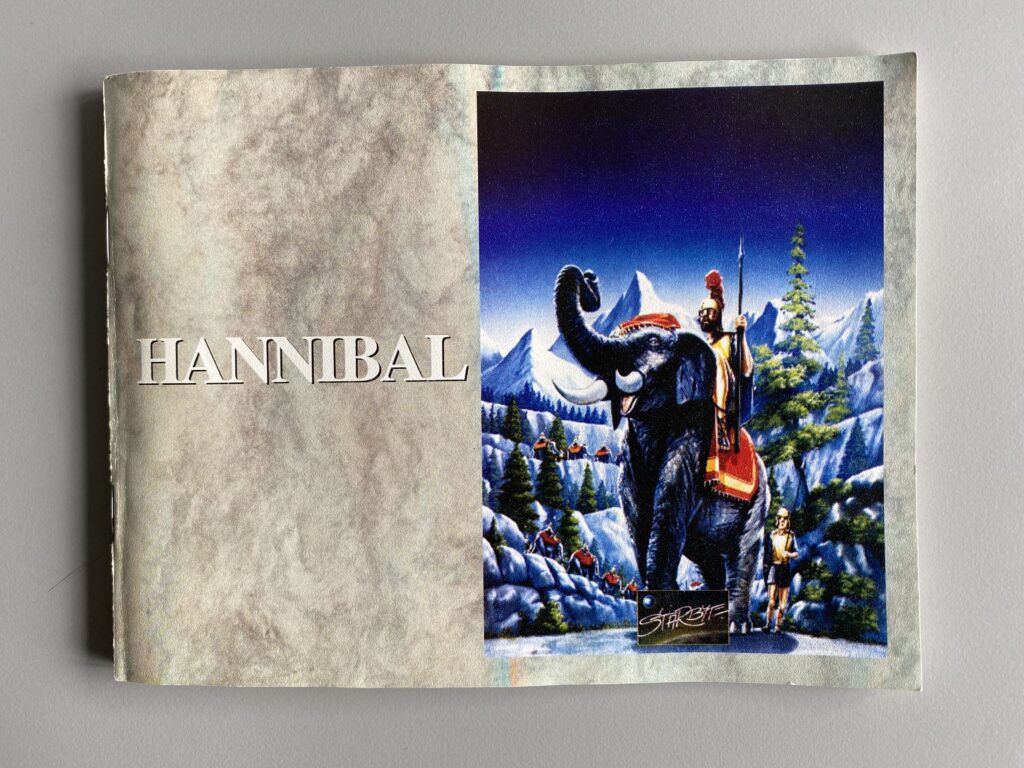
The Hannibal booklet comes in the official game box with floppy discs and features a completely different standard of information and writing than the quoted ‘quick intro’. The booklet has 48 pages with two columns per page and a colorful illustrative picture of Hannibal’s elephants traversing the snowy alpine mountains (Figure 2).
Figure 2: Booklet for Hannibal (1993). Source: Photo Suter.
It starts with a polite and friendly welcome that assures you the developers took a serious approach to create a strategy simulation that is based on thoroughly researched historical context for Hannibal’s campaign to invade the Roman empire.
“Herzlich Willkommen
Zu Ihrer neuerworbenen geschichtlichen Strategiesimulation. Wir haben uns bemüht, für Sie dieses Spiel so interessant und geschichtlich realitätsnah zu gestalten, daß Ihnen mehrere Wochen Spielspass garantiert sind.” (Hannibal 1993 Einleitung)
“Welcome
To your newly acquired historical strategy simulation. We have tried to make this game so interesting and historically realistic for you that you are guaranteed several weeks of fun.“ (Translated by author)
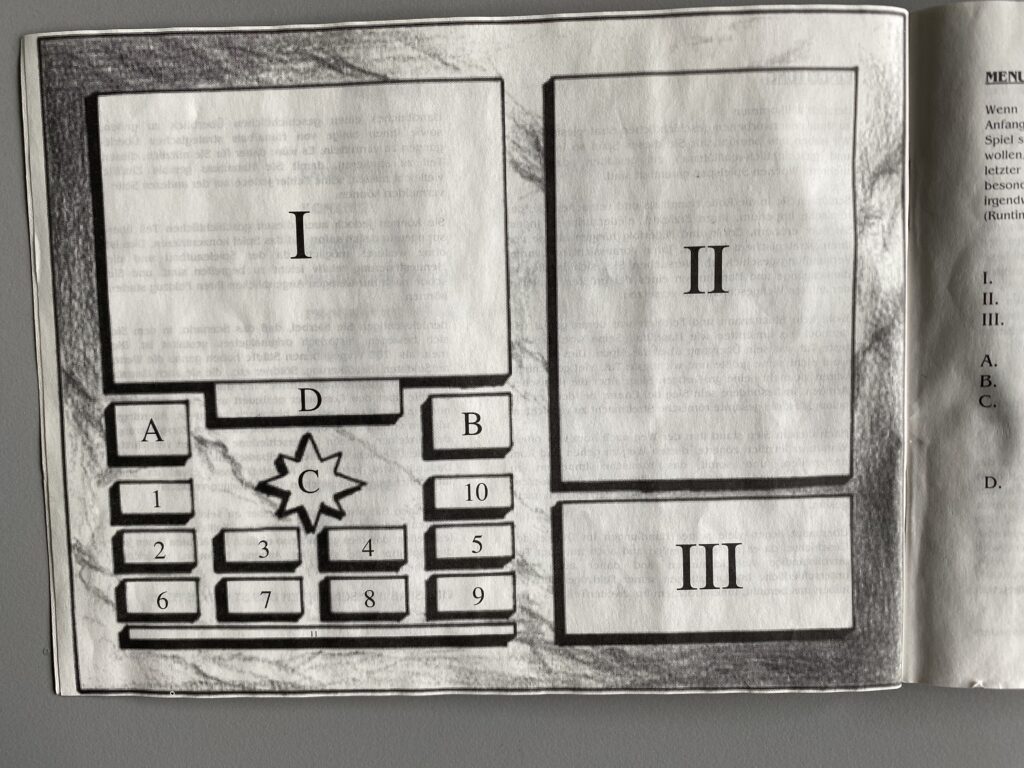
After an initial general introduction by the Starbyte team, the next pages come with a simplified box graphic and explanation of the UI (User Interface) (Figure 3), showing that the game works with maps, a large text window for events and action news on parchment paper.
Figure 3: User Interface outline as shown in the manual. Source: Photo Suter.
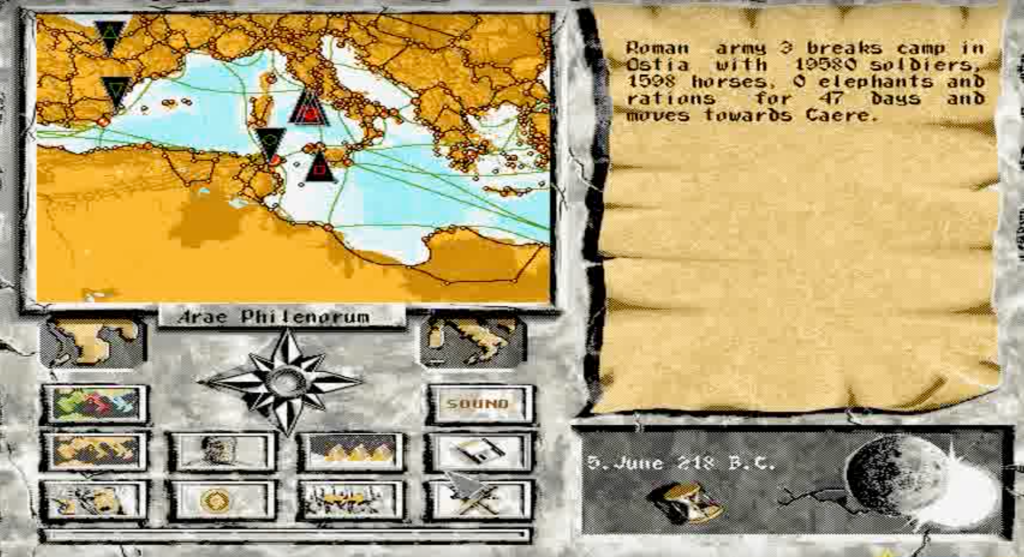
Mouse control and GUI were rather new at the time, they needed to be explained in detail. Beneath the map window, you find a wind rose, two buttons for switching maps and 10 other functional buttons, all of them appropriately illustrated. Beneath the parchment news window, you find a time indication button that tells you when the playing events take place – e.g., 1. June 218 B.C. All of this is shown in a in-game screenshot of the described UI (Figure 4).
Figure 4: User Interface as seen in the game with map display (top right) and event news (top left). Source: screenshot Suter.
Starbyte has taken great pains to approach this booklet as seriously as possible. The target audience was probably not only the well-known young gamers, but everyone interested in history and historical events or in rather thorough strategy games. The next four pages are filled with detailed descriptions of what happens when you use the nice menu points 1 – 9 on the lower left. Menu point 4 for example let you send your armies into a winter camp if you use the button after 1. November and forwards the time to 1. April next year, showing you also in the news window, what was the outcome of all negotiations that took place during the winter period.
Context
And here, after 12 pages, the actual instructions for the game already come to an end. On the next page, the explanations of the historical references begin. First, four pages are devoted to the city of Carthage and its development.
This is followed by a description of the Punic Wars on four pages again. Finally, the showpiece is a ten-page biography of Hannibal with a photography of his bust (in stone). The warlike events in Hannibal’s life – as well as before and after – are described almost without any gaps, so that the reader gets an excellent guide for his game. Unfortunately, the whole booklet remains without references.
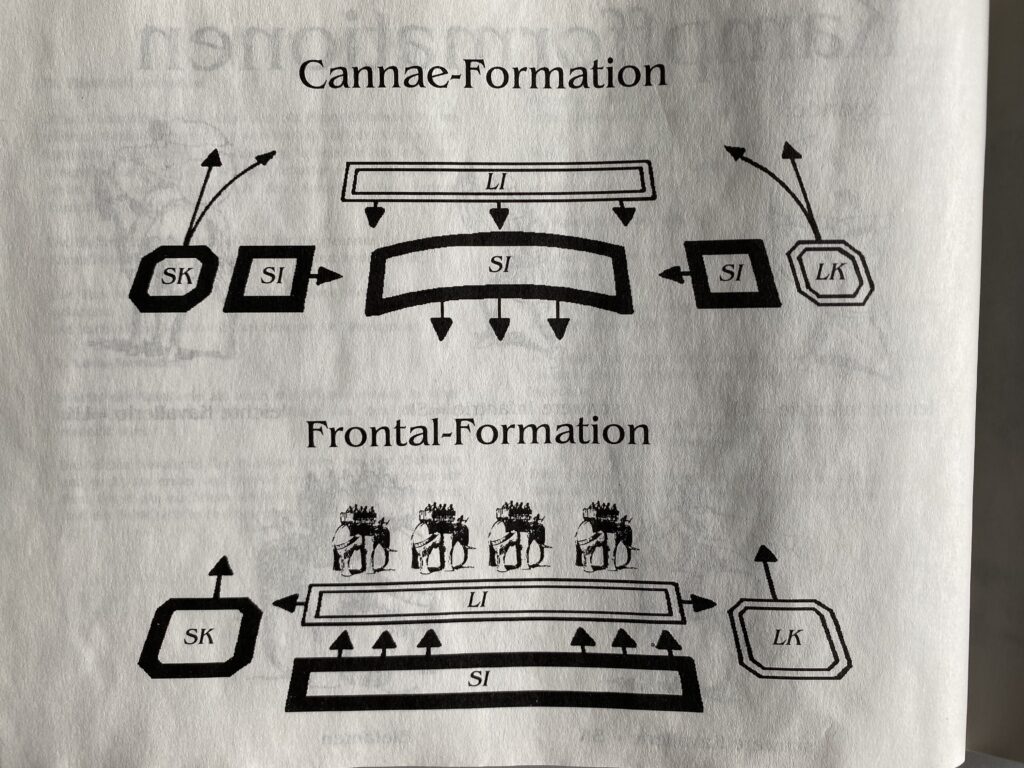
Explanations of historical battle tactics follow on the next 8 pages. The individual battle formations are depicted by means of diagrams (Figure 5) and the individual different fighters with characteristic drawings. Two additional photographs also embed this explanation in an authentic historical context. The historical references are rounded off with a two-page chronology of the events from 247 to 183 B.C.
Figure 5: Battle formations as sketched in the manual. Source: Photo Suter.
And finally, before the copyright page, there are two pages of tips and tricks, which are intended as helpful gameplay advice and should make the players‘ gameplay a little easier if they want to accept these tips. Tip 6, for example, advises: “Plündern sie Städte nur, wenn sich ihre Armeekasse dem Ende zuneigt, und die Imperiumskasse nicht genügend enthält.”(Hannibal 1993, p.44), “Only pillage cities when your army treasury is low, and the empire treasury is running out soon.” (Translated by author) And tip 10 says dryly: “Es ist nicht ratsam, Rom mit weniger als 200’000 Soldaten anzugreifen.” (Hannibal 1993, p.45). “It is not advisable to attack Rome with less than 200,000 soldiers.” (Translated by author)
In the end of the booklet, you find three empty pages to take notes – a common sight in game manuals of the 80s and 90s. Mostly, they needed to add some more pages to have an odd number for the printing process. But some games came with code that you could write down on those pages or you were able to make a note about an in-game secret, an easter egg or remember an unforeseeable choice or a cheat code. But gamers that loved those manuals would never write down anything on those pages, they rather memorize cheats or write them down on a separate paper.
Cost saving
The paper itself was often thin or otherwise cheap. The printing was not supposed to be too expensive. So, publishers saved cost on paper quality (Figures 4 and 5) and with a smaller size of the printed text. The Hannibal booklet used thin paper and put two text pages on one in a small font size (possibly 8) in two columns. Only the cover was better quality and featured a surprisingly colorful illustration (Figure 2).
Die Zusammenarbeit des Fantoches mit dem Gamedesign der ZHDK reicht zurück bis 2008/09 mit einer ersten Ausstellung des Studiengangs Gamedesigns ZHdK, Vorträgen (GameTalks) und waren damals das Erschliessen von Neuland. Inzwischen ist viel passiert und unzählige Ausstellungen (etwa Visual Playgrounds 2010, Spiel und Märliwelten 2010, Arcade Closed, Reopening Everywhere 2013, MoshiMoshi! 2014 und viele danach mehr etc), Talks, Filme (Angespielt 2010), Workshops haben am Fantoche stattgefunden im Bereich der Gamekultur. Später kamen eigene Festivals in Zürich (gamezfestival.ch oder ludicious) hinzu und verschoben den Focus in Sachen Game-Festivals nach Zürich. Das Thema Games ist inzwischen Alltag, wenn auch nicht an Kulturinstitutionen oder in den Medien (Die Festivals sind eingegangen, einzig das Endkundenfestival popcorn & game show hat überlebt. Medien behandeln Games kaum und schon gar nicht die Kultur- und Kunstseite der Games).
Idee, Philosophie (Strategie)
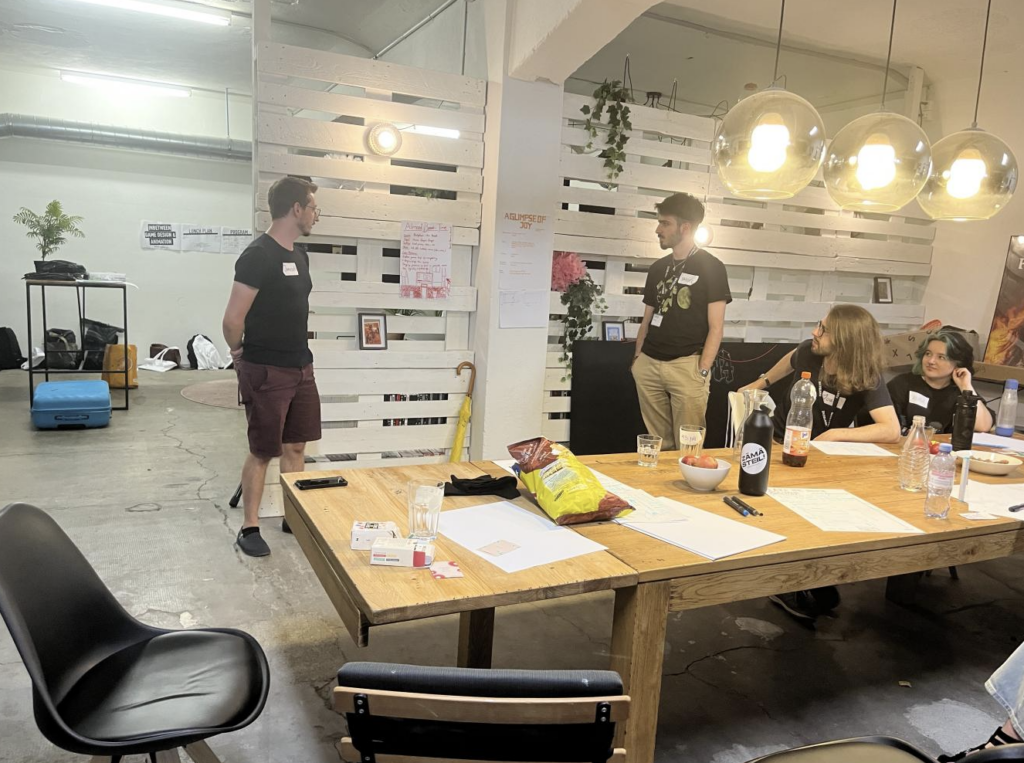
Den Workshop ‚Inbetween GameDesign und Animation“ gibt es spätestens seit 2009 in verschiedenen Varianten. Wichtig dabei war es, die Studierenden der Schweizer Gamedesignszene (spezifische GameDesign ZHDK) und die Animationszene (spezifisch Animation HSLU) an einen Tisch zu bringen bzw. sie dazu zu bringen zusammenzuarbeiten im Bereich Animation und Gamedesign. Dieses Jahr waren Studierende der ZHdK, der HSLU und der Filmakademie Baden-Württemberg dabei. Das Zusammenbringen hat sicherlich immer geklappt, viele interessante Projekte sind entstanden. Ob die Zusammenarbeit die Gesamtszene gestärkt hat, ist – neben einigen erfolgreichen Beispielen – unklar.
Örtlichkeit
Der Workshop fand nach vielen Jahren im Badener ‚Zwoi‚ in den Räumlichkeiten von Maybaum Film statt. Das ist eine Agentur für Videofilme, Animation und Mediaplanung, im Gebäude der Stanzerei (Merker Areal).
Zuerst gab es einen Blog blog.gametheory.ch, dieser wurde abgelöst von www.gamelab.ch (2010). Und 2017 wurde der Blog von 2010 erneut transferiert, die von 2010-2016 erstellten Posts sind mit # gekennzeichnet und deautor-isiert.
Über diese Website
_ABOUT
GameLab.ch ist ein Blog von verschiedenen Autoren rund um die Gamekultur, Gamedesign und Games.